Overview
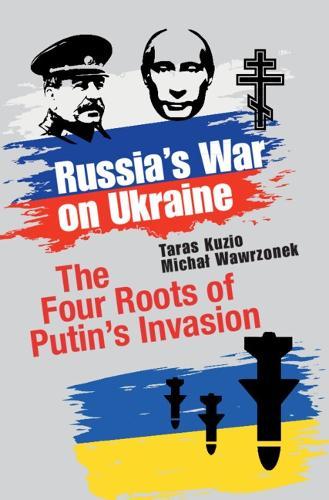
Understanding why Russia invaded Ukraine in 2014 and 2022 is vital for preparing for what may come next. This groundbreaking book is the first to provide an interdisciplinary study of the first full-scale war in Europe since 1945, which is having global ramifications on interstate relations, international law, international organisations, energy questions and economies. Written by two leading scholars of Ukrainian and Russian politics and history, and based on extensive field work and primary sources, the book moves beyond established Western ideas about Russia to show that Russian military aggression against Ukraine is domestically, not externally, driven. The authors analyse the statements and policies of the Russian leadership under Putin, Russia's post-communist political culture and Russia's understanding of itself as a civilisation without borders. Imperial nationalism, nostalgia, Russia's divergent identity and political system to Ukraine's, and Kremlin anti-Western xenophobia are the key elements underlying Russian aggression.
Full Product Details
Author: Taras Kuzio (National University of Kyiv, Mohyla Academy) ,
Michał Wawrzonek (Jesuit University Ignatianum, Krakow)
Publisher: Cambridge University Press
Imprint: Cambridge University Press
Weight: 0.582kg
ISBN: 9781009645539
ISBN 10: 1009645536
Pages: 404
Publication Date: 04 December 2025
Audience:
General/trade
,
General
Format: Paperback
Publisher's Status: Active
Availability: Manufactured on demand

We will order this item for you from a manufactured on demand supplier.
Reviews
'Taras Kuzio and Michał Wawrzonek's exhaustive work unravels a tangled knot of historical myths, cultural paranoia, and grand geopolitical ambitions to explain the imperial nationalist and xenophobic roots of Russia's war against Ukraine. This volume will prove essential reading for all scholars of Russian nationalism and warfare.' Ian Garner, Assistant Professor, Pilecki Institute, Warsaw 'Taras Kuzio and Michał Wawrzonek have written an exceptionally timely book that is required reading for the Trump administration and anyone who still refuses to accept that Putin's invasion of Ukraine had nothing to do with NATO enlargement. Kuzio and Wawrzonek marshal all the facts, know all the literature, and convincingly show that the roots of the war lie in Russia's imperial political culture and Putin's fascist regime. Their analysis also suggests that ending the war will require that Russians abandon that culture and that Putin leave. A richly researched study that minces no words, Russia's War on Ukraine is indispensable and necessary.' Alexander J. Motyl, Professor of Political Science, Rutgers University-Newark 'Kuzio and Wawrzonek dig deeply into Russian history, society, and politics to show how imperial nationalism, nostalgia, divergence, and xenophobia have driven Russian aggression towards Ukraine. The evidence they amass is impossible to ignore. The book should be read by anyone hoping to understand the internal roots of Russia's actions.' Paul D'Anieri, Professor of Political Science and Public Policy, University of California, Riverside
Author Information
Taras Kuzio is Professor at the National University of Kyiv Mohyla Academy. He has written and edited twenty-four books and seven think tank monographs, including, most recently, Russia and Modern Fascism: New Perspectives on the Kremlin's War Against Ukraine (2025), Crimea: Where Russia's War Started, and Where Ukraine Will Win (2024), Russian Disinformation and Western Scholarship (2023), Russian Nationalism and the Russian-Ukrainian War (2022). Michał Wawrzonek is Professor at the Jesuit University in Cracow (Poland). He is the author or co-author of four monographs: Memory, Politics and Legacy of Metropolitan Andrey Sheptytsky (2023), Orthodoxy Versus Post-Communism? Belarus, Serbia, Ukraine and the Russkiy Mir (2016), Religion and Politics in Ukraine: The Orthodox and Greek Catholic Churches as Elements of Ukraine's Political System (2014) and Ecumenical Activity of Metropolitan Sheptytsky in Ukraine and Russia (2006 in Ukrainian).