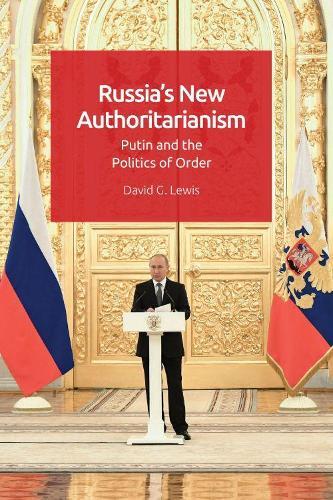
Russia’s New Authoritarianism: Putin and the Politics of Order

Author:   David G. Lewis (Associate Professor of International Relations in the Department of Politics, University of Exeter)
Publisher:   Edinburgh University Press
ISBN:  

9781474454766


Pages:   334
Publication Date:   31 March 2020
Format:   Hardback
Availability:   Manufactured on demand   Availability explained
We will order this item for you from a manufactured on demand supplier.

Our Price $219.00 Quantity:  
Add to Cart

Share |

Russia’s New Authoritarianism: Putin and the Politics of Order


Overview

David G. Lewis explores Russia's political system under Putin by unpacking the ideological paradigm that underpins it. Heinvestigates the Russian understanding of key concepts such as sovereignty, democracy and political community. Through the dissection of a series of case studies including Russia's legal system, the annexation of Crimea, and Russian policy in Syria Lewis explains why these ideas matter in Russian domestic and foreign policy.

Full Product Details

Author:   David G. Lewis (Associate Professor of International Relations in the Department of Politics, University of Exeter)
Publisher:   Edinburgh University Press
Imprint:   Edinburgh University Press
Weight:   0.588kg
ISBN:  

9781474454766


ISBN 10:   1474454763
Pages:   334
Publication Date:   31 March 2020
Audience:   Professional and scholarly ,  Professional & Vocational
Format:   Hardback
Publisher's Status:   Active
Availability:   Manufactured on demand   Availability explained
We will order this item for you from a manufactured on demand supplier.

Table of Contents

Preface 1: Authoritarianism, Ideology and Order Understanding Russian Authoritarianism Order, smuta and the Russian State Russia as Weimar Carl Schmitt and Authoritarian Order 2: Carl Schmitt and Russian Conservatism Carl Schmitt in Moscow Schmitt in the Academy Dugin, Schmitt, and Neo-Eurasianist thought Remizov and the New Conservatives Normalising Schmitt 3. Sovereignty and the Exception The Centrality of Sovereignty Sovereignty in International Affairs Discursive sovereignty Domestic Sovereignty: Deciding on the Exception The Sovereign Leader The Sovereign and the Court Exception, Norms and ‘Manual Control’ The Dual State 4: Democracy and the People Putinism and Democracy The Decline of Parliamentarianism Constructing a Majority A majority of values 5: Defining the Enemy Russia and its enemies Constructing the Enemy Discourse The Enemy Within: The fifth column Civil society and foreign agents The End of Consensus 6: Dualism, Exceptionality and the Rule of Law Law in Russia Conceptualising dualism Politicized justice Mechanisms of exception Prokuratura Security services Courts and judges The exception becomes the norm 7: The Crimean Exception Crimea: The sovereign decision Legality as imperialism Order and orientation 8: Großraum Thinking in Russian Foreign Policy A World of Great Spaces Russia’s Spatial Crisis Russia’s Spatial Projects Russia as Hegemonic Power The Political Idea Exclusion of Foreign Powers The new Schmittians 9: Apocalypse Delayed: Katechontic Thinking in late Putinist Russia Russian messianism Russia as contemporary katechon Katechontic thinking and the Syrian intervention Conclusion Bibliography

Reviews

"[Lewis'] book gives us another way of thinking about the nature of the Russian polity ... rich and thought-provoking--Dr John Anderson, University of St Andrews ""Rights in Russia"" Lewis' work is a tantalizing interpretation of many of contemporary Russia's political choices. There are real jewels in this book, including a deep reading of the anti-LGBT campaign, and Russia's so-called information warfare, as ways of articulating Russia's sovereignty by creating the ability to establish norms and narratives.--Yakov Feygin, The Berggruen Institute ""The Russian Review"" This book is a thought-provoking contribution to the literature on Russian politics and foreign policy, presenting a coherent and strong argument regarding the ideas and strategies of Putinism.--Zerrin Torun, Middle East Technical University ""Europe-Asia Studies"" This is the first work to thoroughly examine the relevance and impact of the ideas of Carl Schmitt in contemporary Russia. Lewis convincingly argues that Putin's world view reflects some of Schmitt's categories, such as ""identitarian democracy"" and ""great space"" power projection beyond the nation-state. This is a valuable contribution both to the politics of comparative authoritarianism and the history of ideas in contemporary Russia.-- ""Peter Rutland, Wesleyan University"""


Author Information

David G. Lewis is Associate Professor of International Relations in the Department of Politics at the University of Exeter. He is the author of The Temptations of Tyranny in Central Asia (Hurst, 2008) and he has contributed articles to the Journal of Intervention and Statebuilding, Cooperation and Conflict and Europe-Asia Studies, among others.

Tab Content 6

Author Website:  

Countries Available

All regions
Latest Reading Guide

NOV RG 20252


Shopping Cart
Your cart is empty
Shopping cart
Mailing List