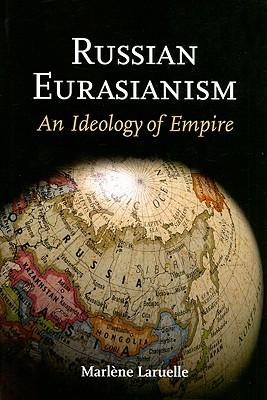
Full Product Details
Author: Marlène Laruelle
Publisher: Johns Hopkins University Press
Imprint: Johns Hopkins University Press
Dimensions:
Width: 15.20cm
, Height: 2.60cm
, Length: 22.90cm
Weight: 0.544kg
ISBN: 9780801890734
ISBN 10: 080189073
Pages: 296
Publication Date: 26 November 2008
Recommended Age: From 17
Audience:
College/higher education
,
Professional and scholarly
,
Undergraduate
,
Postgraduate, Research & Scholarly
Format: Hardback
Publisher's Status: Active
Availability: Out of stock

The supplier is temporarily out of stock of this item. It will be ordered for you on backorder and shipped when it becomes available.
Reviews
The importance of this work lies in the remarkable, even extraordinary, research effort that underpins its writing. The work's best features are the breadth of its coverage and the trenchancy of its analysis. - John B. Dunlop, Hoover Institution This book is an impressive achievement - wide-ranging yet sensitive to context and careful to bring together the many varieties of Eurasianism that have emerged over the 20th century. Laruelle makes us see why and how the idea of empire continues to appeal in post-Soviet space. - Willard Sunderland, University of Cincinnati
A tour de force not merely because of the depth of the scholarship and the skill of the argument but also because Laruelle unveils a subject crucial to understanding today's Russia but never given proper due... Even the most serious student of contemporary Russia will get from this book a vastly deeper sense of what makes Russian intellectual life, for all of its vexed affinity with the West, fundamentally different. -- Robert Legvold Foreign Affairs 2009 A masterful job of describing the various philosophical threads of Eurasianism... The author's lucid style makes the book accessible to the educated general public. Choice 2009 This volume certainly engages the reader to explore... Laruell's deft treatment of Eurasianism's shifting position in contemporary discourse makes this a fascinating volume that extends beyond the boundaries of any single academic discipline. -- Kathleen Macfie Eurasian Geography and Economics 2009 Laruelle is to be congratulated on her lucid and intellectually disciplined discussion of the ambiguous, intricate, and often contradictory ideas that shape Russian Neo-Eurasiansim... a must-read for intellectual historians, policymakers, cultural scholars, Russia Watchers, or for that matter, anyone who uneasily senses that something is moving in the deep currents beneath the surface of contemporary Russia, but is not sure of what it is. -- Maria Carlson Russian Review 2009 Russian Eurasianism is a lucid and rational guide, based on thorough scholarship and an admirable reluctance to sensationalize or to claim too much. -- Edmund Griffiths Times Literary Supplement 2009 A richly interdisciplinary and meticulously researched analysis of both the historical and contemporary sources of Eurasianist cultural and philosophical/ideological traditions and discourse... this book will be an invaluable resource for policymakers and academics providing a deeper understanding of the forces shaping Russia's identity and the unfolding of circumstances for the entire Eurasian region. -- Sharyl N. Cross Journal of Slavic Military Studies Laruelle, an established authority in the field. International Affairs 2010 Russian Eurasianism is an impressive achievement. The author writes with an erudition and breadth of insight that is unique in the burgeoning field of what we might call 'Eurasianism studies.' -- Mark Bassin Slavic Review 2009
Author Information
Marlene Laruelle is currently a research fellow at the Central Asia and Caucasus Institute of the Paul H. Nitze School of Advanced International Studies at the Johns Hopkins University. In Paris, she is an associate scholar at the French Center for Russian, Caucasian, and East-European Studies at the School of Advanced Social Sciences Studies.