Overview
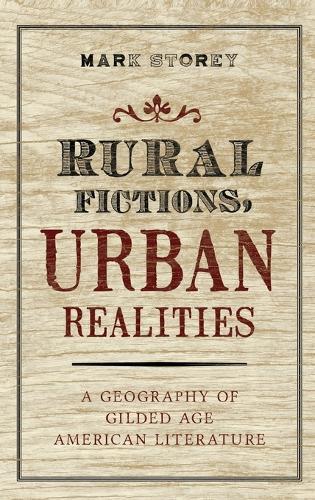
The diminishment of rural life at the hands of urbanization, for many, defines the years between the end of the Civil War and the dawn of the twentieth century in the U.S. Traditional literary histories find this transformation clearly demarcated between rural tales-stories set in the countryside, marked by attention to regional dialect and close-knit communities-and grittier novels and short stories that reflected the harsh realities of America's growing cities. Challenging this conventional division, Mark Storey proffers a capacious, trans-regional version of rural fiction that contains and coexists with urban-industrial modernity.To remap literary representations of the rural, Storey pinpoints four key aspects of everyday life that recur with surprising frequency in late nineteenth-century fiction: train journeys, travelling circuses, country doctors, and lynch mobs. Fiction by figures such as Hamlin Garland, Booth Tarkington, and William Dean Howells use railroads and roving carnivals to signify the deeper incursions of urban capitalism into the American countryside. A similar, somewhat disruptive migration of the urban into the rural occurs with the arrival of modern medicine, as viewed in depictions of the country doctor in novels like Sarah Orne Jewett's A Country Doctor and Harold Frederic's The Damnation of Theron Ware. This discussion gives way to a far darker interaction between the urban and the rural, with the intricate relationship of vigilante justice to an emerging modernity used to frame readings of rural lynchings in works by writers like Bret Harte, Charles Chesnutt, Paul Laurence Dunbar, and Owen Wister. The four arenas-transport, entertainment, medicine, and the law-used to organize the study come together in a coda devoted to utopian fiction, which demonstrates one of the more imaginative methods used to express the social and literary anxieties around the changing nature of urban and rural space at the end of the nineteenth century.Mining a rich variety of long neglected novels and short stories, Rural Fictions, Urban Realities provides a new literary geography of Gilded Age America, and in the process, contributes to our understanding of how we represent and register the cultural complexities of modernization.
Full Product Details
Author: Mark Storey (Lecturer, Faculty of Arts, Lecturer, Faculty of Arts, University of Nottingham)
Publisher: Oxford University Press Inc
Imprint: Oxford University Press Inc
Dimensions:
Width: 23.90cm
, Height: 2.80cm
, Length: 16.00cm
Weight: 0.530kg
ISBN: 9780199893188
ISBN 10: 0199893187
Pages: 208
Publication Date: 07 February 2013
Audience:
College/higher education
,
Postgraduate, Research & Scholarly
Format: Hardback
Publisher's Status: Active
Availability: To order

Stock availability from the supplier is unknown. We will order it for you and ship this item to you once it is received by us.
Reviews
<br> Mark Storey's nuanced study evokes and analyzes the continuing power of the country/city binary, at the same time showing us that rural fiction and urban modernity are inescapably connected, composing a single complex landscape. His thematic chapters-on such wide-ranging topics as train journeys, the country doctor, and lynch law-effortlessly integrate genre criticism and cultural history. --June Howard, author of Publishing the Family<p><br> Meticulously researched and full of fascinating juxtapositions of literary and historical processes, Rural Fictions, Urban Realities bridges the divide between regionalism and modernization as it demonstrates how postbellum rural fiction documents the effects of urbanism well beyond the borders of actual cities. --Hsuan L. Hsu, author of Geography and the Production of Space in Nineteenth-Century American Literature<p><br> By interrogating the spatial and literary configurations of urban and rural--and by dismantling their use as signposts for the modern and the pre-modern--Mark Storey redefines our understanding of the rural in fresh and exciting ways. Readers will learn much from this illuminating book. --Donna Campbell, author of Resisting Regionalism: Gender and Naturalism in American Fiction, 1885-1915<p><br>
Author Information
Mark Storey is Assistant Professor of English at the University of Warwick.