Overview
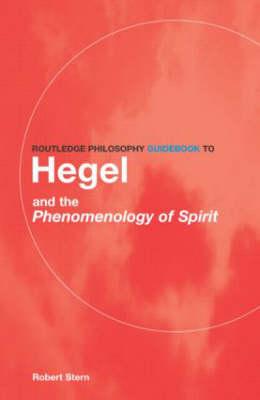
The Routledge Philosophy GuideBooks painlessly introduce students to the classic works of philosophy. Each GuideBook considers a major philosopher and a key area of their philosophy by focusing on an important text - situating the philosopher and the work in a historical context, considering the text in question and assessing the philosopher's contribution to contemporary thought. The Phenomenology of Spirit is Hegel's most important and famous work. It is essential to understanding Hegel's philosophical system and why he remains a major figure in Western Philosophy. This GuideBook introduces and assesses: Hegel's life and the background to the Phenomenology of Spirit the ideas and the text of the Phenomenology of Spirit the continuing importance of Hegel's work to philosophy.
Full Product Details
Author: Robert Stern
Publisher: Taylor & Francis Ltd
Imprint: Routledge
Dimensions:
Width: 12.90cm
, Height: 2.00cm
, Length: 19.80cm
Weight: 0.272kg
ISBN: 9780415217880
ISBN 10: 0415217881
Pages: 256
Publication Date: 22 November 2001
Audience:
College/higher education
,
Professional and scholarly
,
Tertiary & Higher Education
,
Postgraduate, Research & Scholarly
Format: Paperback
Publisher's Status: Out of Print
Availability: Out of stock

Reviews
While alerting students to the wide range of controversies regarding almost any topic in Hegel's complex masterpiece, Stern charts a clear and interesting course through Hegel's text, highlighting important methodological and thematic continuities universal, particular, and individual aspects. Stern's interpretation is distinctive, and yet accessible, useful, and stimulating for students and professionals alike. He quotes and clarifies a good selection of passages which would otherwise puzzle students. His bibliography provides useful references for both beginning and advanced students. Recent Hegel scholarship has made significant advances. In this context, Stern's new introduction is very welcome indeed. -Kenneth R. Westphal, University of East Anglia
While alerting students to the wide range of controversies regarding almost any topic in Hegel's complex masterpiece, Stern charts a clear and interesting course through Hegel's text, highlighting important methodological and thematic continuities universal, particular, and individual aspects. Stern's interpretation is distinctive, and yet accessible, useful, and stimulating for students and professionals alike. He quotes and clarifies a good selection of passages which would otherwise puzzle students. His bibliography provides useful references for both beginning and advanced students. Recent Hegel scholarship has made significant advances. In this context, Stern's new introduction is very welcome indeed. <br>-Kenneth R. Westphal, University of East Anglia <br>
Author Information
Robert A. Stern is Reader in Philosophy at the University of Sheffield