Overview
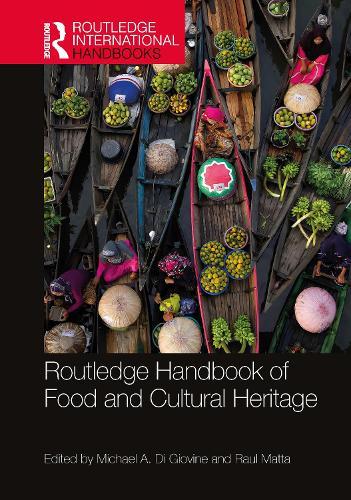
The Routledge Handbook of Food and Cultural Heritage explores the many varied intersections of food and cultural heritage from a robust, transdisciplinary perspective. Innovative in its approach, this cutting-edge Handbook thinks beyond traditional boundaries to present unique perspectives on the myriad ways in which food and cultural heritage are entangled in theory and practice. Both are growing industries; both are deeply rooted in families, cultures, and societies; both generate controversy and are deployed for political and economic activism. They also both have intellectual lives of their own, and are centers of interdisciplinary fields themselves—yet they also intersect in interesting and, until this book, under-theorized ways. After a comprehensive introduction that presents and challenges the state-of-the-art in the disciplines of critical food and critical heritage studies, the Handbook’s chapters are divided into six themes common to both fields: Ontologies and epistemologies of food and cultural heritage; material culture; identity, placemaking and belonging; politics and regulation; tourism development and heritage management; and contemporary issues and emerging approaches. To give representation of voices not usually heard in the scholarly tradition, special interviews with food-and-heritage practitioners complement the comprehensive chapters, adding further depth to the volume through their own lived experiences. With contributions from nearly 50 internationally recognized scholars, social scientists, dieticians, practitioners, and activists, this book is essential reading to scholars, students, researchers, industry professionals, and practitioners looking to understand the complex and compelling ways in which food, foodways, and cultural heritage overlap and impact each other, providing venues for collaborations.
Full Product Details
Author: Michael A. Di Giovine (West Chester University, USA) ,
Raúl Matta
Publisher: Taylor & Francis Ltd
Imprint: Routledge
Weight: 1.030kg
ISBN: 9781032026558
ISBN 10: 1032026553
Pages: 448
Publication Date: 29 September 2025
Audience:
College/higher education
,
Professional and scholarly
,
Tertiary & Higher Education
,
Professional & Vocational
Format: Hardback
Publisher's Status: Active
Availability: Not yet available

This item is yet to be released. You can pre-order this item and we will dispatch it to you upon its release.
Reviews
'In joining their expertise and their networks, Di Giovine and Matta have succeeded in assembling an impressive, global set of contributors. Bringing food and heritage together proves a winning combination in generating chapters that are throughout charting new terrain. The deep past of food production and consumption, material and immaterial alike, reconfirms that food is good to think with, particularly for understanding the mushrooming of heritage practices in realms ranging from identity and belonging to regulation and policy. Food is an arena that requires more than the safeguarding typical of heritage discourses; it is ideal for charting new practical and intellectual terrain so direly needed in the present.' Regina F. Bendix, Georg-August-University, Göttingen, Germany 'This fascinating and comprehensive volume explores myriad ways that food and cultural heritage intertwine in constructing meaning, place, and power. Contributors from across the social sciences show the explanatory potential of culinary heritage by examining its role in empirical case studies of migration, nation-building, terroir, tourism, restaurant and domestic cooking, museums, and activism. Papers examine food as matter, symbol, social glue, and means of survival, and reveal its centrality in expressing and challenging assumptions about tradition and identity. This book is an essential volume for scholars and students seeking to deepen their understanding of foodways across time and place.' Carole Counihan, co-editor of Chefs, Restaurants and Culinary Sustainability 'The Routledge Handbook of Food and Cultural Heritage is an indispensable resource for anyone seeking to comprehend the profound ways in which food—through its procurement, preparation, and consumption—serves as a compelling connection between our past and present. Editors Michael A. Di Giovine and Raúl Matta have curated insights from some of the foremost scholars operating at the intersection of critical food and heritage studies, alongside contributions from practitioners and activists actively engaged in the field today. This groundbreaking handbook offers a rich, multi-dimensional exploration of how food, in both its everyday and institutionalized forms, profoundly influences our identities, rooting us in particular places and histories.' Ronda L. Brulotte, University of New Mexico 'Tackling the social, economic, legal, and cultural Implications of food-as heritage, this volume offers a nuanced, multidisciplinary perspective on how caring about and transmitting foodways along with agropastoral and agricultural traditions is a crucial concern in today’s social movements and policy debates globally. Against alarming scenarios of ecological and socio-economic emergencies the potential and contradictions of conceiving food as heritage reflect here the most pressing anxieties of the Anthropocene, from climate change to forced migration, malnutrition or farming crises.' Chiara Bortolotto, Centre National de Recherche Scientifique (CNRS) 'Organized around productive themes in critical heritage studies and food studies, this collection authored by more than 50 scholars worldwide, will become a text to structure our thinking and argue with. It is a robust collection of empirically rich and theoretically generative essays that are good to think with.' Krishnendu Ray, Director of the Doctoral Program in Food Studies at NYU
Author Information
Michael A. Di Giovine is Professor of Anthropology at West Chester University; Director of its Museum of Anthropology and Archaeology, and Museum Studies Program; and Director of the Ethnographic Field School on Sustainable Food and Cultural Heritage in Perugia, Italy. An Honorary Fellow at the University of Wisconsin-Madison, Michael is also a former tour operator whose research in Europe and Southeast Asia focuses on the intersection of food, heritage, and tourism/pilgrimage. He is the founding President of the Council on Heritage and the Anthropology of Tourism (CHAT) at the American Anthropological Association, where he also served on its Task Force on Cultural Heritage. He has authored or edited nearly a dozen books, including The Heritage-scape: UNESCO, World Heritage and Tourism (2009) and Edible Identities: Food as Cultural Heritage (2016), and is the series editor of Bloomsbury’s The Anthropology of Tourism: Heritage, Mobility and Society. www.wcupa.edu/michaeldigiovine. Raúl Matta is a Full Researcher at the Institute Lyfe Research and Innovation Center in Lyon, France. He works at the intersection of anthropology, food and heritage studies. Raúl has conducted fieldwork in Peru, Mexico, Germany, and France, and occupied leading roles in projects funded by the German Research Foundation, the French National Research Agency, and the European Commission. From 2024 to 2027 he is serving as the scientific coordinator (WP2 Leader) for the Horizon Europe project CONVIVIUM: New European Bauhaus Solutions in Food, Living Heritage and Conviviality. His articles have appeared in Social Anthropology, International Journal of Cultural Property, Food, Culture & Society, Food and Foodways, among others. He is the author of From the Plate to Gastro-Politics. Unravelling the Boom of Peruvian Cuisine (2023).