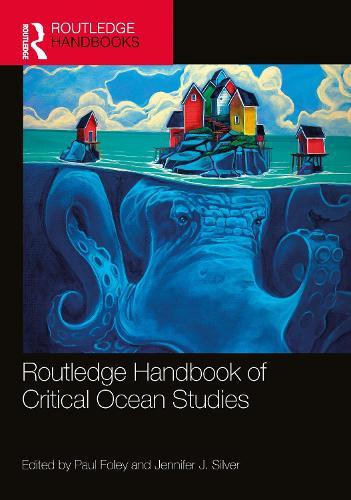
Overview
This handbook provides a path-breaking overview of the rapidly developing field of critical ocean studies. It is the first cross-disciplinary and in-depth account of critical ocean studies. While the academic application of critical analysis to ocean, coastal, and island studies has been expanding in recent decades, studies are fragmented across disciplines and publishing venues. This handbook brings together perspectives from the humanities, social sciences, arts, and other ways of knowing to identify key insights from the diverse and dynamic field of critical ocean studies. Organized into three sections covering themes of concepts, criticisms and agency, it examines ways in which researchers enhance understanding of environmental and social relationships and injustices in and around the ocean. This handbook will invite critical analysis and shape research agendas to meet the demands of new knowledge and a changing world. Routledge Handbook of Critical Ocean Studies will be of interest to scholars from across disciplines. By engaging a wide range of perspectives on critical ocean studies, it will serve as an excellent resource for graduate students, interdisciplinary researchers and practitioners. This handbook identifies emerging research opportunities in critical ocean studies and encourages students and researchers to apply insights from this field to better understand and address environmental and social problems.
Full Product Details
Author: Paul Foley ,
Jennifer J. Silver
Publisher: Taylor & Francis Ltd
Imprint: Routledge
Weight: 0.453kg
ISBN: 9781032324715
ISBN 10: 1032324716
Pages: 262
Publication Date: 04 December 2025
Audience:
College/higher education
,
Professional and scholarly
,
Tertiary & Higher Education
,
Professional & Vocational
Format: Hardback
Publisher's Status: Forthcoming
Availability: Not yet available

This item is yet to be released. You can pre-order this item and we will dispatch it to you upon its release.
Reviews
""This handbook is a monumental effort, exceptionally well done and greatly enriched by the editors' introductory exposition of ""critical ocean studies."" The oceans are often viewed as frontiers only tentatively visited, much less colonized, by humans. This handbook represents a critical reflection on the fact that the oceans have been far more central to human experience, practice, and culture than that. It’s a much needed and welcome effort to discern and shape the contours of cutting edge studies of the oceans and their socio-economic, cultural, and ecological systems. The chapters are grounded in scholarship from the humanities and the social sciences, but the work reported on comes from dynamic and ever-shifting zones of transdisciplinarity, making it reasonable to see an “oceanic turn” therein and to claim “critical ocean studies” as a discipline in and of itself. Sensitive to the novelty of much of this, the chapter authors are careful to provide helpful reviews of relevant literatures while also pointing to new knowledge and concepts (such as “wet ontologies” and “ocean regimes”), making the book a gold mine for advanced students and scholars. There are intriguing and unusual topics, such as building human habitats at sea, the roles of seabirds in navigation, and the sonics of ocean understanding, as well as foci on inequities at sea such as labour in the offshore industrial fisheries and the construction of new modes and shapes of governance dealing with, for example, sea level rise, migration, and opening of the Arctic. Consistent throughout is respect for the complexities and indeterminacies of changing oceans and commitment to knowledge and practice that support social and ecological justice."" Bonnie McCay, Retired Professor, Dept of Human Ecology, Rutgers the State University, New Brunswick, New Jersey, USA ""Anyone tempted to think of oceans as barren and monotonous spaces remote from people and human concerns should consult this handbook. As contributors to this volume show, we need to scrutinize past and present knowledge creation in order to imagine new and diverse ways of knowing that may secure the health of the oceans and our future. The enterprise of critical ocean studies demonstrates the central role for the humanities in our collective quest for a more just, sustainable ocean."" Helen M. Rozwadowski, Professor of History and Founder of the Maritime Studies Program at the University of Connecticut
""This handbook is a monumental effort, exceptionally well done and greatly enriched by the editors' introductory exposition of ""critical ocean studies."" The oceans are often viewed as frontiers only tentatively visited, much less colonized, by humans. This handbook represents a critical reflection on the fact that the oceans have been far more central to human experience, practice, and culture than that. It’s a much needed and welcome effort to discern and shape the contours of cutting edge studies of the oceans and their socio-economic, cultural, and ecological systems. The chapters are grounded in scholarship from the humanities and the social sciences, but the work reported on comes from dynamic and ever-shifting zones of transdisciplinarity, making it reasonable to see an “oceanic turn” therein and to claim “critical ocean studies” as a discipline in and of itself. Sensitive to the novelty of much of this, the chapter authors are careful to provide helpful reviews of relevant literatures while also pointing to new knowledge and concepts (such as “wet ontologies” and “ocean regimes”), making the book a gold mine for advanced students and scholars. There are intriguing and unusual topics, such as building human habitats at sea, the roles of seabirds in navigation, and the sonics of ocean understanding, as well as foci on inequities at sea such as labour in the offshore industrial fisheries and the construction of new modes and shapes of governance dealing with, for example, sea level rise, migration, and opening of the Arctic. Consistent throughout is respect for the complexities and indeterminacies of changing oceans and commitment to knowledge and practice that support social and ecological justice. "" Bonnie McCay, Retired Professor, Dept of Human Ecology, Rutgers the State University, New Brunswick, New Jersey, USA (and/or: Member, U.S. National Academy of Sciences. ). ""Anyone tempted to think of oceans as barren and monotonous spaces remote from people and human concerns should consult this handbook. As contributors to this volume show, we need to scrutinize past and present knowledge creation in order to imagine new and diverse ways of knowing that may secure the health of the oceans and our future. The enterprise of critical ocean studies demonstrates the central role for the humanities in our collective quest for a more just, sustainable ocean."" Helen M. Rozwadowski, Professor of History and Founder of the Maritime Studies Program at the University of Connecticut.
Author Information
Paul Foley is a Professor in the Environmental Policy Institute and the School of Science and the Environment at Memorial University’s Grenfell Campus, Canada. Jennifer J. Silver is a Professor in the Department of Geography, Environment and Geomatics at the University of Guelph, Canada.