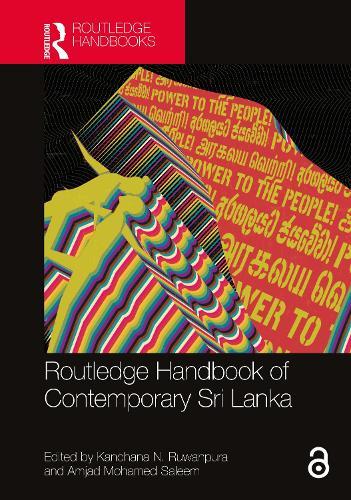
Full Product Details
Author: Kanchana N. Ruwanpura (University of Gothenburg, Sweden) ,
Amjad Mohamed Saleem (Centre for Humanitarian Diplomacy, Sarajevo, Bosnia and Herzegovina)
Publisher: Taylor & Francis Ltd
Imprint: Routledge
ISBN: 9781032293097
ISBN 10: 1032293098
Pages: 446
Publication Date: 22 May 2026
Audience:
College/higher education
,
Tertiary & Higher Education
Format: Paperback
Publisher's Status: Forthcoming
Availability: Not yet available

This item is yet to be released. You can pre-order this item and we will dispatch it to you upon its release.
Reviews
“Sri Lanka is at the cross-roads on many fronts. The Routledge Handbook of Contemporary Sri Lanka comes at as a boon to researchers on these different fronts by identifying issues involved in the many problems that confront Sri Lanka. The problems of Sri Lanka reflect the conditions in many developing countries. It is befuddled with economic crises resulting from inability to service sovereign debts, unresolved ethnic crises fomented by chauvinist leaders, heavy corruption that depletes the national treasury, a political shift towards authoritarianism, environmental depletion, drug problems, pervasive criminal violence and other situations of social disruption. These different areas are covered by leading experts. This superbly written research handbook serves as a tool to study not only Sri Lanka but to compare its problems with other developing states with similar problems. It serves as an introduction to scholars new to the field and as a book that provides fresh insights into different aspects of social and economic life in the island to the established researchers. It will remain the best guide to research on aspects of socio-economic issues in Sri Lanka.” Muthucumaraswamy Sornarajah, Emeritus Professor of Law, National University of Singapore “This excellent and important volume brings together a broad range of contemporary scholars in a hard-hitting, multi-disciplinary analysis of Sri Lanka’s current political and economic malaise. Thirty-five original chapters carefully and critically delineate the multiple factors which converged in the 2022 anti-government “struggle” (aragalaya) and its subsequent repression, and cautiously point the way forward to greater political, economic, social and environmental justice in Sri Lanka. This unique collection will be valuable to everyone who wants to understand Sri Lanka’s contemporary situation, and indispensable both to scholars who study it and to policy-makers who attempt to redress it.” Jonathan S. Walters, Professor of Religion and George Hudson Ball Endowed Chair of Humanities, Whitman College, USA “This is a valuable reference book on a country that defies easy readings. Sri Lanka is today in flux navigating political turmoil, environmental degradation, ethnic tensions, and economic hardships due to an unprecedented collapse of the economy. This volume of 35 essays and reflections captures this moment in all its unevenness, shedding light on the ambiguities that lace Sri Lankan society. The book moves from chapters dissecting nationalism, politics, and institutions to more specific topics on the economy and political economy, labour, environmental tensions and social and cultural formations. The contributions are sharp, well researched, theoretically informed and seamlessly connected. While different approaches and positions are represented, they share a commitment to an equitable, just, and ecologically sensitive country to be forged in the future. This is an inspiring volume and a reliable source for anyone interested in Sri Lanka today.” Nira Wickramasinghe, Chair and Professor of Modern South Asian Studies, Leiden University, The Netherlands “[This book] describes itself as “a comprehensive survey of issues facing [Sri Lanka].” While it certainly does that, evidenced by the multitude of topics discussed by highly qualified authors, to simply call it a “handbook” is an understatement. The book is not merely “here is Sri Lanka and its issues.” It is an indictment of the mistakes, spanning decades in some cases, that have led Sri Lanka to where it is today. […] The book, spanning many topics, is best suited for readers familiar with the basics of the Sri Lankan context, especially those with a social science, humanities, or political science background. It is strongly critical of colonial influences and the Sinhala-Buddhist, patriarchal status quo in Sri Lanka. Furthermore, it is a summary of academic literature on its various topics, evident in the tendency to cite secondary literature throughout the chapters. […] It is a one-stop shop that provides readers with a clear picture of current academic thinking on a diverse set of topics. From there, they can delve further into the subjects with the rich lists of sources in the references. Considering the dire situation in which Sri Lanka finds itself, it needs its citizens to have greater literacy in its affairs, both past and current. The Routledge Handbook is a fine step in that direction. ” G.A. Abayaratna, University of Colombo Review (Series III), Vol.5, No.2, 2024 “Once among the most promising societies in the Global South, Sri Lanka has been beset by daunting problems for decades. Readers interested in social scientific studies describing its current situation will find value in the many contributions on economic, environmental, and health policy in this collection. Essays detailing the sovereign debt crisis, agricultural labor conditions, multiple social inequalities, wetlands governance, health care provision, and urban development are particularly good. Chapters examining politics directly focus on the development of constitutional authority and issues of national and minority identities.” J. C. Hickman, Berry College, USA
Author Information
Kanchana N. Ruwanpura is a Professor of Development Geography, the University of Gothenburg, Sweden, and an Honorary Fellow at CSAS, at the University of Edinburgh, Scotland. Amjad Mohamed Saleem currently works at the International Federation of Red Cross and Red Crescent Societies in Geneva, Switzerland.