Overview
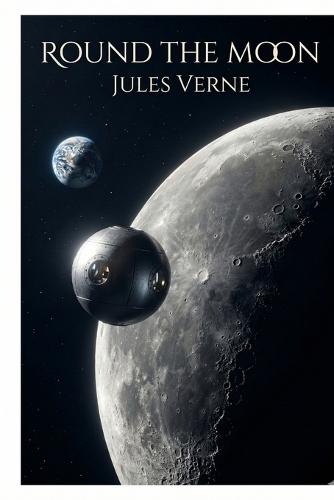
This sequel to From the Earth to the Moon narrates the eventful journey to the Moon of three passengers-Impey Barbicane, president of the Gun Club, Captain Nicholl, Barbicane's rival and then collaborator, and Michel Ardan, a French scientist-aboard a hollow cannonball. They orbit the Moon and perform geographical observations, but the projectile fails to land, propelling them instead toward the Earth. They're rescued at sea and widely celebrated as the first humans to leave Earth. ROUND THE MOON A SEQUEL TO FROM THE EARTH TO THE MOON ROUND THE MOON - A TRIP AROUND IT PRELIMINARY CHAPTER During the year 186-, the whole world was greatly excited by a scientific experiment unprecedented in the annals of science. The members of the Gun Club, a circle of artillerymen formed at Baltimore after the American war, conceived the idea of putting themselves in communication with the moon!-- yes, with the moon-- by sending to her a projectile. Their president, Barbicane, the promoter of the enterprise, having consulted the astronomers of the Cambridge Observatory upon the subject, took all necessary means to ensure the success of this extraordinary enterprise, which had been declared practicable by the majority of competent judges. After setting on foot a public subscription, which realized nearly L1,200,000, they began the gigantic work. According to the advice forwarded from the members of the Observatory, the gun destined to launch the projectile had to be fixed in a country situated between the 0 and 28th degrees of north or south latitude, in order to aim at the moon when at the zenith; and its initiatory velocity was fixed at twelve thousand yards to the second. Launched on the 1st of December, at 10hrs. 46m. 40s. P.M., it ought to reach the moon four days after its departure, that is on the 5th of December, at midnight precisely, at the moment of her attaining her perigee, that is her nearest distance from the earth, which is exactly 86,410 leagues (French), or 238,833 miles mean distance (English). The principal members of the Gun Club, President Barbicane, Major Elphinstone, the secretary Joseph T. Maston, and other learned men, held several meetings, at which the shape and composition of the projectile were discussed, also the position and nature of the gun, and the quality and quantity of powder to be used. It was decided: First, that the projectile should be a shell made of aluminum with a diameter of 108 inches and a thickness of twelve inches to its walls; and should weigh 19,250 pounds. Second, that the gun should be a Columbiad cast in iron, 900 feet long, and run perpendicularly into the earth. Third, that the charge should contain 400,000 pounds of gun-cotton, which, giving out six billions of litres of gas in rear of the projectile, would easily carry it toward the orb of night. These questions determined President Barbicane, assisted by Murchison the engineer, to choose a spot situated in Florida, in 27@ 7' North latitude, and 77@ 3' West (Greenwich) longitude. It was on this spot, after stupendous labor, that the Columbiad was cast with full success. Things stood thus, when an incident took place which increased the interest attached to this great enterprise a hundredfold.
Full Product Details
Author: Jules Verne
Publisher: Les Prairies Numeriques
Imprint: Les Prairies Numeriques
Dimensions:
Width: 15.20cm
, Height: 1.30cm
, Length: 22.90cm
Weight: 0.308kg
ISBN: 9791043136276
Pages: 226
Publication Date: 01 March 2026
Audience:
General/trade
,
General
Format: Paperback
Publisher's Status: Active
Availability: Available To Order

We have confirmation that this item is in stock with the supplier. It will be ordered in for you and dispatched immediately.
Reviews
This sequel to From the Earth to the Moon narrates the eventful journey to the Moon of three passengers-Impey Barbicane, president of the Gun Club, Captain Nicholl, Barbicane's rival and then collaborator, and Michel Ardan, a French scientist-aboard a hollow cannonball. They orbit the Moon and perform geographical observations, but the projectile fails to land, propelling them instead toward the Earth. They're rescued at sea and widely celebrated as the first humans to leave Earth.