Overview
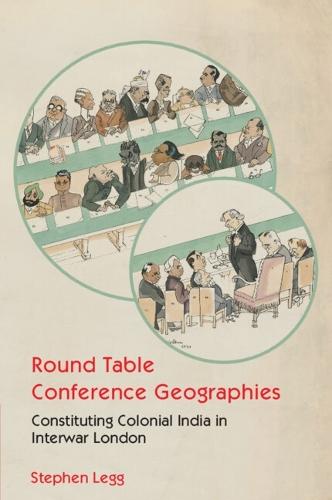
Round Table Conference Geographies explores a major international conference in 1930s London which determined India's constitutional future in the British Empire. Pre-dating the decolonising conferences of the 1950s–60s, the Round Table Conference laid the blueprint for India's future federal constitution. Despite this the conference is unanimously read as a failure, for not having comprehensively reconciled the competing demands of liberal and Indian National Congress politicians, of Hindus and Muslims, and of British versus Princely India. This book argues that the conference's three sessions were vital sites of Indian and imperial politics that demand serious attention. It explores the spatial politics of the conference in terms of its imaginary geographies, infrastructures, host city, and how the conference was contested and represented. The book concludes by asking who gained through representing the conference as a failure and explores it, instead, as a teeming political, social and material space.
Full Product Details
Author: Stephen Legg (University of Nottingham)
Publisher: Cambridge University Press
Imprint: Cambridge University Press
Weight: 0.671kg
ISBN: 9781009573320
ISBN 10: 1009573322
Pages: 413
Publication Date: 03 April 2025
Audience:
General/trade
,
General
Format: Paperback
Publisher's Status: Active
Availability: Manufactured on demand

We will order this item for you from a manufactured on demand supplier.
Reviews
'To think about the geographies of the Round Table Conference is to appreciate that what occurred 'behind the scenes' was absolutely consequential to 20th century global imperial history. Legg shows how critical a variety of infrastructures - from palaces, flats and tearooms to gavels, coat racks and washstands - were to both official and subaltern diplomacy during this watershed interwar event. If London was the great unacknowledged delegate to the conference, its most public and most intimate spaces are key to understanding the role of cultural relations in the history of India's pathway to full political sovereignty. Thanks to Legg's amazing footwork, we have a whole new understanding of all the rooms where it happened.' Antoinette Burton, University of Illinois Urbana-Champaign 'Legg radically reimagines the Round Table Conference (RTC), often relegated to a stodgier sideshow of state-making and nationalism on the ground, by focusing on the politics of representation, labour, infrastructure and space that went into making the RTC. In doing so, he shows how Indian delegates at the RTC innovated new spaces of internationalist politics and challenged Western stereotypes of backwardness. Elegantly crafted, and engagingly written, Legg offers us rich theoretical tools and incisive methods to understand the production of internationalism in the 20th century.' Rohit De, Yale University 'This compelling, beautifully written and detailed account of the Round Table Conference brings together geographies of colonialism and diplomacy to exemplify how colonial democracy was practised. Stephen Legg brings to attention a largely overlooked conference and the deliberations that occurred and extended beyond the meeting venue itself, providing captivating insights into how representation, communication and decision-making unfolded. The book includes evocative details of how the Indian delegates negotiated the simultaneously racist and hospitable landscape of 1930s London and draws on archival material to illuminate their experiences of being lavishly entertained at tea parties, receptions and soirees. Legg offers a distinctly geographical exploration of a unique historical event that highlights how liberalism and imperialism were being played out in the interwar period. In bringing together geo-political debates with the intricacies of practices and encounters, this book both delights and challenges the reader.' Uma Kothari, University of Manchester 'Legg helps us understand the contentious relationship between empire and democratisation through an underappreciated forum - the conference. With forensic and careful argumentation, Legg provides an intimate political geography of power and representation.' Robbie Shilliam, Johns Hopkins University 'Stephen Legg's scholarship was already beyond compare. With Round Table Conference Geographies, Legg has cemented his position as a historian whose works must be read in order to understand late colonial India. In particular, for anyone working on Indian constitutional histories, Legg's book is a must-read. In the beginning of the book, Legg mentions three doyens of this field whose works remained close to him, R. J. Moore, Carl Bridge, and Ian Copland. (13). Undoubtedly, Stephen Legg has to be the fourth name added by any future scholar working in this field.' Arvind Elangovan, The London Journal
Author Information
Stephen Legg is Professor of Historical Geography at University of Nottingham, England. He is a specialist on interwar colonial India with a particular interest in the politics of urban space within imperial and international frames. He has analyzed these spaces and frames through drawing upon theoretical approaches from memory scholarship, postcolonialism, political theory and governmentality studies. He published the co-edited volume (with Deana Heath) South Asian Governmentalities: Michel Foucault and the Question of Postcolonial Orderings with the Press in 2018. Some of his other publications are Spaces of Colonialism: Delhi's Urban Governmentalities (2007), Prostitution and the Ends of Empire: Scale, Governmentalities, and Interwar India (2014) and the edited collection Spatiality, Sovereignty and Carl Schmitt: Geographies of the Nomos (2011).