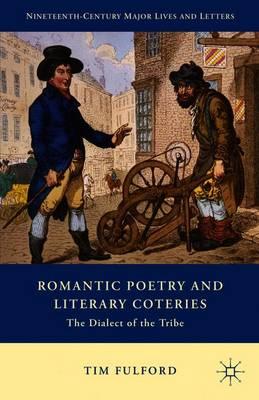
Full Product Details
Author: Tim Fulford
Publisher: Palgrave Macmillan
Imprint: Palgrave Macmillan
Edition: 1st ed. 2015
Dimensions:
Width: 14.00cm
, Height: 1.80cm
, Length: 21.60cm
Weight: 4.483kg
ISBN: 9781137533968
ISBN 10: 113753396
Pages: 264
Publication Date: 11 August 2015
Audience:
Professional and scholarly
,
Professional & Vocational
Format: Hardback
Publisher's Status: Active
Availability: In Print

This item will be ordered in for you from one of our suppliers. Upon receipt, we will promptly dispatch it out to you. For in store availability, please contact us.
Reviews
In Romantic Poetry and Literary Coteries Tim Fulford weaves a series of rich literary networks, or coteries. Arguing that coteries create collective poetic projects, he revisits literary 'allusion', demonstrating that it knits together such projects as one of the means by which authors interact. Such an approach reveals the development of poetic language and subject matter as a communal project, sometimes across generations-Wordsworth's plain diction in conversation with Cowper, for instance. By focusing on how these coteries were constituted, this book makes a series of important contributions to our understanding of Romantic authorship. - Alan Vardy, Associate Professor of English, Hunter College and the Graduate Center, City University of New York, USA Ranging from the Lake Poets to the Cockneys and beyond, Tim Fulford makes a major contribution to our understanding of romantic sociality and the role of circles in literary production. His encyclopedic erudition is brought to bear not only upon the usual suspects such as Wordsworth or Hunt, but also Blooomfield and Robinson, country poets and city prophets. Particularly striking is his analysis of coterie language, as he shows how the poetry of the various groups he examines creates through allusion a kind of collective dialect. - Jeffrey N. Cox, Professor of English, University of Colorado Boulder, USA
“In this well-researched and wide-ranging study, Tim Fulford joins critics such as Jeffrey Cox, Jon Mee and Paul Magnuson who instead see Romantic writing as a collaborative endeavour, investigating small writing communities (pejoratively dubbed ‘schools’ by Romantic-era reviewers) or twosomes. … Romantic Poetry and Literary Coteries displays an impressive command of material with admirable alertness to the effects on the writers’ work of the ‘micro-historical’ as well as larger-scale social and political developments … .” (Kim Wheatley, Review of English Studies, Vol. 67, June, 2016)
Fulford's astonishing command of the diverse methods, interests, and materials dispersed throughout the field of Romantic studies today and of the critical practices of the past thirty years gives this study title to its own title: it is itself a grammar, lexicon, and demonstration of the dialect of our tribe - the scholars, critics, and historians of things and themes Romantic. - Marjorie Levinson, F.L. Huetwell Professor of English Language and Literature, University of Michigan, USA In Romantic Poetry and Literary Coteries Tim Fulford weaves a series of rich literary networks, or coteries. Arguing that coteries create collective poetic projects, he revisits literary 'allusion', demonstrating that it knits together such projects as one of the means by which authors interact. Such an approach reveals the development of poetic language and subject matter as a communal project, sometimes across generations-Wordsworth's plain diction in conversation with Cowper, for instance. By focusing on how these coteries were constituted, this book makes a series of important contributions to our understanding of Romantic authorship. - Alan Vardy, Associate Professor of English, Hunter College and the Graduate Center, City University of New York, USA Ranging from the Lake Poets to the Cockneys and beyond, Tim Fulford makes a major contribution to our understanding of romantic sociality and the role of circles in literary production. His encyclopedic erudition is brought to bear not only upon the usual suspects such as Wordsworth or Hunt, but also Blooomfield and Robinson, country poets and city prophets. Particularly striking is his analysis of coterie language, as he shows how the poetry of the various groups he examines creates through allusion a kind of collective dialect. - Jeffrey N. Cox, Professor of English, University of Colorado Boulder, USA
Fulford's astonishing command of the diverse methods, interests, and materials dispersed throughout the field of Romantic studies today and of the critical practices of the past thirty years gives this study title to its own title: it is itself a grammar, lexicon, and demonstration of the dialect of our tribe - the scholars, critics, and historians of things and themes Romantic. - Marjorie Levinson, F.L. Huetwell Professor of English Language and Literature, University of Michigan, USA In Romantic Poetry and Literary Coteries Tim Fulford weaves a series of rich literary networks, or coteries. Arguing that coteries create collective poetic projects, he revisits literary 'allusion', demonstrating that it knits together such projects as one of the means by which authors interact. Such an approach reveals the development of poetic language and subject matter as a communal project, sometimes across generations Wordsworth's plain diction in conversation with Cowper, for instance. By focusing on how these coteries were constituted, this book makes a series of important contributions to our understanding of Romantic authorship. - Alan Vardy, Professor of English, Hunter College and the Graduate Center, City University of New York, USA Ranging from the Lake Poets to the Cockneys and beyond, Tim Fulford makes a major contribution to our understanding of romantic sociality and the role of circles in literary production. His encyclopedic erudition is brought to bear not only upon the usual suspects such as Wordsworth or Hunt, but also Blooomfield and Robinson, country poets and city prophets. Particularly striking is his analysis of coterie language, as he shows how the poetry of the various groups he examines creates through allusion a kind of collective dialect. - Jeffrey N. Cox, Professor of English, University of Colorado Boulder, USA
Author Information
Tim Fulford is Professor of English at De Montfort University, UK. His most recent publications include The Late Poetry of the Lake Poets, The Collected Letters of Robert Southey, and Robert Southey: Poetical Works 1811-38. He is currently editing the Collected Letters of Sir Humphry Davy.