Overview
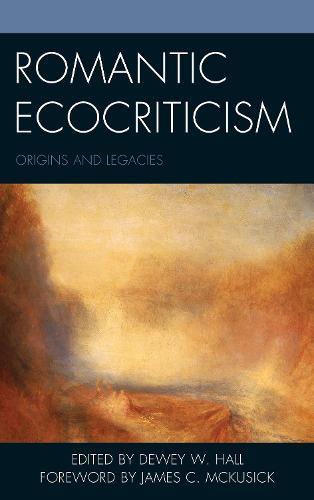
Romantic Ecocriticism: Origins and Legacies is unique due to its rare assemblage of essays, which has not appeared within an edited collection before. Romantic Ecocriticism is distinct because the essays in the collection develop transnational and transhistorical approaches to the proto-ecological early environmental aspects in British and American Romanticism. First, the edition’s transnational approach is evident through transatlantic connections such as, but are not limited to, comparisons among the following writers: William Wordsworth, William Howitt, and Henry D. Thoreau; John Clare and Aldo Leopold; Charles Darwin and Ralph W. Emerson. Second, the transhistorical approach of RomanticEcocriticism is evident in connections among the following writers: William Wordsworth and Emily Bronte; Thomas Malthus and George Gordon Byron; James Hutton and Percy Shelley; Erasmus Darwin and Charlotte Smith; Gilbert White and Dorothy Wordsworth among others. Thus, Romantic Ecocriticism offers a dynamic collection of essays dedicated to links between scientists and literary figures interested in natural history.
Full Product Details
Author: Dewey W. Hall ,
James C. McKusick ,
Colin Carman ,
Alicia Carroll
Publisher: Bloomsbury Publishing Plc
Imprint: Lexington Books
Dimensions:
Width: 15.10cm
, Height: 2.30cm
, Length: 22.90cm
Weight: 0.458kg
ISBN: 9781498518031
ISBN 10: 1498518036
Pages: 336
Publication Date: 11 September 2017
Audience:
College/higher education
,
Postgraduate, Research & Scholarly
Format: Paperback
Publisher's Status: Active
Availability: In Print

This item will be ordered in for you from one of our suppliers. Upon receipt, we will promptly dispatch it out to you. For in store availability, please contact us.
Reviews
Romantic Ecocriticism considers how natural philosophy and science informed, and sometimes influenced, 19th-century English and American Romantic writing. The essays tend to dwell on canonical figures; Wordsworth, Byron, the Shelleys, Emerson, and Thoreau play important roles in most of the essays, although the final contributions connect the Romantic movement to 20th-century environmentalism. In putting the collection together, Hall intends to erode the assumption that these Romantic writers were mere idealists by demonstrating the extent to which they drew on contemporaneous theories from the natural sciences. The essays broaden the critical context of Romantic study by traversing national boundaries to highlight thematic connections between US and English Romantic writers. The contributors range from full professors to graduate students, but essays are consistently insightful-sometimes, perhaps, more intriguing for the 19th-century scientific theories that are unveiled than for the critical insights those theories make available. Summing Up: Recommended. Graduate students; researchers/faculty. * CHOICE * With his edited collection, Romantic Ecocriticism, Dewey Hall launches a much-needed new wave of eco-historical scholarship of Romanticism, one that explores ecocriticism's own historical roots in transatlantic writing of the late Georgian period. Representing a great diversity of theoretical concerns, these essays are united in two vital objectives: to break down the 'two culture' divide between ecocriticism and ecological science, and to move beyond the narrow presentism of our ecological anxieties, toward multiple encounters with geological and biological 'deep time,' the formulae for which first emerged around 1800. Romantic Ecocriticism takes us deep into the Anthropocene, and beyond. -- Gillen D'Arcy Wood, University of Illinois Romantic Ecocriticism is a forceful reminder that literature and science do not exist in isolation. These essays further establish the engagement of literary Romanticism with the major scientific and socio-theoretical debates of the period. -- Rochelle Johnson, College of Idaho
Author Information
Dewey W. Hall is professor of English at California State Polytechnic University, Pomona. He is also the author of Romantic Naturalists, Early Environmentalists: An Ecocritical Study, 1789–1912 (2014).