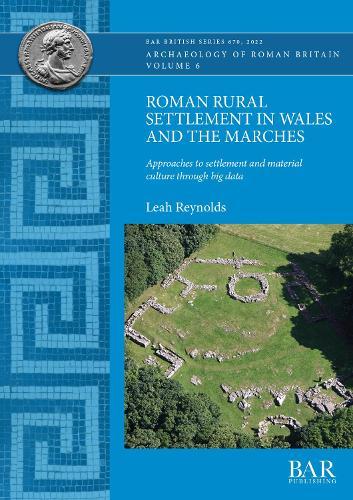
Roman Rural Settlement in Wales and the Marches: Approaches to settlement and material culture through big data

Author:   Leah Reynolds
Publisher:   BAR Publishing
ISBN:  

9781407358963


Pages:   198
Publication Date:   31 March 2022
Format:   Paperback
Availability:   Available To Order   Availability explained
We have confirmation that this item is in stock with the supplier. It will be ordered in for you and dispatched immediately.

Our Price $119.03 Quantity:  
Add to Cart

Share |

Roman Rural Settlement in Wales and the Marches: Approaches to settlement and material culture through big data


Overview

While the rural settlements of Wales and the Marches have often been used as a backdrop to the study of the military, this book seeks to move beyond a simplistic Roman/native dichotomy to present a more nuanced understanding of the nature and development of rural settlement during the Roman period. It takes advantage of the recent rise of big data approaches to analyse the distribution of settlements and material culture and to explore the regional diversity, economic basis, and social practice of rural settlements. A methodology for the analysis of regional ceramic assemblages is also presented and offers both a new perspective on the distribution of ceramics in the region and a reappraisal of rural engagement in networks of trade and production. The evidence presented demonstrates that, far from being a homogenous region peripheral to Roman Britain, Wales and the Marches were far more diverse and dynamic than previous work has suggested.  

Full Product Details

Author:   Leah Reynolds
Publisher:   BAR Publishing
Imprint:   BAR Publishing
Weight:   0.790kg
ISBN:  

9781407358963


ISBN 10:   1407358960
Pages:   198
Publication Date:   31 March 2022
Audience:   Professional and scholarly ,  Professional & Vocational
Format:   Paperback
Publisher's Status:   Active
Availability:   Available To Order   Availability explained
We have confirmation that this item is in stock with the supplier. It will be ordered in for you and dispatched immediately.

Table of Contents

List of Figures List of Tables Abstract  1 Introduction 1.1. Aims 1.2. Study Structure   2. The Archaeology of the Iron Age in Wales the Marches 2.1. The development of Iron Age Studies 2.1.1. The ABCs of the Iron Age 2.1.2. Iron Age Communities in Britain 2.1.3. Regional narratives and a 'Different Iron Age' 2.1.4. Criticism 2.2. The Late Iron Age in Wales and the Marches 2.2.1. The Hillfort Zone 2.2.2. Non-Hillfort Settlement 2.2.3. Social Structure and Practice 2.2.4. Material Culture 2.3. Summary   3. The Roman Period in Wales and the Marches 3.1. Theoretical Developments in Romano-British Studies 3.1.1. Romanisation and Related Theories 3.1.2. The Material-Cultural Turn 3.1.3. Big Data 3.2. Romano-British Studies in Wales and the Marches 3.2.1. 1st Century: Conquest and Consolidation 3.2.2. 1st to 3rd Centuries 3.2.3. The 3rd Century Onwards 3.3. Work in Wales and the Marches 3.4. Summary   4. The Scope of the Study 4.1. Defining the Study Region 4.2. Site Data 4.2.1. Rural Settlement of Roman Britain Project Overview 4.2.2. Defining the Dataset 4.3. Ceramic Methodology 4.3.1. Ceramics and the Rural Settlement of Roman Britain Project 4.3.2. Inter-Site Comparison and Previous Methodologies 4.3.3. Developing a Methodology 4.3.4. Aims and Objectives 4.3.5. Methods of Quantification 4.3.6. Defining the Methodology 4.3.7. Strengths and Weaknesses 4.4. Summary   5. Introducing the Data 5.1. Settlement Types 5.1.1. Excluded Settlement Types 5.1.2. Farms 5.1.3. Villas 5.1.4. Problems of Definition 5.1.5. Other Settlement Forms 5.2. Structural Information 5.2.1. Circular Buildings 5.2.2. Rectilinear buildings 5.2.3. Masonry buildings 5.3. Economy 5.3.1. Coins 5.3.2. Pottery 5.3.3. Other Evidence 5.4. Personal Identity and Socio-Cultural Practice 5.4.1. Personal Ornament 5.4.2. Brooches 5.4.3. Toilet Implements 5.4.4. Objects associated with writing 5.5. Summary   6. Landscape 6.1. Settlement Density 6.1.1. The Portable Antiquities Scheme: Evidence of Absence? 6.2. Settlement Distribution and Chronology 6.2.1. Defining Continuity 6.2.2. Late Pre-Roman Iron Age and Early Roman (AD75-AD150) 6.2.3. Middle Roman (AD150-AD300) 6.2.4. Late Roman (300+) 6.3. Site Morphology 6.3.1. Enclosed Settlements 6.3.2. Villa Settlements 6.4. Structural Morphology 6.4.1. Roundhouses 6.4.2. Rectilinear Structures 6.4.3. Mixed Architecture 6.5. Discussion   7.             Economy 7.1. Production 7.1.1. Forms of Agriculture 7.1.2. Arable Farming 7.1.3. Arable Farming - Processing and Storage 7.1.4. Pastoral Farming 7.1.5. Pastoral - Secondary Production 7.1.6. Other Economic Activities 7.1.7. Discussion 7.2. Distribution 7.2.1. General Distribution 7.2.2. Distribution of Imported and Romano-British Wares 7.3. Consumption 7.3.1. Coinage 7.3.2. Distribution and Chronology 7.3.3. Denomination 7.4. Discussion   8. Personal Identities and Socio-Cultural Practices 8.1. Personal Presentation 8.1.1. The Body 8.1.2. Dress 8.1.3. Hair 8.1.4. Personal Ornament 8.1.5. Summary 8.2. Food and Drink 8.2.1. New Introductions: Amphorae and Mortaria 8.2.2. Ways of Cooking and Eating 8.2.3. Fabric 8.2.4. Drinking Vessels 8.2.5. Summary 8.3. Discussion   9. Discussion 9.1. General Review 9.1.1. Chapter Six - Landscape 9.1.2. Chapter Seven - Economy 9.1.3. Chapter Eight - Personal Identity and Socio-Cultural Practice 9.2. Regionality 9.2.1. Regions as Units of Analysis 9.2.2. Continuity and Change 9.2.3. The Presence of Absence 9.3. Rural Economy 9.3.1. Connectivity 9.3.2. Demanding Supply 9.3.3. Economic Integration 9.4. Personal Identities and Socio-Cultural Practices 9.4.1. Resistance and Acceptance 9.4.2. Villa Settlements and Ways of Being 9.4.3. Material Culture and Nested Identities 9.5. Critical Review 9.5.1. Suggestions for Future Work 9.5.2. 'Big Data' and the Rural Settlement of Roman Britain Project 9.5.3. Ceramic Methodology 9.6. Final Statement   Appendix 1: List of Sites Bibliography Ancient Authors Modern Texts    

Reviews

'Leah's study is a very welcome addition to the subject of Iron Age and Roman settlement in Wales and the Marches; it crucially bridges the gap between IA and Roman studies - contextualising both - and displays its modern approach and up to date datasets in its opening literature reviews. This is a very valuable new statement on the subject, and will be widely read when published. I can't think that any other recent publication so thoroughly covers the same ground.' Dr Toby Driver, Royal Commission on the Ancient and Historical Monuments of Wales 'The work makes a significant contribution to Romano-British archaeology, and not just in relation to its region of focus, as it is an exemplary study in the use of the very important Rural Settlement Project datasets. It provides further evidence of the importance of sub-regional variation within what have been treated as relatively homogenous parts of the Roman province.' Dr Andrew Gardner, University College London


Author Information

Leah Reynolds completed her PhD at the School of History, Archaeology and Religion at Cardiff University in 2019. Her research interests lie in the settlements and material culture of Wales and the Marches during the Roman period.  

Tab Content 6

Author Website:  

Countries Available

All regions
Latest Reading Guide

April RG 26_2


Shopping Cart
Your cart is empty
Shopping cart
Mailing List