Overview
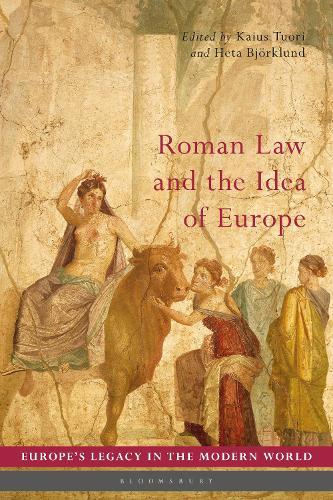
This book is available as open access through the Bloomsbury Open Access programme and is available on bloomsburycollections.com. It is funded by the European Research Council. Roman law is widely considered to be the foundation of European legal culture and an inherent source of unity within European law. Roman Law and the Idea of Europe explores the emergence of this idea of Roman law as an idealized shared heritage, tracing its origins among exiled German scholars in Britain during the Nazi regime. The book follows the spread and influence of these ideas in Europe after the war as part of the larger enthusiasm for European unity. It argues that the rise of the importance of Roman law was a reaction against the crisis of jurisprudence in the face of Nazi ideas of racial and ultranationalistic law, leading to the establishment of the idea of Europe founded on shared legal principles. With contributions from leading academics in the field as well as established younger scholars, this volume will be of immense interests to anyone studying intellectual history, legal history, political history and Roman law in the context of Europe.
Full Product Details
Author: Dr Kaius Tuori (University of Helsinki, Finland) , Dr Heta Björklund (University of Helsinki, Finland) , Bo Stråth (University of Helsinki, Finland) , Martti Koskenniemi
Publisher: Bloomsbury Publishing PLC
Imprint: Bloomsbury Academic
Weight: 0.599kg
ISBN: 9781350058736
ISBN 10: 1350058734
Pages: 304
Publication Date: 27 December 2018
Audience:
College/higher education
,
Tertiary & Higher Education
Format: Hardback
Publisher's Status: Active
Availability: Manufactured on demand 
We will order this item for you from a manufactured on demand supplier.
Table of Contents
List of Figures List of Contributors Acknowledgements Introduction: Roman Law and the Idea of Europe Kaius Tuori, University of Helsinki, Finland 1.The Impact of Exile on Law and Legal Science 1934–1964 Magdalena Kmak, University of Helsinki, Finland 2.Exiled Romanists between Traditions: Pringsheim, Schulz and Daube Kaius Tuori, University of Helsinki, Finland 3.Francis de Zulueta (1878?1958): An Oxford Roman Lawyer between Totalitarianisms Lorena Atzeri, Università degli Studi Milano, Italy 4.Autonomy and Authority: The image of the Roman Jurists in Schulz and Wieacker Jacob Giltaij, University of Helsinki, Finland 5.Roman Law after 1917: A Stateless Lawyer in Search of Byzantium Dina Gusejnova, The University of Sheffield, UK 6.The Denaturalization of Nordic Law: Germanic Law and the Reception of ‘Roman Law’ Johann Chapoutot, Institut d'Histoire du Temps Présent, France 7.The Idea of Rome: Political Fascism and Fascist (Roman) Law Cosimo Cascione, University of Naples, Italy 8.‘Byzantium!’ – Bona Fides between Rome and 20th-Century Germany Hans-Peter Haferkamp, University of Munster, Germany 9.The Arduous Path to Recover a Common European Legal Culture: Paul Koschaker, 1937?1951 Tommaso Beggio, University of Trento, Finland 10.The Weakening of Judgment: Johan Huizinga (1872?1945) and the Crisis of the Western Legal Tradition Diego Quaglioni, University of Trento, Finland 11.Roman Law as Wisdom: Justice and Truth, Honour and Disappointment in Franz Wieacker’s Ideas on Roman Law Ville Erkkilä, University of Helsinki, Finland 12.Conceptions of Roman Law in Scots Law: 1900–1960 Paul Du Plessis, University of Edinburgh, UK 13.The Search for Authenticity and Singularity in European National History Writing, 1800 to the Present Stefan Berger, Ruhr University Bochum, Germany 14.A Genealogy of Crisis: Europe’s Legal Legacy and Ordoliberalism Bo Stråth, University of Helsinki, Finland Index
Reviews
This lively and learned collection of essays on Roman law in the twentieth century deserves a wide readership. The authors bring home the profound ideological significance of Roman law in modern European history, in essays of fundamental importance for students of fascism and liberalism alike. * James Q. Whitman, Ford Foundation Professor of Comparative and Foreign Law, Yale University, USA * This excellent book explores the impact of politics and history on a generation of scholars’ interpretations of Roman law and reinterprets these scholars’ personal histories in the light of this crisis. It throws considerable light on an important episode of cultural transmission and exchange, and will be of great importance to political, intellectual, and legal historians. * John W. Cairns, Professor of Civil Law, University of Edinburgh, UK *
This lively and learned collection of essays on Roman law in the twentieth century deserves a wide readership. The authors bring home the profound ideological significance of Roman law in modern European history, in essays of fundamental importance for students of fascism and liberalism alike. * James Q. Whitman, Ford Foundation Professor of Comparative and Foreign Law, Yale University, USA * This excellent book explores the impact of politics and history on a generation of scholars' interpretations of Roman law and reinterprets these scholars' personal histories in the light of this crisis. It throws considerable light on an important episode of cultural transmission and exchange, and will be of great importance to political, intellectual, and legal historians. * John W. Cairns, Professor of Civil Law, University of Edinburgh, UK *
Author Information
Kaius Tuori is University Lecturer in European Studies at the University of Helsinki, Finland. He is the author of The Emperor of Law: The Emergence of Roman Imperial Adjudication (2016) and Lawyers and Savages: Ancient History and Legal Realism in the Making of Legal Anthropology (2014). He is also the co-editor, with Paul J du Plessis and Clifford Ando, The Oxford Handbook of Roman Law and Society (2016). Heta Björklund has a PhD in Classics from the University of Helsinki, Finland. She has previously worked as an editor at the Classical journal Arctos.
Tab Content 6
Author Website:
Countries Available
All regions
|