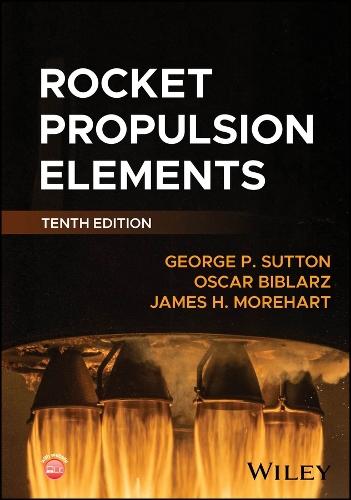
Rocket Propulsion Elements

Author:   George P. Sutton (Rocketdyne) ,  Oscar Biblarz (Naval Postgraduate School, Monterey, USA) ,  James H. Morehart (The Aerospace Corporation, California, USA)
Publisher:   John Wiley & Sons Inc
Edition:   10th edition
ISBN:  

9781394187201


Pages:   704
Publication Date:   28 March 2026
Format:   Hardback
Availability:   Awaiting stock   Availability explained


Our Price $238.95 Quantity:  
Pre-Order

Share |

Rocket Propulsion Elements


Overview

Best-selling classic text covering all major aspects of rocket propulsion, now updated to cover the latest industry trends Building on the success of the previous editions, the Tenth Edition of Rocket Propulsion Elements offers a thorough introduction to the basic principles of rocket propulsion, a description of the various components of rocket propulsion systems, and an understanding of how rocket propulsion is applied to flight vehicles. The strength of the book lies in its delivery of both theory and practical applications, covering rocket propulsion for guided missiles, space flight, and satellite flight clearly and comprehensively. This Tenth Edition includes the latest advances in the field, such as improvements in materials, systems design, applications, propellants such as chemical propellants, manufacturing technologies such as additive manufacturing, rocket-stage recovery and reuse, and new types of launch vehicles. Older system types that have fallen out of use are replaced with updated examples of systems representative of those used in the industry today. New problems are introduced in many chapters, and the book is accompanied by an online gas dynamics and two-stage flight vehicle calculator. Rocket Propulsion Elements includes information on: Liquid, solid, and hybrid chemical propulsion and electric propulsion concepts, illustrated using detailed examples Nozzle theory and thermodynamic relations, covering isentropic flow, nozzle configurations including cone- and bell-shaped nozzles, and nozzle alignment Flight performance, covering launch vehicles and satellite systems, basic relations of motion, space flight maneuvers, and flight stability Liquid propellants, covering liquid oxidizers, fuels, and monopropellants as well as safety and environmental concerns Thrust chambers, propellant feed systems, and turbomachinery, covering materials, fabrication, and heat transfer analysis Solid propellant fundamentals, properties of energetic materials, combustion stability, and construction of solid propellant rocket motors Rocket Propulsion Elements is an excellent learning resource for graduate and upper-level undergraduate students in the fields of mechanical and aerospace engineering taking courses related to rocket propulsion, spacecraft propulsion, or advanced space propulsion. The book is also useful for practicing engineers and scientists in aerospace related industries and research and development firms.

Full Product Details

Author:   George P. Sutton (Rocketdyne) ,  Oscar Biblarz (Naval Postgraduate School, Monterey, USA) ,  James H. Morehart (The Aerospace Corporation, California, USA)
Publisher:   John Wiley & Sons Inc
Imprint:   John Wiley & Sons Inc
Edition:   10th edition
Dimensions:   Width: 18.80cm , Height: 4.10cm , Length: 25.40cm
Weight:   1.134kg
ISBN:  

9781394187201


ISBN 10:   1394187203
Pages:   704
Publication Date:   28 March 2026
Audience:   Professional and scholarly ,  Professional & Vocational
Format:   Hardback
Publisher's Status:   Forthcoming
Availability:   Awaiting stock   Availability explained

Table of Contents

PREFACE TO THE 10TH EDITION xv In Memoriam George Paul Sutton (1920–2020) / xvii 1 Classification 1 1.1. Jet Propulsion / 2 1.2. Rocket Propulsion / 5 Chemical Rocket Propulsion / 5 Combinations of Air-Breathing Jet Engines and Rocket Motors / 8 Nuclear Rocket Engines / 10 Electric Rocket Propulsion (EP) / 11 Other Rocket Propulsion Concepts / 12 International Rocket Propulsion Effort / 13 1.3. Applications of Rocket Propulsion / 14 Space Launch Vehicles / 14 Spacecraft / 19 Military and Other Applications / 20 References / 23 2 Definitions and Fundamentals 25 2.1. Definitions / 25 2.2. Thrust / 29 2.3. Exhaust Velocity / 31 2.4. Energy and Efficiencies / 32 2.5. Multiple Parallel Propulsion Systems / 35 2.6. Typical Performance Values / 36 2.7. Variable Thrust / 37 Symbols / 38 Greek Letters / 39 Problems / 39 References / 41 3 Nozzle Theory and Thermodynamic Relations 42 3.1. Ideal Rocket Propulsion Systems / 42 3.2. Summary of Thermodynamic Relations / 44 3.3. Isentropic Flow Through Nozzles / 47 Velocity / 48 Nozzle Flow and Throat Condition / 52 Thrust and Thrust Coefficient / 56 Characteristic Velocity and Specific Impulse / 59 Under- and Over-expanded Nozzles / 61 Influence of Chamber Geometry / 65 3.4. Nozzle Configurations / 66 Cone- and Bell-Shaped Nozzles / 66 3.5. Real Nozzles / 73 Boundary Layers / 73 Multiphase Flow / 75 Other Phenomena and Losses / 76 Performance Correction Factors / 76 3.6. Nozzle Alignment / 81 Symbols / 82 Greek Letters / 83 Subscripts / 83 Problems / 84 References / 86 4 Flight Performance 88 4.1. Gravity-Free Drag-Free Space Flight / 88 4.2. Forces Acting on a Vehicle in the Atmosphere / 91 4.3. Basic Relations of Motion / 94 4.4. Space Flight / 100 Elliptical Orbits / 103 Deep Space / 106 Perturbations / 107 Mission Velocity / 110 4.5. Space Flight Maneuvers / 112 Reaction Control System (RCS) / 115 4.6. Effect of Propulsion System on Vehicle Performance / 117 4.7. Flight Vehicles / 119 Multistage Vehicles in Series / 120 Stage Separation / 121 Launch Vehicles / 124 4.8. Military Missiles / 127 4.9. Flight Stability / 130 Symbols / 131 Greek Letters / 132 Subscripts / 133 Problems / 133 References / 134 5 Chemical Rocket Propellant Performance Analysis 136 5.1. Background and Fundamentals / 137 5.2. Analysis of Chamber or Motor Case Conditions / 143 5.3. Analysis of Nozzle Expansion Processes / 147 5.4. Computer-Assisted Analysis / 150 5.5. Results of Thermochemical Calculations / 151 Symbols / 162 Greek Letters / 163 Subscripts / 163 Problems / 163 References / 164 6 Liquid Propellant Rocket Engine Fundamentals 165 6.1. Types of Propellants / 168 6.2. Propellant Tanks / 171 6.3. Propellant Feed Systems / 176 Local Pressures and Flows / 177 6.4. Gas Pressure Feed Systems / 178 6.5. Tank Pressurization / 183 Factors Influencing the Required Mass of Pressurizing Gas / 185 Simplified Analysis for the Mass of Pressurizing Gas / 186 6.6. Turbopump Feed Systems and Engine Cycles / 187 Engine Cycles / 188 6.7. Rocket Engines for Maneuvering, Orbit Adjustments, or Attitude Control / 196 6.8. Engine Families / 199 6.9. Valves and Pipelines / 200 6.10. Engine Support Structure / 204 Symbols / 205 Subscripts / 206 Problems / 206 References / 208 7 Liquid Propellants 210 7.1. Propellant Properties / 214 Economic Factors / 214 Performance of Propellants / 214 Common Physical Hazards / 215 Desirable Physical Properties of Propellants / 217 Ignition, Combustion, and Flame Properties / 218 Property Variations and Specifications / 219 Additives / 219 7.2. Liquid Oxidizers / 219 Liquid Oxygen (O2) (LOX) / 220 Hydrogen Peroxide (H2O2) / 221 Nitric Acid (HNO3) / 221 Nitrogen Tetroxide (N2O4 or NTO) / 222 Nitrous Oxide (N2O) / 222 Oxidizer Cleaning Process / 223 7.3. Liquid Fuels / 223 Hydrocarbon Fuels / 223 Liquid Hydrogen / 224 Hydrazine (N2H4) / 225 Unsymmetrical Dimethylhydrazine [(CH3)2NNH2] / 226 Monomethylhydrazine (CH3NHNH2) / 226 Metallic Hydrogen / 226 7.4. Liquid Monopropellants / 227 Hydrazine as a Monopropellant / 227 7.5. Gaseous Propellants / 230 7.6. Safety and Environmental Concerns / 231 Symbols / 232 Greek Letters / 232 Problems / 232 References / 234 8 Thrust Chambers 237 8.1. Injectors / 237 Injector Flow Characteristics / 246 Factors Influencing Injector Behavior / 248 8.2. Combustion Chamber and Nozzle / 250 Volume and Shape / 250 Heat Transfer Distribution / 252 Cooling of Thrust Chambers / 253 Hydraulic Losses in the Cooling Passage / 258 Thrust Chamber Wall Loads and Stresses / 259 8.3. Low-Thrust Rocket Thrust Chambers or Thrusters / 262 8.4. Materials and Fabrication / 265 Additive Manufacturing of Rocket Engine Components / 271 8.5. Heat Transfer Analysis / 272 General Steady-State Heat Transfer Relations / 272 Transient Heat Transfer Analysis / 276 Steady-State Transfer to Liquids in Cooling Channels / 278 Radiation / 281 8.6. Start-up and Ignition / 282 8.7. Useful Life of Thrust Chambers / 285 8.8. Random Variable Thrust / 286 8.9. Sample Thrust Chamber Design Analysis / 287 Symbols / 296 Greek Letters / 297 Subscripts / 297 Problems / 297 References / 300 9 Liquid Propellant Combustion and its Stability 303 9.1. Combustion Process / 303 Injection/Atomization zone / 304 Rapid Combustion Zone / 306 Streamtube Combustion Zone / 306 9.2. Analysis and Simulation / 306 9.3. Combustion Instability / 307 Rating Techniques / 313 Control of Instabilities / 314 Symbols / 317 Problems / 317 References / 318 10 Turbopumps and their Gas Supplies 320 10.1. Introduction / 320 10.2. Descriptions of Several Turbopump Assemblies / 321 10.3. Selection of Turbopump Configuration / 325 10.4. Flow, Shaft Speeds, Power, and Pressure Balances / 329 10.5. Pumps / 330 Classification and Description / 330 Pump Parameters / 331 Influence of Propellants / 336 10.6. Turbines / 338 Classification and Description / 338 Turbine Performance and Design Considerations / 340 10.7. Approach to Turbopump Preliminary Design / 341 10.8. Gas Generators and Preburners / 344 Symbols / 345 Greek Letters / 346 Subscripts / 346 Problems / 346 References / 347 11 Engine Systems, Controls, and Integration 350 11.1. Propellant Budget / 350 11.2. Performance of Complete or Multiple Rocket Propulsion Systems / 352 11.3. Engine Design / 355 11.4. Engine Controls / 361 Control of Engine Starting and Thrust Buildup / 363 Automatic Controls / 368 Control by Computer / 369 11.5. Engine System Calibration / 371 Engine Health Monitoring System / 375 11.6. System Integration and Engine Optimization / 377 Symbols / 378 Greek Letters / 378 Subscripts / 378 Problems / 378 References / 379 12 Solid-propellant Rocket Motor Fundamentals 381 12.1. Basic Relations and Propellant Burning Rate / 388 Mass Flow Relations / 390 Burning Rate Relation with Pressure / 391 Burning Rate Relation with Ambient Temperature (Tb) / 394 Variable Burning Rate Exponent n / 397 Burning Enhancement by Erosion / 398 Other Burning Rate Enhancements / 400 12.2. Other Performance Issues / 401 12.3. Propellant Grain and Grain Configuration / 405 Slivers / 412 12.4. Propellant Grain Stress and Strain / 413 Material Characterization / 414 Structural Design / 416 12.5. Attitude Control and Side Maneuvers with Solid-Propellant Rocket Motors / 422 Symbols / 423 Greek Letters / 425 Subscripts / 425 Problems / 425 References / 427 13 Solid Rocket Propellants 431 13.1. Classification / 431 13.2. Propellant Characteristics / 436 13.3. Hazards / 442 Inadvertent Ignition / 442 Aging and Useful Life / 443 Case Overpressure and Failure / 443 Detonation Versus Deflagration / 444 Hazard Classification / 444 Insensitive Munitions / 445 Upper Pressure Limit / 447 Toxicity / 447 Safety Rules / 447 13.4. Propellant Ingredients / 447 Inorganic Oxidizers / 452 Fuels / 453 Binders / 453 Burning-Rate Modifiers / 454 Plasticizers / 454 Curing Agents or Crosslinkers / 454 Energetic Binders and Plasticizers / 455 Organic Oxidizers or Explosives / 455 Additives / 456 Particle-Size Parameters / 456 13.5. Other Propellant Categories / 458 Gas Generator Propellants / 458 Smokeless or Low-Smoke Propellant / 459 Igniter Propellants / 460 13.6. Liners, Insulators, and Inhibitors / 460 13.7. Propellant Processing and Manufacture / 463 Symbols / 466 Greek Letters / 466 Problems / 466 References / 468 14 Solid Propellant Combustion and its Stability 472 14.1. Physical and Chemical Processes / 472 14.2. Ignition Process / 475 14.3. Extinction or Thrust Termination / 476 14.4. Combustion Instability / 478 Acoustic Instabilities / 478 Analytical Models and Simulation of Combustion Stability / 481 Combustion Stability Assessment, Remedy, and Design / 482 Vortex-Shedding Instability / 484 Problems / 485 References / 485 15 Solid Rocket Motor Components and Design 488 15.1. Rocket Motor Case / 488 Metal Cases / 491 Wound-Filament-Reinforced Plastic Cases / 494 15.2. Nozzles / 496 Classification / 496 Design and Construction / 498 Heat Absorption and Nozzle Materials / 502 15.3. Igniter Hardware / 507 Pyrotechnic Igniters / 508 Pyrogen Igniters / 509 Igniter Analysis and Design / 511 15.4. Rocket Motor Design Approach / 512 Symbols / 518 Greek Letters / 518 Subscripts / 518 Problems / 519 References / 520 16 Hybrid Propellants Rocket Propulsion 523 16.1. Applications and Propellants / 525 16.2. Hybrid Rocket Engine Interior Ballistics / 528 16.3. Performance Analysis and Grain Configuration / 531 Dynamic Behavior / 533 16.4. Design Example / 535 16.5. Combustion Instability / 539 Symbols / 542 Greek Letters / 543 Problems / 543 References / 544 17 Electric Propulsion 547 17.1. Ideal Flight Performance / 552 17.2. Electrothermal Thrusters / 556 Resistojets / 556 Arcjets / 558 17.3. Nonthermal Electrical Thrusters / 562 Electrostatic Devices / 562 Basic Relationships for Electrostatic Thrusters / 563 Electromagnetic Thrusters / 569 17.4. Optimum Flight Performance / 575 17.5. Mission Applications / 579 17.6. Electric Space-power Supplies and Power-conditioning Systems / 580 Power Generation Units / 581 Power-Conditioning Equipment (PCU or PPU) / 583 Symbols / 584 Greek Letters / 585 Problems / 586 References / 588 References for Table: 17–7 / 590 18 Thrust Vector Control (TVC) 591 18.1. TVC Mechanisms with a Single Nozzle / 593 18.2. TVC with Multiple Thrust Chambers or Nozzles / 601 18.3. Testing / 603 18.4. Integration with Vehicle / 605 Problems / 606 References / 606 19 Selection of Rocket Propulsion Systems 608 19.1. Selection Process / 610 19.2. Criteria for Selection / 614 19.3. Interfaces / 616 19.4. Cost Reduction / 616 19.5. Optimization Results / 618 References / 620 20 Rocket Exhaust Plumes 621 20.1. Plume Appearance and Flow Behavior / 621 Spectral Distribution of Radiation / 627 Multiple Nozzles / 630 Plume Signature / 630 Vehicle Base Geometry and Recirculation / 631 Compression and Expansion Waves / 632 20.2. Plume Effects / 633 Smoke and Vapor Trails / 633 Toxicity / 634 Noise / 634 Spacecraft Surface Contamination / 635 Radio Signal Attenuation / 636 Plume Impingement on Structures / 637 Heat Transfer to Clusters of Liquid Propellant Rocket Engines / 637 20.3. Analysis and Mathematical Simulation / 638 Problems / 638 References / 639 21 Rocket Testing 641 21.1. Types of Tests / 641 21.2. Test Facilities and Safeguards / 643 Monitoring the Environment and Controlling Toxic Materials / 646 21.3. Instrumentation and Data Management / 648 Measurement System Terminology / 649 Test Measurements / 650 Health Monitoring System (HMS) / 651 21.4. Flight Testing / 652 21.5. Postaccident Procedures / 652 Symbols / 653 References / 653 Appendix 1 Conversion Factors and Constants 655 Conversion Factors (Arranged Alphabetically) / 655 Constants / 657 Appendix 2 Properties of the Earth’s Standard Atmosphere 658 Appendix 3 Summary of Key Equations for Ideal Chemical Rockets 659 Appendix 4 Rockets Book Calculator 662 Index 665

Reviews

Author Information

GEORGE P. SUTTON was a consultant for the aerospace industry who served as Executive Director of Engineering at Rocketdyne (now L3Harris/Aerojet Rocketdyne) and as a Laboratory Associate at Lawrence Livermore National Laboratory. OSCAR BIBLARZ is a Professor Emeritus in the Department of Mechanical and Aerospace Engineering at the Naval Postgraduate School, Monterey, CA. JAMES H. MOREHART is a Senior Project Leader in the Special Programs Division of The Aerospace Corporation, El Segundo, CA.

Tab Content 6

Author Website:  

Countries Available

All regions
Latest Reading Guide

MRG 26 2


Shopping Cart
Your cart is empty
Shopping cart
Mailing List