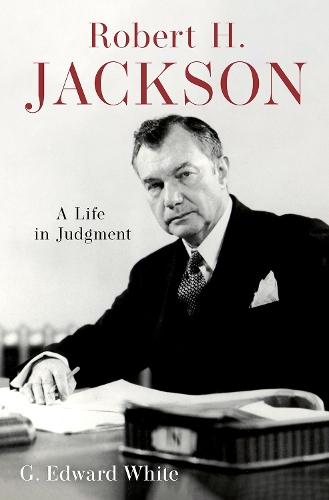
Overview
Discover the meteoric rise of one of the most extraordinary and singular figures in American jurisprudence, Robert H. Jackson, from self-trained lawyer to influential Supreme Court Justice and chief U.S. prosecutor at the Nuremberg trials, in this compelling new biography.Until he joined the U.S. government in 1934, Robert H. Jackson had been a lawyer in private practice in Upstate New York who was admitted to the bar without going to college and after completing only one year of law school. Once part of FDR's administration, Jackson became, in rapid succession, United States Solicitor General and United States Attorney General, where he successfully defended New Deal programs before the Supreme Court, including the legality of Lend Lease, which helped the U.S. give war supplies to England in exchange for grants of territory and harbors. Jackson played a central role in formulating the arguments justifying a number of initiatives on constitutional grounds and in drafting the policy statements that accompanied them. In 1941, FDR nominated him to be Associate Justice of the Supreme Court, on which he served until his death in 1954, only months after his adding his vote to the unanimous decision in Brown V. Board of Education. It was a meteoric rise for someone from outside the elite, and essentially self-trained. That didn't stop Jackson from becoming one of the most influential and independent-minded judges of his day, unafraid to question the status quo and leave his mark on a number of landmark cases, including West Virginia State Board of Education v. Barnett, which guaranteed First Amendment rights by holding that students in public schools did not have to salute the flag or recite the Pledge of Allegiance. He dissented from the notorious decision in Korematsu v. U.S., which condoned the internment of Japanese-Americans during World War Two. To many, however, Jackson's most significant contribution was as chief U.S. prosecutor at the Nuremberg war trials following the war. Drawing on Jackson's extensive personal papers in the Library of Congress and the Jackson Center, as well as a substantial oral history, G. Edward White's biography offers the first full-length portrait in decades of this fascinating and seminal figure.
Full Product Details
Author: G. Edward White (David and Mary Harrison Distinguished Professor, David and Mary Harrison Distinguished Professor, University of Virginia School of Law)
Publisher: Oxford University Press Inc
Imprint: Oxford University Press Inc
Dimensions:
Width: 16.30cm
, Height: 3.80cm
, Length: 22.60cm
Weight: 0.680kg
ISBN: 9780197778432
ISBN 10: 0197778437
Pages: 408
Publication Date: 06 January 2026
Audience:
Professional and scholarly
,
College/higher education
,
Professional & Vocational
,
Postgraduate, Research & Scholarly
Format: Hardback
Publisher's Status: Active
Availability: To order

Stock availability from the supplier is unknown. We will order it for you and ship this item to you once it is received by us.
Author Information
G. Edward White is the David and Mary Harrison Distinguished Professor at the University of Virginia School of Law and the author of twenty books and numerous articles on law and legal history, including the three-volume Law in American History and Oliver Wendell Holmes: Sage of the Supreme Court.