Overview
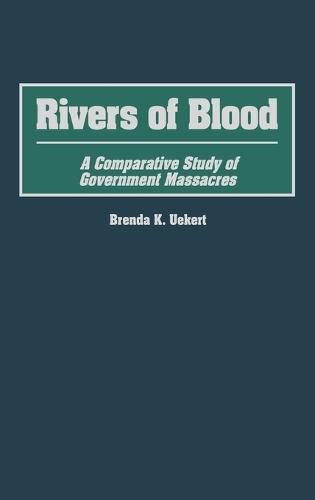
Rivers of Blood offers a glimpse into the brutal world of state terrorism. In this innovative study, the author explores the strategies, targets, and motives of terror by reviewing the conditions surrounding government massacres. By introducing an innovative typology of massacres and a classification of terror strategies, the author develops a structural approach to the study of state terror, thus challenging the viewpoint that state terrorism is a situational or reactionary phenomenon. Case studies of government massacres such as those occuring in China (Tiananmen), Iraq (Halabja), and El Salvador (San Salvador), are included. Each case study includes a discussion on the historical, political, and social climate preceding the massacre. Rivers of Blood is a welcome addition to the literature on state terrorism.
Full Product Details
Author: Brenda K. Uekert, Ph.D.
Publisher: Bloomsbury Publishing Plc
Imprint: Praeger Publishers Inc
Dimensions:
Width: 15.60cm
, Height: 1.50cm
, Length: 23.40cm
Weight: 0.534kg
ISBN: 9780275951658
ISBN 10: 0275951650
Pages: 256
Publication Date: 17 July 1995
Recommended Age: From 7 to 17 years
Audience:
College/higher education
,
General/trade
,
Professional and scholarly
,
Undergraduate
,
General
Format: Hardback
Publisher's Status: Active
Availability: Manufactured on demand

We will order this item for you from a manufactured on demand supplier.
Reviews
.,. this book systematically compares ten microlevel cases of recent massacres by the governments of China, the Soviet Union, Ethiopia, Iraq, Sudan, India, Guatemala, Peru, Columbia, and El Salvador. A theoretically soild conceptual framework is used to analyze the character of state terrorism in terms of strategies, targets, motives, and outcomes. This is a welcome addition for scholars of genocide, human rights, and ethnic conflict. Upper-division through faculty. -Choice ?...this book systematically compares ten microlevel cases of recent massacres by the governments of China, the Soviet Union, Ethiopia, Iraq, Sudan, India, Guatemala, Peru, Columbia, and El Salvador. A theoretically soild conceptual framework is used to analyze the character of state terrorism in terms of strategies, targets, motives, and outcomes. This is a welcome addition for scholars of genocide, human rights, and ethnic conflict. Upper-division through faculty.?-Choice ... this book systematically compares ten microlevel cases of recent massacres by the governments of China, the Soviet Union, Ethiopia, Iraq, Sudan, India, Guatemala, Peru, Columbia, and El Salvador. A theoretically soild conceptual framework is used to analyze the character of state terrorism in terms of strategies, targets, motives, and outcomes. This is a welcome addition for scholars of genocide, human rights, and ethnic conflict. Upper-division through faculty. -Choice
... this book systematically compares ten microlevel cases of recent massacres by the governments of China, the Soviet Union, Ethiopia, Iraq, Sudan, India, Guatemala, Peru, Columbia, and El Salvador. A theoretically soild conceptual framework is used to analyze the character of state terrorism in terms of strategies, targets, motives, and outcomes. This is a welcome addition for scholars of genocide, human rights, and ethnic conflict. Upper-division through faculty. -Choice ?...this book systematically compares ten microlevel cases of recent massacres by the governments of China, the Soviet Union, Ethiopia, Iraq, Sudan, India, Guatemala, Peru, Columbia, and El Salvador. A theoretically soild conceptual framework is used to analyze the character of state terrorism in terms of strategies, targets, motives, and outcomes. This is a welcome addition for scholars of genocide, human rights, and ethnic conflict. Upper-division through faculty.?-Choice .,. this book systematically compares ten microlevel cases of recent massacres by the governments of China, the Soviet Union, Ethiopia, Iraq, Sudan, India, Guatemala, Peru, Columbia, and El Salvador. A theoretically soild conceptual framework is used to analyze the character of state terrorism in terms of strategies, targets, motives, and outcomes. This is a welcome addition for scholars of genocide, human rights, and ethnic conflict. Upper-division through faculty. -Choice
.,. this book systematically compares ten microlevel cases of recent massacres by the governments of China, the Soviet Union, Ethiopia, Iraq, Sudan, India, Guatemala, Peru, Columbia, and El Salvador. A theoretically soild conceptual framework is used to analyze the character of state terrorism in terms of strategies, targets, motives, and outcomes. This is a welcome addition for scholars of genocide, human rights, and ethnic conflict. Upper-division through faculty. -Choice
Author Information
BRENDA K. UEKERT holds a Ph.D. in Sociology from Syracuse University. She completed her undergraduate studies at the University of Wisconsin at Eau Claire, and spent several years as a senior research analyst at the University of California. Uekert is currently an adjunct instructor at the University of Wisconsin, Green Bay.