Awards
- Winner of Global and Transnational Sociology Best Scholarly Book Award 2023 (United States)
- Winner of Humanities and Social Sciences Book 2020 (United States)
- Winner of Most Influential Books in Humanities and Social Sciences 2020 (United States)
- Winner of Sun Yun-Suan Academic Prize 2019 (United States)
Overview
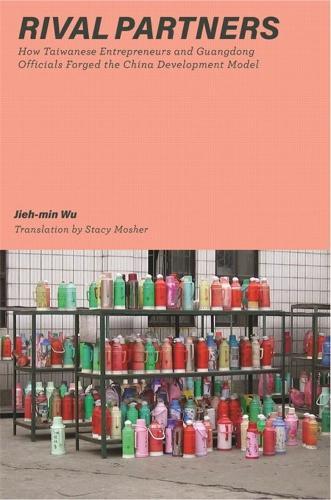
"Taiwan has been depicted as an island facing the incessant threat of forcible unification with the People's Republic of China. Why, then, has Taiwan spent more than three decades pouring capital and talent into China? In award-winning Rival Partners, Jieh-min Wu follows the development of Taiwanese enterprises in China over twenty-five years and provides fresh insights. The geopolitical shift in Asia beginning in the 1970s and the global restructuring of value chains since the 1980s created strong incentives for Taiwanese entrepreneurs to rush into China despite high political risks and insecure property rights. Taiwanese investment, in conjunction with Hong Kong capital, laid the foundation for the world's factory to flourish in the southern province of Guangdong, but official Chinese narratives play down Taiwan's vital contribution. It is hard to imagine the Guangdong model without Taiwanese investment, and, without the Guangdong model, China's rise could not have occurred. Going beyond the received wisdom of the ""China miracle"" and ""Taiwan factor,"" Wu delineates how Taiwanese businesspeople, with the cooperation of local officials, ushered global capitalism into China. By partnering with its political archrival, Taiwan has benefited enormously, while helping to cultivate an economic superpower that increasingly exerts its influence around the world."
Full Product Details
Author: Jieh-min Wu ,
Stacy Mosher ,
Elizabeth J. Perry
Publisher: Harvard University Press
Imprint: Harvard University Press
Dimensions:
Width: 15.20cm
, Height: 3.70cm
, Length: 22.90cm
Weight: 0.794kg
ISBN: 9780674278226
ISBN 10: 0674278224
Pages: 532
Publication Date: 06 December 2022
Audience:
Professional and scholarly
,
Professional & Vocational
Format: Hardback
Publisher's Status: Active
Availability: Available To Order

We have confirmation that this item is in stock with the supplier. It will be ordered in for you and dispatched immediately.
Reviews
Rival Partners is a major contribution to the study of Chinese development and global capitalism. Weaving together rich materials on Taiwanese manufacturers, local Chinese officials, and migrant labor, Wu details how China's export manufacturing model thrived and unraveled, leading to today's crisis and transformation. It is a meticulous study of the rent-seeking and developmental dual characters of the Chinese state. -- Ho-fung Hung, author of <i>The China Boom</i> Based on decades of theoretically informed and expertly crafted empirical research, this book is an intellectual feast connecting shop-floor realities and local citizenship regimes to cross-strait relations and global political economy. A rare and singularly insightful Taiwan perspective on China's rise. -- Ching Kwan Lee, author of <i>The Specter of Global China</i> and <i>Hong Kong: Global China's Restive Frontier</i> Wu has written a magnificent monograph on the collaborative construction of development between two seemingly rivaling actors: Guangdong officials and Taiwanese entrepreneurs. It points to the significance of invisible coalitions in developmental theory. -- Nan Lin, Duke University Rival Partners explores export-oriented industrialization in China as a chapter of the post-war capitalist development of Taiwan. With its sharp research question and original argument combined with solid fieldwork, meticulous analysis, and comprehensive theoretical dialogue, Rival Partners is a milestone in our understanding of China as the world factory since the 1980s. -- Gwo-shyong Shieh, Academia Sinica, Taipei, Taiwan
Author Information
Wu Jieh-min is a research fellow at the Institute of Sociology, Academia Sinica, Taiwan. Stacy Mosher is a translator and editor based in Brooklyn. Elizabeth J. Perry is Henry Rosovsky Professor of Government at Harvard University and Director of the Harvard-Yenching Institute.