Overview
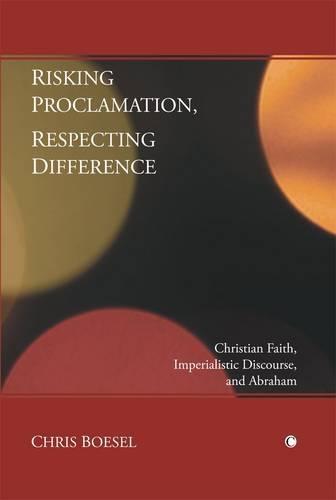
This important book poses the question of whether Christian proclamation can be made ethically safe for the Jewish neighbour. Boesel assesses two major approaches to a Christian theology of Judaism - those exemplified by Rosemary Radford Ruether and Karl Barth. This book makes a significant contribution to our understanding of systematics, ethics, and homiletics at the intersection of Jewish-Christian relations.
Full Product Details
Author: Chris Boesel
Publisher: James Clarke & Co Ltd
Imprint: James Clarke & Co Ltd
Dimensions:
Width: 15.30cm
, Height: 1.90cm
, Length: 22.90cm
Weight: 0.453kg
ISBN: 9780227173145
ISBN 10: 0227173147
Pages: 306
Publication Date: 29 April 2010
Audience:
College/higher education
,
Tertiary & Higher Education
Format: Paperback
Publisher's Status: Active
Availability: Out of stock

The supplier is temporarily out of stock of this item. It will be ordered for you on backorder and shipped when it becomes available.
Reviews
If handwringing and guilt are but sanitised forms of nihilism, indicative of loss (or, worse, an ambivalence) regarding Christian hope in resurrection of the material world, then Chris Boesel's book - a re-working of his doctoral thesis - may offer some timely and sensitive alternatives for a discipleship that is both humble and evangelical. His articulation of a solution is far from simple, but by its tone and execution Boesel does instil in the reader a sense of the vulnerability and grace required to witness to a gospel-constituted human community. Richard P Whaite, University of Notre Dame, IN, in Theological Book Review, Vol 23, No. 1, 2011
''Chris Boesel's fairly recent book undertakes a renewed contemplation of Jewish and Christian relations, meriting a serious look at the two main culprits historically responsible for Christian imperialism: anti-Judaism and supersessionism. ... This is a provocative - though perhaps, in the end, slightly traditional - claim to make, though it is one that certainly deserves its retelling in a contemporary context.'' C. Dickinson in: Louvain Journal of Theological and Canonical Studies, Vol. 88 (1), September 2012
If handwringing and guilt are but sanitised forms of nihilism, indicative of loss (or, worse, an ambivalence) regarding Christian hope in resurrection of the material world, then Chris Boesel's book - a re-working of his doctoral thesis - may offer some timely and sensitive alternatives for a discipleship that is both humble and evangelical. His articulation of a solution is far from simple, but by its tone and execution Boesel does instil in the reader a sense of the vulnerability and grace required to witness to a gospel-constituted human community. Richard P Whaite, University of Notre Dame, IN, in Theological Book Review, Vol 23, No. 1, 2011 'Chris Boesel embarks upon a creative exploration of the theological and ethical underpinnings of Christian-Jewish dialogue ... [an] engaging style and conversational approach ... This book positively wrestles with some of the complexities spoken and unspoken ... a deep engagement with Barth, Ruether, Kierkegaard and other influential thinkers, this book re-examines some of the deep held theological assumptions behind understandings of the Christian faith'. THE EXPOSITORY TIMES, VOL. 123, NO. 4, JANUARY
Author Information
Chris Boesel is Assistant Professor of Christian Theology at Drew University's Theological School and Graduate Division of Religion.