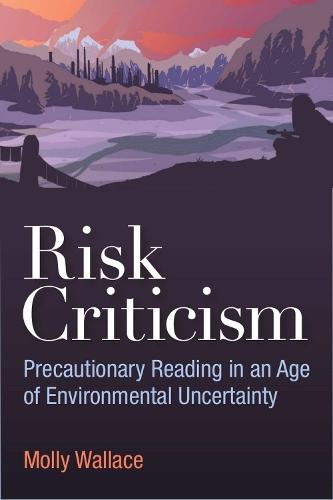
Full Product Details
Author: Molly Wallace
Publisher: The University of Michigan Press
Imprint: The University of Michigan Press
Dimensions:
Width: 15.20cm
, Height: 2.40cm
, Length: 22.90cm
Weight: 0.431kg
ISBN: 9780472053025
ISBN 10: 0472053027
Pages: 274
Publication Date: 10 May 2016
Audience:
College/higher education
,
Postgraduate, Research & Scholarly
Format: Paperback
Publisher's Status: Active
Availability: In Print

This item will be ordered in for you from one of our suppliers. Upon receipt, we will promptly dispatch it out to you. For in store availability, please contact us.
Reviews
This is an important book, one that will be of interest to students of contemporary literature and culture generally and to eco-criticism and eco-theory particularly. It is impressively steeped in eco-critical scholarship and theory, advances knowledge in the environmental humanities, and exposes readers to absorbing, intelligent discussions of a variety of texts.”—Fred Buell, Queen’s College, CUNY """"Risk Criticism makes a significant, original contribution to ecocriticism in showing how we might learn from the juxtaposition and overlap of varied types and sites of risk, including climate change, plastics, and nuclear weapons. This book is valuable in its rich archive, which encompasses canonical and emerging literary works as well as visual art, film, and other materials, and is important for providing ways to engage the unknown in present, past, and future ecological upheaval.”—Teresa Shewry, University of California, Santa Barbara """"With rare skill, Molly Wallace pulls together the imaginative, technological, ethical and political dimensions of environmental risk. Her book offers an impressive mix of conceptual innovation and grounded case studies. Risk Criticism exemplifies the environmental humanities at their eclectic best: consequential, worldly, and infused with an interdisciplinary vitality.”—Rob Nixon, Princeton University """"Here we have a careful and astute reworking of nuclear criticism—brought thoughtfully together with contemporary ecocritical work and sociological theories of risk. The great achievement of this book is that Wallace invents and performs a kind of risk criticism appropriate to life in the twenty-first century; more than fabulously textual, this risk criticism is alive to the speculative, the fictive, the imaginative and the decidedly real predicaments of our second nuclear age.”—Peter van Wyck, Concordia University
This is an important book, one that will be of interest to students of contemporary literature and culture generally and to eco-criticism and eco-theory particularly. It is impressively steeped in eco-critical scholarship and theory, advances knowledge in the environmental humanities, and exposes readers to absorbing, intelligent discussions of a variety of texts. -Fred Buell, Queen's College, CUNY Risk Criticism makes a significant, original contribution to ecocriticism in showing how we might learn from the juxtaposition and overlap of varied types and sites of risk, including climate change, plastics, and nuclear weapons. This book is valuable in its rich archive, which encompasses canonical and emerging literary works as well as visual art, film, and other materials, and is important for providing ways to engage the unknown in present, past, and future ecological upheaval. -Teresa Shewry, University of California, Santa Barbara With rare skill, Molly Wallace pulls together the imaginative, technological, ethical and political dimensions of environmental risk. Her book offers an impressive mix of conceptual innovation and grounded case studies. Risk Criticism exemplifies the environmental humanities at their eclectic best: consequential, worldly, and infused with an interdisciplinary vitality. -Rob Nixon, Princeton University Here we have a careful and astute reworking of nuclear criticism-brought thoughtfully together with contemporary ecocritical work and sociological theories of risk. The great achievement of this book is that Wallace invents and performs a kind of risk criticism appropriate to life in the twenty-first century; more than fabulously textual, this risk criticism is alive to the speculative, the fictive, the imaginative and the decidedly real predicaments of our second nuclear age. -Peter van Wyck, Concordia University
This is an important book, one that will be of interest to students of contemporary literature and culture generally and to eco-criticism and eco-theory particularly. It is impressively steeped in eco-critical scholarship and theory, advances knowledge in the environmental humanities, and exposes readers to absorbing, intelligent discussions of a variety of texts. -Fred Buell, Queen's College, CUNY Risk Criticism makes a significant, original contribution to ecocriticism in showing how we might learn from the juxtaposition and overlap of varied types and sites of risk, including climate change, plastics, and nuclear weapons. This book is valuable in its rich archive, which encompasses canonical and emerging literary works as well as visual art, film, and other materials, and is important for providing ways to engage the unknown in present, past, and future ecological upheaval. -Teresa Shewry, University of California, Santa Barbara With rare skill, Molly Wallace pulls together the imaginative, technological, ethical and political dimensions of environmental risk. Her book offers an impressive mix of conceptual innovation and grounded case studies. Risk Criticism exemplifies the environmental humanities at their eclectic best: consequential, worldly, and infused with an interdisciplinary vitality. -Rob Nixon, Princeton University Here we have a careful and astute reworking of nuclear criticism-brought thoughtfully together with contemporary ecocritical work and sociological theories of risk. The great achievement of this book is that Wallace invents and performs a kind of risk criticism appropriate to life in the twenty-first century; more than fabulously textual, this risk criticism is alive to the speculative, the fictive, the imaginative and the decidedly real predicaments of our second nuclear age. -Peter van Wyck, Concordia University
Author Information
Molly Wallace is Associate Professor of English at Queen’s University. She obtained her PhD from the University of Washington.