Overview
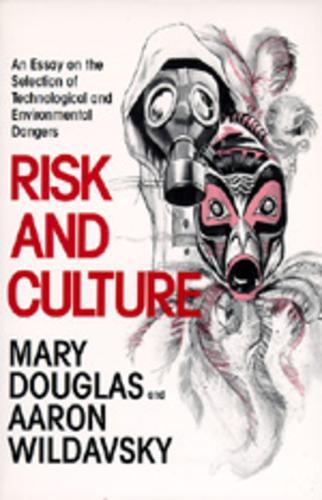
Can we know the risks we face, now or in the future? No, we cannot; but yes, we must act as if we do. Some dangers are unknown; others are known, but not by us because no one person can know everything. Most people cannot be aware of most dangers at most times. Hence, no one can calculate precisely the total risk to be faced. How, then, do people decide which risks to take and which to ignore? On what basis are certain dangers guarded against and others relegated to secondary status? This book explores how we decide what risks to take and which to ignore, both as individuals and as a culture.
Full Product Details
Author: Mary Douglas ,
Aaron Wildavsky
Publisher: University of California Press
Imprint: University of California Press
Dimensions:
Width: 14.00cm
, Height: 1.50cm
, Length: 21.00cm
Weight: 0.272kg
ISBN: 9780520050631
ISBN 10: 0520050630
Pages: 224
Publication Date: 27 October 1983
Audience:
College/higher education
,
Professional and scholarly
,
Undergraduate
,
Postgraduate, Research & Scholarly
Format: Paperback
Publisher's Status: Active
Availability: Available To Order

We have confirmation that this item is in stock with the supplier. It will be ordered in for you and dispatched immediately.
Reviews
""Offering what they call a 'cultural theory of risk perception, ' the authors suggest that peoples' complaints about hazards should never be taken at face value. One must look further to discover what forms of social organization are being defended or attacked.""--""New York Times
With flair and scholarly acumen, British anthropologist Mary Douglas (Purity and Danger) and Berkeley political scientist Aaron Wildavsky (Speaking Truth to Power) apply the yardstick of cultural bias to American society - and attack scientific objectivity, in the bargain. What is it, they ask, that Americans fear? Why have we, above all other modern societies, fostered strong environmental groups, concerned with single issues (like the building of a nuclear-power plant next door), as well as with the technological threat to planetary survival? Their answers derive from cultural analysis of nomadic groups, of isolated communities like the Hutterites or the Amish, and of contemporary American society itself. Each culture, each community, the authors aver, has its pollution beliefs, connecting certain actions to disasters (e.g., the woman's adultery causes the child to die). To deny the involvement of personal, moral, and political values is absurd. Yet in appeals to science, to risk-assessment analysis, Americans pretend that their fears are rational. Building their argument in early chapters that deal with fear, risk, and scientific disagreement, the pair then develop parallels between America today and pre-modern cultures, singling out three common ways that groups in society are structured. There is the centrist hierarchy, exemplified by a bureaucracy with stability and resistance to change. There is the individualist economic model, also centrist, that allows persons to move and compete for gain or loss in the market. And there is the sectarian border, composed of egalitarian voluntary groups united by a common doctrine - usually a transcendent religious or moral precept - critical of the center. For example, the Sierra Club tends to be hierarchical, while Friends of the Earth and the Clamshell Alliance are sectarian. Douglas & Wildavsky suggest a variety of reasons for the post-WW II growth of environmentalist groups: more college-educated affluent citizens, the increase of service jobs, the civil rights movement, mistrust after Vietnam and Watergate. And in their closing chapters, they describe the inherent inconsistency of centrist and border groups, not to mention their self-destructive qualities, should any achieve their goals. Though some of the central chapters pursue abstract arguments to the neglect of concretions, the authors' summation of issues, their argument that one should always look for the hidden rules governing a vision of the good life, and their plea for resiliency in response to risk are all sound and stimulating. Admirers of Mary Douglas' Purity and Danger will not be disappointed. (Kirkus Reviews)
Offering what they call a 'cultural theory of risk perception, ' the authors suggest that peoples' complaints about hazards should never be taken at face value. One must look further to discover what forms of social organization are being defended or attacked. -- New York Times
Author Information
Dame Mary Douglas, DBE, FBA (25 March 1921 - 16 May 2007) was a British anthropologist, known for her writings on human culture and symbolism, whose area of speciality was social anthropology. Douglas was considered a follower of Emile Durkheim and a proponent of structuralist analysis, with a strong interest in comparative religion. Aaron Wildavsky (May 31, 1930 - September 4, 1993) was an American political scientist known for his pioneering work in public policy, government budgeting, and risk management.