Overview
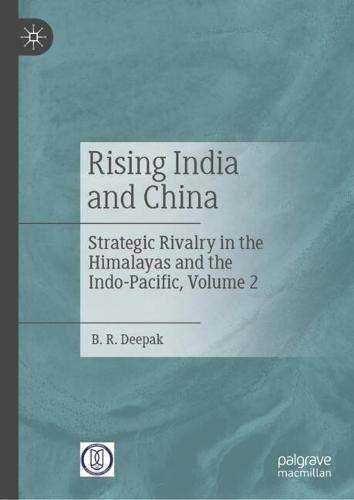
This book, part of a two-volume exploration, examines the trajectory of Sino-Indian relations, spanning from the aftermath of 1962 war in the Himalayas to the growing rivalries in the Indo-Pacific. It scrutinizes the decade-long diplomatic freeze post-1962, analysing China’s propaganda, collusion with Pakistan, and supporting insurgency in India’s northeast. It delves into the rebalancing approaches starting from Rajiv Gandhi’s pivotal 1988 China visit to finding an equilibrium with China and then losing it after three decades owing to widening asymmetries with China, resulting in the crisis of confidence building and a prolonged military standoff in the Western Sector in the aftermath of the Galwan face off. Furthermore, it explores the Indian choices for finding a new equilibrium with China navigating China’s discourse on the Indo-Pacific strategy, India’s equations with major powers, and makes enquiries into China’s military modernization and implications to India in a complex security environment influenced by internal and external factors, economic considerations, and global power dynamics. This book, part of a two-volume exploration, examines the trajectory of Sino-Indian relations, spanning from the aftermath of 1962 war in the Himalayas to the growing rivalries in the Indo-Pacific. It scrutinizes the decade-long diplomatic freeze post-1962, analysing China’s propaganda, collusion with Pakistan, and supporting insurgency in India’s northeast. It delves into the rebalancing approaches starting from Rajiv Gandhi’s pivotal 1988 China visit to finding an equilibrium with China and then losing it after three decades owing to widening asymmetries with China, resulting in the crisis of confidence building and a prolonged military standoff in the Western Sector in the aftermath of the Galwan face off. Furthermore, it explores the Indian choices for finding a new equilibrium with China navigating China’s discourse on the Indo-Pacific strategy, India’s equations with major powers, and makes enquiries into China’s military modernization and implications to India in a complex security environment influenced by internal and external factors, economic considerations, and global power dynamics.
Full Product Details
Author: B. R. Deepak
Publisher: Springer Verlag, Singapore
Imprint: Palgrave Macmillan
Edition: 2025 ed.
ISBN: 9789819792252
ISBN 10: 9819792258
Pages: 355
Publication Date: 01 April 2025
Audience:
Professional and scholarly
,
College/higher education
,
Professional & Vocational
,
Postgraduate, Research & Scholarly
Format: Hardback
Publisher's Status: Active
Availability: Manufactured on demand

We will order this item for you from a manufactured on demand supplier.
Author Information
B. R. Deepak is professor of Chinese studies at the Centre for Chinese and South East Asian Studies, Jawaharlal Nehru University, New Delhi. Some of his recent authored works include, India’s China Dilemma: The Lost Equilibrium and Widening Asymmetries and India and China: Beyond the Binary of Friendship and Enmity. He is the first Indian to have translated The Four Books of Confucianism (The Analects of Confucius, The Mencius, The Great Learning and The Mean) from Chinese to Hindi. Some of his other translations from Chinese to Hindi and English include, China and India: Dialogue of Civilizations, Ji Xianlin: A Critical Biography, and Core Values of Chinese Civilization.