Overview
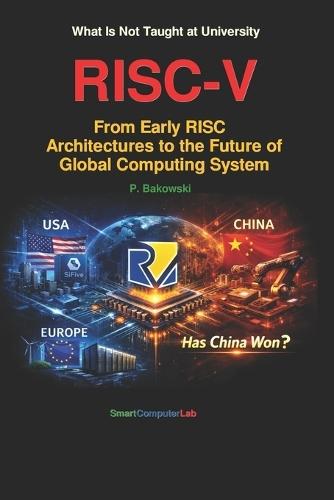
This book analyzes the evolution of reduced instruction set computing (RISC), from early academic research to the global RISC-V ecosystem. It focuses on how instruction set design, semiconductor industry structure, and geopolitical dynamics have jointly shaped modern computing platforms, with particular attention to RISC-V and China's rapid ecosystem development. RISC originated at the University of California, Berkeley (RISC-I, RISC-II) and Stanford (MIPS), introducing simplified instructions, load/store architectures, and efficient pipelining as an alternative to CISC complexity. The SPARC-MIPS divergence refined core principles such as register organization and execution efficiency, forming the basis of modern processor design. RISC concepts were later adopted in IBM POWER, SPARC, PA-RISC, and DEC Alpha, while x86 evolved internally toward RISC-like micro-operations. In parallel, Verilog, FPGA prototyping, and fabless design transformed the semiconductor industry into an IP-driven ecosystem separating design from manufacturing. Arm Holdings extended this model through a licensing-based approach that enabled companies such as Apple, Qualcomm, NVIDIA, Samsung, Huawei, and MediaTek to develop custom SoCs. Its expansion from mobile to servers strengthened ecosystem scale but increased fragmentation and software dependency. RISC-V introduces an open, royalty-free ISA governed by RISC-V International. Its modular design supports extensions for embedded systems, vector processing, and high-performance computing, with standardization efforts such as RVA23 marking ecosystem maturity. However, the global ecosystem is uneven. The United States leads in IP innovation (e.g., SiFive) but lacks large-scale productization, while Europe remains research-focused with limited industrial scaling and manufacturing capacity. In contrast, China has built a full-stack RISC-V ecosystem spanning ISA design, SoC development, hardware production, and software stacks, led by actors such as Alibaba (T-Head), StarFive, ESWIN Computing, and SpacemiT. This ecosystem covers a wide range of computing platforms from microcontrollers to server-class systems. A key driver is the tight integration of hardware availability and software maturity, including Linux support, mainline kernel integration, Ubuntu distributions, and AI software stacks. Combined with low-cost boards, this enables rapid development across AI, robotics, industrial systems, and emerging computing platforms. Regional innovation clusters in Beijing, Shanghai, Shenzhen, and Wuhan further accelerate this model by linking policy, research, and industrial capacity, enabling fast transitions from IP to mass deployment. Overall, the global RISC-V landscape reflects three trajectories: U.S. leadership in IP, European research specialization, and China's full-stack industrial integration. RISC-V thus represents a shift toward open, ecosystem-driven computing models. In conclusion, the evolution from early RISC research to RISC-V shows that computing progress depends as much on ecosystem structure as on architecture. China's rapid system-level integration positions it as a central force in shaping the future of global semiconductor and computing technologies.
Full Product Details
Author: Przemyslaw Bakowski
Publisher: Independently Published
Imprint: Independently Published
Dimensions:
Width: 15.20cm
, Height: 0.90cm
, Length: 22.90cm
Weight: 0.240kg
ISBN: 9798257503184
Pages: 174
Publication Date: 15 April 2026
Audience:
General/trade
,
General
Format: Paperback
Publisher's Status: Active
Availability: Available To Order

We have confirmation that this item is in stock with the supplier. It will be ordered in for you and dispatched immediately.