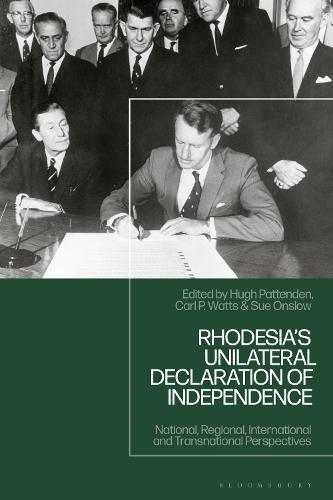
Overview
60 years on from Rhodesia’s Unilateral Declaration of Independence in 1965, this book brings together many important themes to examine its consequences and offer the most comprehensive overview to date. Situating the UDI in its local, regional, international and transnational context, this collection offers a range of historical approaches; political, economic, social, cultural, international and transnational, to provide a richer and deeper understanding of the emergence of contemporary Zimbabwe. Based on an array of rich archival and oral history sources, this book brings together new ways of understanding the multiple and complex dimensions of Rhodesia’s UDI and highlights its importance to wider African and World history.
Full Product Details
Author: Hugh Pattenden (University of Southampton, UK) , Carl P. Watts (Global College of Professional Military Education, USA) , Sue Onslow (Kings College London, UK)
Publisher: Bloomsbury Publishing PLC
Imprint: Bloomsbury Academic
Dimensions:
Width: 15.00cm
, Height: 2.20cm
, Length: 23.60cm
Weight: 0.620kg
ISBN: 9781350476998
ISBN 10: 1350476994
Pages: 320
Publication Date: 13 November 2025
Audience:
Professional and scholarly
,
College/higher education
,
Professional & Vocational
,
Postgraduate, Research & Scholarly
Format: Hardback
Publisher's Status: Active
Availability: Manufactured on demand 
We will order this item for you from a manufactured on demand supplier.
Table of Contents
Introduction, Sue Onslow, Hugh Pattenden, and Carl P. Watts (King’s College London, UK, University of Southampton, UK and Global College of Professional Military Education, USA) Part I: Rhodesia and the UDI 1. The Origins of Rhodesia’s Unilateral Declaration of Independence, Alois Mlambo (University of Pretoria, South Africa) 2. African Nationalists and Rhodesia’s UDI, Eliakim M. Sibanda (University of Winnipeg, Canada) 3. The military history of the war for Zimbabwe, M. T. Howard (Independent Scholar) 4. Security anxieties and white civilian life during the Rhodesian Guerrilla War, 1970-1979, Josiah Brownell (Pratt Institute New York, USA) 5. The Legacy of the UDI, Stephen Chan (School of Oriental and African Studies, University of London, UK) Part II: Regional Responses to the UDI 6. Zambia and the UDI, Andy DeRoche (Front Range Community College, USA) 7. South Africa and the UDI, Chris Saunders and Sue Onslow (University of Cape Town, South Africa, and King’s College London, UK) 8. Portuguese Africa and Rhodesia, 1965-1975, Filipe Ribeiro de Meneses and Robert McNamara (Maynooth University, USA and University of Ulster, UK) 9. The impact of cross-border raids on the Frontline States, Rhodesia, and Patriotic Front negotiations, 1976-1979, Timothy Scarnecchia (Kent State University, USA) Part III: International Responses to the UDI 10. Britain and the UDI, Hugh Pattenden (University of Southampton, UK) 11. The Commonwealth and Rhodesia’s UDI, Carl P. Watts (Global College of Professional Military Education, USA) 12. U.S. Policy towards Rhodesia, 1965-1979, Eddie Michel (University of Pretoria, South Africa) 13. The Soviet Union and its Allies vs Rhodesia, Vladimir Shubin (Institute for African Studies, Russian Academy of Sciences). 14. Britain, Rhodesia and the Lancaster House Settlement, Sue Onslow (King’s College London, UK) Part IV: Transnational Perspectives on the UDI 15. Sanctions, Sanction-Busting, and the Rhodesian Independence Crisis, 1965-1980, Chris Dietrich (Fordham University, USA) 16. International Sports Boycotts as a Response to the UDI, 1965-1980, Charles Little (St. Mary’s University, UK) 17. Forging Transnational White Solidarity in Support of the UDI, R. Joseph Parrott (The Ohio State University, USA) 18. The British Anti-Apartheid Movement and the UDI, Jean Smith (King’s College London, UK) 19. Pan-African Responses to the UDI,” by Matteo Grilli (University of Padova, Italy) 20. Race and Gendered Memories in the Time of the UDI, Ruramisai Charumbira (Western University, Canada)
Reviews
All too often the story of how Rhodesia became Zimbabwe is told as a struggle in one country that ends in majority rule. This collection contests that with a multi-sited history in which no single nation’s aspirations or actions stand alone but are in vigorous dialogue with the decolonizing world. * Luise White, Professor Emerita, University of Florida, USA * The aftershocks of Rhodesia’s ill-fated unilateral declaration of independence continue to shape political dynamics in Zimbabwe, southern Africa, and the West. The dynamic accounts presented here enrich our understanding of the complex geopolitical dimensions through which Rhodesia's traumatic resistance against decolonization unfolded in the 1960s and 70s. * Brooks Marmon, Research Associate, University of Pretoria, South Africa *
All too often the story of how Rhodesia became Zimbabwe is told as a struggle in one country that ends in majority rule. This collection contests that with a multi-sited history in which no single nation’s aspirations or actions stand alone but are in vigorous dialogue with the decolonizing world. * Luise White, Professor Emerita, University of Florida, USA *
Author Information
Hugh Pattenden is a Visiting Academic at the Centre for Imperial and Postcolonial Studies at the University of Southampton, an IHR Fellow at the Institute of Historical Research in the University of London, and a Fellow of the Royal Historical Society. His research on UDI has appeared in a range of journals, including the International History Review, the Journal of Contemporary History, the Journal of Imperial and Commonwealth History, and War in History. Carl P. Watts is an Associate Professor of National Security Studies at Air University, Global College of Professional Military Education, USA, and a Fellow of the Royal Historical Society. His research on UDI has been published in many journals and he is also the author of Rhodesia’s Unilateral Declaration of Independence: An International History (2012). Sue Onslow is a Visiting Professor in the Department of Political Economy at King’s College London, UK, and a Fellow of the Royal Historical Society. A leading historian of Rhodesia’s UDI, she has published extensively on Southern Africa in the Cold War era including books and in journals such as Britain and the World, Cold War History, The South African Historical Journal, The Journal of Southern African Studies, The Round Table: The Commonwealth Journal of International Affairs, and The International History Review.
Tab Content 6
Author Website:
Countries Available
All regions
|