Overview
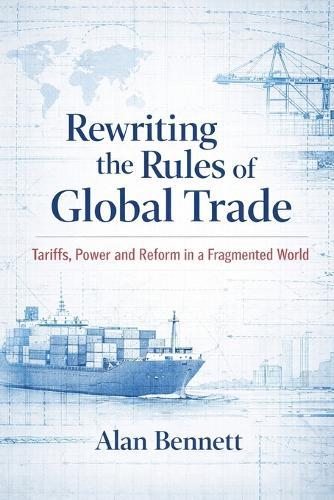
The rules of global trade were built for a world that no longer exists. For decades, the postwar trading system was treated as a relatively stable legal and institutional framework capable of supporting expanding commerce, deeper interdependence, and a broadly shared commitment to liberalisation. That confidence has now weakened. Trade policy is no longer shaped primarily by the assumptions that governed the high period of economic openness. It is increasingly shaped by strategic rivalry, national security, industrial policy, technological competition, supply chain vulnerability, and the reassertion of state power. In Rewriting the Rules of Global Trade, Alan Bennett argues that the modern trading system has entered a period of fragmentation and structural strain. The legal architecture developed around the General Agreement on Tariffs and Trade and later the World Trade Organization was designed for a different economic and political era. It was not built for a world in which tariffs are once again instruments of leverage, in which subsidies are used to shape strategic industries, in which semiconductors and rare earths carry geopolitical significance, and in which governments increasingly prioritise resilience, capability, and economic security alongside market access. This book explains how that transformation occurred and why it matters. It examines the weakening of the liberal consensus that once underpinned the trading order, the return of tariffs as practical policy tools, the growing role of industrial policy, the expanded use of non-tariff barriers, the strategic misuse of market power, and the institutional crisis facing the WTO. It also considers the rise of regional trade agreements, the limits of free trade agreements, the strategic importance of critical minerals and advanced technology, and the breakdown of effective dispute settlement. But this is not merely a diagnosis of decline. The book is also a constructive argument for reform. Bennett moves beyond critique to ask what a more credible and durable framework of trade governance might require in the contemporary world. He proposes foundational principles for a new trade framework and develops practical ideas for reforming tariff governance, subsidy regulation, the treatment of non-tariff barriers, and the institutional architecture of international commerce itself. Written by an Australian lawyer, author, and former Adjunct Professor of Law at the University of Sydney, with decades of professional experience in international trade law and legislative drafting, this book combines legal analysis with practical insight. It is designed for lawyers, policy professionals, business readers, students, and general readers seeking a clear and serious account of why global trade governance is under pressure and what may need to replace the assumptions of the past. At its heart, this book makes a simple but urgent argument: international commerce still requires law, but that law will retain authority only if it is anchored in present realities rather than inherited assumptions. In a world increasingly shaped by power, strategy, security, and technological competition, the rules of global trade must be rewritten.
Full Product Details
Author: Alan Bennett
Publisher: Independently Published
Imprint: Independently Published
Dimensions:
Width: 15.20cm
, Height: 1.90cm
, Length: 22.90cm
Weight: 0.481kg
ISBN: 9798251761870
Pages: 360
Publication Date: 12 March 2026
Audience:
General/trade
,
General
Format: Paperback
Publisher's Status: Active
Availability: Available To Order

We have confirmation that this item is in stock with the supplier. It will be ordered in for you and dispatched immediately.