Overview
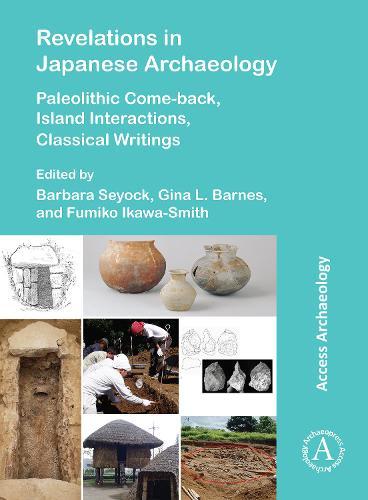
Revelations in Japanese Archaeology presents a selection of articles from the BSEAA (Bulletin of the Society for East Asian Archaeology). All articles represent important research questions that have retained their relevance to the present day. Many have been updated for inclusion in this volume. Especially important are the chapters on the Japanese Paleolithic, with data presented in Part I to counter the devastating impact of the ‘Paleolithic Hoax’ uncovered in 2000. These are crucial to re-evaluating the peopling of the Japanese Islands in the Pleistocene and the relationships with continental finds. Part II focuses on the protohistoric periods of Yayoi and Kofun in Japan, with an additional perspective on adjacent regions and intercultural relations in the macro-region during the Iron Age. Unlike mainstream treatments, these articles tend to deal with peripheral regions that are important as cultural transmitters between islands and between island and mainland. They provide different perspectives on the development of dominant subsistence practices and centralized societies. Part III returns to the beginnings of Japanese archaeology, with a history as deep as that in Britain, by elucidating the work of Edward S. Morse. The editors are leaders in the field of Japanese Archaeology, covering periods from the Palaeolithic (Ikawa-Smith), Yayoi (Seyock), and Kofun (Barnes). They have been seminal in the development of the Society for East Asian Archaeology (SEAA), which aims at the dissemination of research in East Asian languages to the English-speaking world. The Society was founded by Barnes, who served together with Ikawa-Smith as Presidents, while Seyock initiated the Bulletin of Society for East Asian Archaeology (BSEAA) and served as Editor. Ikawa-Smith and Barnes are both Professor Emeritae after long careers teaching at their respective universities, while Seyock is an Independent Researcher who has worked closely with archaeologists in Japan throughout her career.
Full Product Details
Author: Barbara Seyock (Independent Researcher, Ruhr-University Bochum) ,
Gina L. Barnes (Professor Emeritus of Japanese Studies, Durham University) ,
Fumiko Ikawa-Smith (Professor emrita, Anthropology, McGill University, Montreal, Canada)
Publisher: Archaeopress
Imprint: Archaeopress Access Archaeology
Dimensions:
Width: 20.30cm
, Height: 1.20cm
, Length: 27.60cm
Weight: 1.381kg
ISBN: 9781803279855
ISBN 10: 1803279850
Pages: 262
Publication Date: 03 April 2025
Audience:
Professional and scholarly
,
Professional & Vocational
Format: Paperback
Publisher's Status: Active
Availability: Manufactured on demand

We will order this item for you from a manufactured on demand supplier.
Author Information
Barbara Seyock is a specialist in trade and exchange in prehistoric and historical East Asia. She received her doctorate in 2003 from the University of Tübingen on the archaeology and history of the ""Eastern Barbarians"" (proto-historical cultures in Korea and Japan). Her research focuses on early cultural transfer around the Korea Strait as well as trade and maritime exchange in pre-modern times in East and Southeast Asia.She has lectured on East Asian archaeology at the Dept. of Archaeology, Ruhr-University of Bochum and was a member of the VW-Project on “the East Asian Mediterranean” at Munich University. Gina L. Barnes, PhD Michigan 1983. Taught East Asian Archaeology at Cambridge University 1981-1995 and at Durham University 1996-2006. She founded the East Asian Archaeology Network in 1990, which became the Society for East Asian Archaeology in 1996, serving as the first President (1996-1998). Her publications include State Formation in Korea (Routledge 2001), State Formation in Japan (2006), East Asian Archaeology (Routledge, 2015), TephroArchaeology (ed. with SODA Tsutomu, Archaeopress 2019), and Tectonic Archaeology (Archaeopress 2022). Born in Japan, Fumiko Ikawa-Smith began her study of Anthropology in the USA as a Fulbright exchange student at Harvard University. She received doctorate in 1974 with a dissertation on the Early Palaeolithic cultures of Japan. It has remained the focus of her research interest, as she explored such topics as food and nutrition, gender in prehistory, and social contexts of archaeology. She is a co-founder of the Japan Studies Association of Canada, and served as its President three times.