Overview
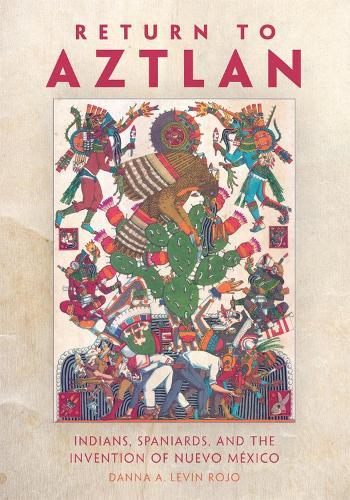
Long before the Spanish colonizers established it in 1598, the """"Kingdom of Nuevo México"""" had existed as an imaginary world - and not the one based on European medieval legend so often said to have driven the Spaniards' ambitions in the New World. What the conquistadors sought in the 1500s, it seems, was what the native Mesoamerican Indians who took part in north-going conquest expeditions also sought: a return to the Aztecs' mythic land of origin, Aztlan. Employing long-overlooked historical and anthropological evidence, Danna A. Levin Rojo reveals how ideas these natives held about their own past helped determine where Spanish explorers would go and what they would conquer in the northwest frontier of New Spain - present-day New Mexico and Arizona. Return to Aztlan thus remaps an extraordinary century during which, for the first time, Western minds were seduced by Native American historical memories. Levin Rojo recounts a transformation - of an abstract geographic space, the imaginary world of Aztlan, into a concrete sociopolitical place. Drawing on a wide variety of early maps, colonial chronicles, soldier reports, letters, and native codices, she charts the gradual redefinition of native and Spanish cultural identity - and shows that the Spanish saw in Nahua, or Aztec, civilization an equivalence to their own. A deviation in European colonial naming practices provides the first clue that a transformation of Aztlan from imaginary to concrete world was taking place: Nuevo México is the only place-name from the early colonial period in which Europeans combined the adjective """"new"""" with an American Indian name. With this toponym, Spaniards referenced both Mexico-Tenochtitlan, the indigenous metropolis whose destruction made possible the birth of New Spain itself, and Aztlan, the ancient Mexicans' place of origin. Levin Rojo collects additional clues as she systematically documents why and how Spaniards would take up native origin stories and make a return to Aztlan their own goal - and in doing so, overturns the traditional understanding of Nuevo México as a concept and as a territory. A book in the Latin American and Caribbean Arts and Culture initiative, supported by the Andrew W. Mellon Foundation.
Full Product Details
Author: Danna A. Levin Rojo
Publisher: University of Oklahoma Press
Imprint: University of Oklahoma Press
Dimensions:
Width: 17.70cm
, Height: 2.70cm
, Length: 25.40cm
Weight: 0.885kg
ISBN: 9780806144344
ISBN 10: 0806144343
Pages: 320
Publication Date: 30 March 2014
Audience:
Professional and scholarly
,
Professional & Vocational
Format: Hardback
Publisher's Status: Active
Availability: Temporarily unavailable

The supplier advises that this item is temporarily unavailable. It will be ordered for you and placed on backorder. Once it does come back in stock, we will ship it out to you.
Reviews
In this innovative reading of a familiar story, Danna A. Levin Rojo challenges scholarly and popular traditions that attribute the Spaniards sixteenth-century search for Nuevo Mexico to European medieval legends of the Seven Cities of Cibola. Instead, she demonstrates the pervasive influence that Mesoamerican historical memories of Aztlan, and the notion of returning to a place of origin, had on the European invaders. This book contributes to the literature on early colonial ethnohistory and will raise new questions in the field of U.S.-Mexico borderlands studies. Cynthia Radding, author of Wandering Peoples: Colonialism, Ethnic Spaces, and Ecological Frontiers in Northwestern Mexico, 1700 1850 In this innovative reading of a familiar story, Danna A. Levin Rojo challenges scholarly and popular traditions that attribute the Spaniards' sixteenth-century search for Nuevo Mexico to European medieval legends of the Seven Cities of Cibola. Instead, she demonstrates the pervasive influence that Mesoamerican historical memories of Aztlan, and the notion of returning to a place of origin, had on the European invaders. This book contributes to the literature on early colonial ethnohistory and will raise new questions in the field of U.S.-Mexico borderlands studies. --Cynthia Radding, author of Wandering Peoples: Colonialism, Ethnic Spaces, and Ecological Frontiers in Northwestern Mexico, 1700-1850 -In this innovative reading of a familiar story, Danna A. Levin Rojo challenges scholarly and popular traditions that attribute the Spaniards' sixteenth-century search for Nuevo Mexico to European medieval legends of the Seven Cities of Cibola. Instead, she demonstrates the pervasive influence that Mesoamerican historical memories of Aztlan, and the notion of returning to a place of origin, had on the European invaders. This book contributes to the literature on early colonial ethnohistory and will raise new questions in the field of U.S.-Mexico borderlands studies.---Cynthia Radding, author of Wandering Peoples: Colonialism, Ethnic Spaces, and Ecological Frontiers in Northwestern Mexico, 1700-1850
In this innovative reading of a familiar story, Danna A. Levin Rojo challenges scholarly and popular traditions that attribute the Spaniards' sixteenth-century search for Nuevo MExico to European medieval legends of the Seven Cities of CIbola. Instead, she demonstrates the pervasive influence that Mesoamerican historical memories of Aztlan, and the notion of returning to a place of origin, had on the European invaders. This book contributes to the literature on early colonial ethnohistory and will raise new questions in the field of U.S.-Mexico borderlands studies. --Cynthia Radding, author of Wandering Peoples: Colonialism, Ethnic Spaces, and Ecological Frontiers in Northwestern Mexico, 1700-1850
In this innovative reading of a familiar story, Danna A. Levin Rojo challenges scholarly and popular traditions that attribute the Spaniards' sixteenth-century search for Nuevo Mexico to European medieval legends of the Seven Cities of Cibola. Instead, she demonstrates the pervasive influence that Mesoamerican historical memories of Aztlan, and the notion of returning to a place of origin, had on the European invaders. This book contributes to the literature on early colonial ethnohistory and will raise new questions in the field of U.S.-Mexico borderlands studies. --Cynthia Radding, author of Wandering Peoples: Colonialism, Ethnic Spaces, and Ecological Frontiers in Northwestern Mexico, 1700-1850
In this innovative reading of a familiar story, Danna A. Levin Rojo challenges scholarly and popular traditions that attribute the Spaniards sixteenth-century search for Nuevo Mexico to European medieval legends of the Seven Cities of Cibola. Instead, she demonstrates the pervasive influence that Mesoamerican historical memories of Aztlan, and the notion of returning to a place of origin, had on the European invaders. This book contributes to the literature on early colonial ethnohistory and will raise new questions in the field of U.S.-Mexico borderlands studies. Cynthia Radding, author of Wandering Peoples: Colonialism, Ethnic Spaces, and Ecological Frontiers in Northwestern Mexico, 1700 1850
Author Information
Danna A. Levin Rojo is Professor of Mexican Historiography at the Universidad Autónoma Metropolitana in Azcapotzalco, Mexico City, and co-editor of The Disputed Territory in the War of 1846-1848.