Full Product Details
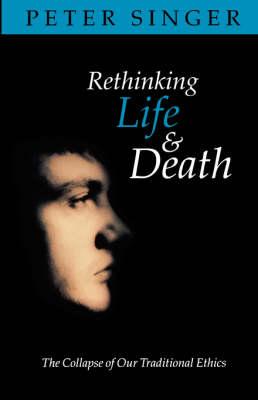
Author: Peter Singer
Publisher: Oxford University Press
Imprint: Oxford University Press
Dimensions:
Width: 12.80cm
, Height: 1.80cm
, Length: 19.70cm
Weight: 0.282kg
ISBN: 9780192861849
ISBN 10: 0192861840
Pages: 268
Publication Date: 01 September 1995
Audience:
College/higher education
,
Tertiary & Higher Education
Format: Paperback
Publisher's Status: Active
Availability: Manufactured on demand

We will order this item for you from a manufactured on demand supplier.
Reviews
Brilliantly debunks old concepts and introduces honesty to modern medical ethics. Derek Humphrey, author of Final Exit
`With the philosopher's commendable lack of concern for the impact of his ideas, Peter Singer has written a wonderfully provoking book.' Dr Brice Avery, Catholic Herald `a work that promises to be deeply controversial and even shocking and, in part, it certainly is' Times Higher
The doctrine of the sanctity of human life is in deep trouble, claims Australian philospher Singer (The Expanding Circle: Ethics and Sociobiology, 1981, etc.), who gives his own clear ideas of what should replace it in this decidedly provocative work. With crisp, dramatic tales involving brain-dead bodies, anencephalic infants, people in persistent vegetative states or with agonizing terminal illnesses, and other now-familiar hospital scenarios, Singer asserts that modern medical practice has become incompatible with a belief in the equal value of all human life. He argues that the ethical problems such situations pose would be simplified if we would only abandon our outdated thinking about life and death. He presents five commandments of what he calls the old ethic and suggests how they might be rewritten. In his scheme, the first, Treat all human life as of equal worth, becomes Recognize that the worth of human life varies ; the second, Never intentionally take innocent human life, becomes Take responsibility for the consequences of your actions. The third and fourth express Singer's views that people have the right to end their own lives and that unwanted children should not be brought into the world. All of these will trigger outrage in various quarters, but perhaps most provocative is his fifth revision: Treat all human life as always more precious than any nonhuman life becomes Do not discriminate on the basis of species. A founder of the Animal Rights Movement, Singer argues that the right to life properly belongs not to Homo sapiens but to persons, by which he means those beings that possess self-awareness. In this view, an embryo or someone in an irreversible coma is clearly not a person, but a gorilla or a baboon is. Singer can't quite figure out how to regard newborn humans, but he gives infanticide a serious look before backing off. By going to the very core of our beliefs about life, Singer has created just about as controversial a book as possible. (Kirkus Reviews)
Brilliantly debunks old concepts and introduces honesty to modern medical ethics. * Derek Humphrey, author of Final Exit *
Author Information
Peter Singer is Professor of Philosophy and Deputy Director of the Centre for Human Bioethics at Monash University, Melbourne. He is the author of the Oxford Reader on Ethics, and Applied Ethics in the Oxford Readings in Philosophy. He is best-known for his books Animal Liberation, and The Way We Live Now.