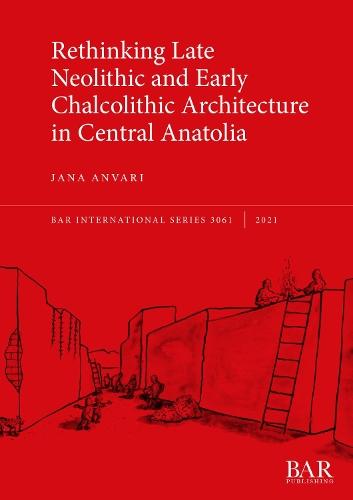
Rethinking Late Neolithic and Early Chalcolithic Architecture in Central Anatolia

Author:   Jana Anvari
Publisher:   BAR Publishing
ISBN:  

9781407357713


Pages:   360
Publication Date:   30 November 2021
Format:   Paperback
Availability:   Available To Order   Availability explained
We have confirmation that this item is in stock with the supplier. It will be ordered in for you and dispatched immediately.

Our Price $196.65 Quantity:  
Add to Cart

Share |

Rethinking Late Neolithic and Early Chalcolithic Architecture in Central Anatolia


Overview

This book evaluates the epistemology by which archaeology has translated the architectural record at Late Neolithic and Early Chalcolithic (6500-5500 BC) sites in central Anatolia into interpretations of social organisation. The first part of the book provides a summary of existing knowledge on the study region, architecture in particular. The second part conducts a content analysis of 284 publications and systematically maps and critiques the archaeological discourse around Late Neolithic and Early Chalcolithic architecture and social organisation. As a by-product of this discussion, the book also provides an exploration of how people in central Anatolia during this period used architecture to create communities. In the tradition of reflexive archaeology, the main purpose of this book is to critically evaluate past research practices to contribute to their improvement. It seeks to improve the research tools to understand the Late Neolithic and Early Chalcolithic as important transformative time periods in Anatolian prehistory that influenced the further course of southwest Asian and European prehistory, for example by initiating development towards social stratification.

Full Product Details

Author:   Jana Anvari
Publisher:   BAR Publishing
Imprint:   BAR Publishing
Weight:   1.436kg
ISBN:  

9781407357713


ISBN 10:   1407357719
Pages:   360
Publication Date:   30 November 2021
Audience:   Professional and scholarly ,  Professional & Vocational
Format:   Paperback
Publisher's Status:   Active
Availability:   Available To Order   Availability explained
We have confirmation that this item is in stock with the supplier. It will be ordered in for you and dispatched immediately.

Table of Contents

List of Figures List of Tables List of Abbreviations Abstract 1. Rethinking 60 years of Architectural Epistemology 1.1. Purpose of this book 1.2. Chapter outline 2. Theoretical Foundations 2.1. Archaeological reflexivity 2.2. A contextual approach 3. Time and Place 3.1. Place: Geographical scop 3.2. Time 3.2.1. Periodisation 3.2.2. Defining the temporal scope 3.2.3. Site chronologies 4. A Brief History of Neolithic and Early Chalcolithic Research in Central Anatolia 4.1. Ignorance (pre-1960) 4.2. Pioneering field work (1950s-1960s) 4.3. Consolidation, reflection, publication (1970s) 4.4. Re-intensification and broadening of field work (since the 1980s) 4.5. Renewed reflection (2000s-2010s), the current state of research and a reflection on the research literature landscape 4.6. Dealing with legacy: existing research on Neolithic and Early Chalcolithic architecture in central Anatolia 4.6.1. The architectural record as legacy data 4.6.2. Previous comparative works on Neolithic and Early Chalcolithic architecture 5. Sites and Architecture in Late Neolithic and Early Chalcolithic Central Anatolia 5.1. Hacilar 5.1.1. The chronology of Hacilar 5.1.2. The architecture of Aceramic Hacilar 5.1.3. The architecture of Hacilar Level VI with Levels IX-VII 5.1.4. The architecture of Hacilar Levels V-III 5.1.5. The architecture of Hacilar Level II 5.1.6. The architecture of Hacilar Level I 5.2. Çatalhöyük East 5.2.1. The chronology of Çatalhöyük East 5.2.2. The architecture of Çatalhöyük East 5.3. Çatalhöyük West 5.3.1. The chronology of Çatalhöyük West 5.3.2. The architecture of Çatalhöyük West 5.4. Canhasan I 5.4.1. The chronology of Canhasan I 5.4.2. The architecture of Canhasan I Layer 2 5.5. Erbaba 5.5.1. The chronology of Erbaba 5.5.2. The architecture of Erbaba Level I 5.6. Kuruçay 5.6.1. The chronology of Kuruçay 5.6.2. The architecture of Kuruçay 5.7. Kösk Höyük 5.7.1. The chronology of Kösk Höyük 5.7.2. The architecture of Kösk Höyük 5.8. Höyücek 5.8.1. The chronology of Höyücek 5.8.2. The architecture of the Höyücek Shrine Phase 5.9. Gelveri 5.9.1. The chronology of Gelveri 5.9.2. The architecture of Gelveri 5.10. Bademagaci 5.10.1. The chronology of Bademagaci 5.10.2. The architecture of Bademagaci 5.11. Pinarbasi B 5.11.1. The chronology of Pinarbasi B 5.11.2. The architecture of Pinarbasi B 5.12. Musular 5.12.1. The chronology of Musular 5.12.2. The architecture of Early Chalcolithic Musular 5.13. Tepecik-Çiftlik 5.13.1. The chronology of Tepecik 5.13.2. The architecture of Tepecik Levels 4-2 5.14. Gökhöyük Baglari 6. Social Organisation in Central Anatolia 8500-2000 BC 6.1. Introduction 6.2. 8500-6500 BC: The Early Neolithic in the Konya plain and Cappadocia and hunter-gatherers of the Lake District 6.2.1. Research framework 6.2.2. The neolithisation of central Anatolia 6.2.3. Making households, making communities 6.2.4. Egalitarianism 6.3. 6500-5500 BC: The Late Neolithic and Early Chalcolithic 6.3.1. The neolithisation of the Lake District and western Anatolia 6.3.2. Climate change and a possible influence on socioeconomic changes 6.3.3. Household autonomy and social competition 6.3.4. Mobility, dispersal and the development of dense cultural landscapes 6.3.5. Warfare? 6.4. 5500-4000 BC: The Middle Chalcolithic 6.4.1. Absence of evidence or evidence of absence? 6.4.2. Middle Chalcolithic mobility? 6.4.3. Cappadocian villagers, pastoralists and chiefs 6.5. 4000-3000 BC: The Late Chalcolithic 6.5.1. Late Chalcolithic: regional perspectives 6.5.2. Early urban centres in the Lake District? 6.6. 3000-2000 BC: The Early Bronze Age 6.6.1. Research framework 6.6.2. Early Bronze Age cultural landscapes 6.6.3. Early Bronze Age elite-making 7. Methods 7.1. Text as data: content analysis 7.1.1. Content analysis 7.1.2. Grounded theory and applying content analysis in reflexive archaeology 7.2. Defining a body of literature to code 7.3. Coding indicators and themes 7.3.1. Identifying relevant text passages 7.3.2. Coding indicators and themes 7.3.3. Exploratory coding 7.3.4. Including and excluding text passages from coding 7.3.5. Challenges encountered 7.3.6. Limitations 7.4. Exploring and evaluating indicators and themes 8. Household Autonomy and Suprahousehold Integration 8.1. Introduction 8.2. Early Neolithic household autonomy 8.2.1. Theme 1: The complete house 8.2.2. Theme 2: Constructing individualities 8.2.3. Theme 3: Symbols of the household 8.2.4. Theme 4: Leaving and continuing the house 8.3. Suprahousehold integration 8.3.1. Theme 9: Living close together 8.3.2. Theme 10: A paradox of division and cohesion 8.3.3. Theme 11: Building and destroying together 8.3.4. Theme 12: Constructing similarities 8.3.5. Theme 13: Sharing social and economic space 8.3.6. Theme 14: Symbols of community 8.3.7. Theme 15: On common ground 8.3.8. Theme 16: Constructing community space 8.4. Post-6500 BC house

Reviews

This is an enormous synthesis of the prehistory of the Central Anatolian region. Anvaris work and approach celebrate the complexities of archaeological knowledge production, which is influenced not only by the nature of the archaeological record but historical contingencies and personal interests.' Dr Burcu Tung, University of California, Berkeley For anyone interested in the emergence of social complexity in prehistoric Anatolia and how this can be studied in innovative and systematic ways - this book is an essential read. It covers key sites dating to the late Neolithic and early Chalcolithic and analyses how buildings and settlements have been used to understand (changes in) prehistoric societies, using the method of content analysis. This book is an important resource for the study of social complexity in Anatolia and beyond. Dr Bleda S. D'fcring, Leiden University


'This is an enormous synthesis of the prehistory of the Central Anatolian region. Anvari's work and approach celebrate the complexities of archaeological knowledge production, which is influenced not only by the nature of the archaeological record but historical contingencies and personal interests.' Dr Burcu Tung, University of California, Berkeley 'For anyone interested in the emergence of social complexity in prehistoric Anatolia and how this can be studied in innovative and systematic ways - this book is an essential read. It covers key sites dating to the late Neolithic and early Chalcolithic and analyses how buildings and settlements have been used to understand (changes in) prehistoric societies, using the method of content analysis. This book is an important resource for the study of social complexity in Anatolia and beyond.' Dr Bleda S. Düring, Leiden University


This is an enormous synthesis of the prehistory of the Central Anatolian region. Anvaris work and approach celebrate the complexities of archaeological knowledge production, which is influenced not only by the nature of the archaeological record but historical contingencies and personal interests.' Dr Burcu Tung, University of California, Berkeley For anyone interested in the emergence of social complexity in prehistoric Anatolia and how this can be studied in innovative and systematic ways - this book is an essential read. It covers key sites dating to the late Neolithic and early Chalcolithic and analyses how buildings and settlements have been used to understand (changes in) prehistoric societies, using the method of content analysis. This book is an important resource for the study of social complexity in Anatolia and beyond. Dr Bleda S. D'fcring, Leiden University


Author Information

Jana Anvari is an assistant professor in Prehistoric Archaeology at the University of Cologne. Her research focuses on the architecture of Neolithic communities in the Eastern Mediterranean. She has participated in excavations at various Neolithic sites in southwest Asia and southeast Europe, experiences that have informed this book.

Tab Content 6

Author Website:  

Countries Available

All regions
Latest Reading Guide

April RG 26_2


Shopping Cart
Your cart is empty
Shopping cart
Mailing List