|
|
|||
|
||||
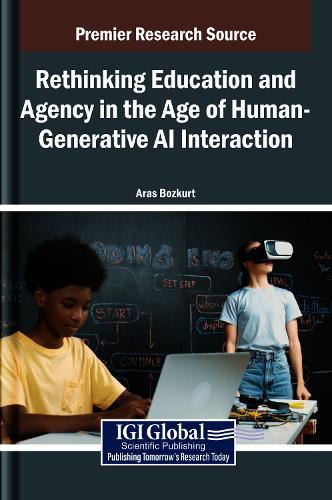
OverviewIn the age of human-generative AI interaction, traditional educational practices are being challenged and redefined. As AI systems become more integrated into learning, teaching, and creating, questions arise about the role of human judgment, creativity, and autonomy in shaping knowledge. Generative AI collaborates with users, raising both opportunities for empowerment and concerns over dependency. This relationship calls for a critical rethinking of educational models, demanding approaches that integrate AI while cultivating human agency, ethical awareness, and complex navigation abilities. Rethinking Education and Agency in the Age of Human-Generative AI Interaction explores the implications of generative AI technologies on higher education. It offers multidimensional analyses from social, cultural, psychological, and economic standpoints, challenging the notion of AI as a neutral tool and unpacking its ideologies, biases, and impacts on teaching, learning, and human agency. This book covers topics such as personalized learning, emotional intelligence, and education policy, and is a useful resource for educators, computer engineers, policymakers, academicians, researchers, and scientists. Full Product DetailsAuthor: Aras BozkurtPublisher: Igi Global Scientific Publishing Imprint: Igi Global Scientific Publishing Dimensions: Width: 17.80cm , Height: 2.90cm , Length: 25.40cm Weight: 1.129kg ISBN: 9798337311951Pages: 550 Publication Date: 17 October 2025 Audience: College/higher education , Professional and scholarly , Tertiary & Higher Education , Professional & Vocational Format: Hardback Publisher's Status: Active Availability: Available To Order We have confirmation that this item is in stock with the supplier. It will be ordered in for you and dispatched immediately. Table of ContentsReviewsAuthor InformationAras Bozkurt is a researcher and faculty member at Anadolu University, Türkiye. With MA and Ph.D. degrees in Distance Education, Dr. Bozkurt's work focuses on empirical studies in areas such as distance education, online learning, networked learning, and educational technology. He applies critical theories like connectivism, rhizomatic learning, and heutagogy to his research. Dr. Bozkurt is also interested in emerging research paradigms, including social network analysis, sentiment analysis, and data mining. His studies also explore the integration of artificial intelligence technologies into educational processes, particularly in the context of human-machine interaction. Tab Content 6Author Website:Countries AvailableAll regions |
||||