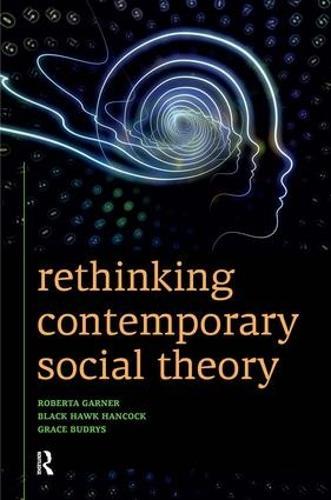
Full Product Details
Author: Roberta Garner ,
Black Hawk Hancock ,
Grace Budrys
Publisher: Taylor & Francis Inc
Imprint: Routledge
Dimensions:
Width: 15.20cm
, Height: 1.70cm
, Length: 22.90cm
Weight: 0.430kg
ISBN: 9781612052601
ISBN 10: 1612052606
Pages: 312
Publication Date: 30 September 2013
Audience:
College/higher education
,
General/trade
,
Tertiary & Higher Education
,
General
Format: Paperback
Publisher's Status: Active
Availability: In Print

This item will be ordered in for you from one of our suppliers. Upon receipt, we will promptly dispatch it out to you. For in store availability, please contact us.
Reviews
“This book provides a clear summary of how postmodern approaches are becoming more entrenched within sociology, and it is a good textbook for teachers interested in this topic. Further, it demonstrates that if sociology is to be true to its calling, it must be able to understand the profound changes of the contemporary era, and radically transform its theoretical self-understanding if need be.” –International Review of Modern Sociology ""Garner, Hancock and Budrys change the game in social-theory pedagogy and research by ‘discovering’ a major new paradigm—conflict constructionism. This is indeed a paradigm shift as they blend traditional conflict theory with social constructionism to explain and explore all manner of phenomena, including discourse, body politics, the microlevels of everyday life, discipline and domination. It is important to understand conflict and coercion as done ""to"" people but also to understand that people have a hand in their own liberation. In my own teaching, I have been looking for a way to put critical theory, feminist theory and cultural studies on the same page—or in the same week!—and now I have it. Rethinking Contemporary Social Theory will instantly become part of the sociological canon."" -Ben Agger, author of Critical Social Theories
This book provides a clear summary of how postmodern approaches are becoming more entrenched within sociology, and it is a good textbook for teachers interested in this topic. Further, it demonstrates that if sociology is to be true to its calling, it must be able to understand the profound changes of the contemporary era, and radically transform its theoretical self-understanding if need be. -International Review of Modern Sociology Garner, Hancock and Budrys change the game in social-theory pedagogy and research by `discovering' a major new paradigm-conflict constructionism. This is indeed a paradigm shift as they blend traditional conflict theory with social constructionism to explain and explore all manner of phenomena, including discourse, body politics, the microlevels of everyday life, discipline and domination. It is important to understand conflict and coercion as done to people but also to understand that people have a hand in their own liberation. In my own teaching, I have been looking for a way to put critical theory, feminist theory and cultural studies on the same page-or in the same week!-and now I have it. Rethinking Contemporary Social Theory will instantly become part of the sociological canon. -Ben Agger, author of Critical Social Theories
This book provides a clear summary of how postmodern approaches are becoming more entrenched within sociology, and it is a good textbook for teachers interested in this topic. Further, it demonstrates that if sociology is to be true to its calling, it must be able to understand the profound changes of the contemporary era, and radically transform its theoretical self-understanding if need be. -International Review of Modern Sociology Garner, Hancock and Budrys change the game in social-theory pedagogy and research by 'discovering' a major new paradigm-conflict constructionism. This is indeed a paradigm shift as they blend traditional conflict theory with social constructionism to explain and explore all manner of phenomena, including discourse, body politics, the microlevels of everyday life, discipline and domination. It is important to understand conflict and coercion as done to people but also to understand that people have a hand in their own liberation. In my own teaching, I have been looking for a way to put critical theory, feminist theory and cultural studies on the same page-or in the same week!-and now I have it. Rethinking Contemporary Social Theory will instantly become part of the sociological canon. -Ben Agger, author of Critical Social Theories
This book provides a clear summary of how postmodern approaches are becoming more entrenched within sociology, and it is a good textbook for teachers interested in this topic. Further, it demonstrates that if sociology is to be true to its calling, it must be able to understand the profound changes of the contemporary era, and radically transform its theoretical self-understanding if need be. -International Review of Modern Sociology Garner, Hancock and Budrys change the game in social-theory pedagogy and research by 'discovering' a major new paradigm-conflict constructionism. This is indeed a paradigm shift as they blend traditional conflict theory with social constructionism to explain and explore all manner of phenomena, including discourse, body politics, the microlevels of everyday life, discipline and domination. It is important to understand conflict and coercion as done to people but also to understand that people have a hand in their own liberation. In my own teaching, I have been looking for a way to put critical theory, feminist theory and cultural studies on the same page-or in the same week!-and now I have it. Rethinking Contemporary Social Theory will instantly become part of the sociological canon. -Ben Agger, author of Critical Social Theories
This book provides a clear summary of how postmodern approaches are becoming more entrenched within sociology, and it is a good textbook for teachers interested in this topic. Further, it demonstrates that if sociology is to be true to its calling, it must be able to understand the profound changes of the contemporary era, and radically transform its theoretical self-understanding if need be. -International Review of Modern Sociology Garner, Hancock and Budrys change the game in social-theory pedagogy and research by 'discovering' a major new paradigm-conflict constructionism. This is indeed a paradigm shift as they blend traditional conflict theory with social constructionism to explain and explore all manner of phenomena, including discourse, body politics, the microlevels of everyday life, discipline and domination. It is important to understand conflict and coercion as done to people but also to understand that people have a hand in their own liberation. In my own teaching, I have been looking for a way to put critical theory, feminist theory and cultural studies on the same page-or in the same week!-and now I have it. Rethinking Contemporary Social Theory will instantly become part of the sociological canon. -Ben Agger, author of Critical Social Theories
Author Information
Roberta Garner, Black Hawk Hancock, Grace Budrys