Overview
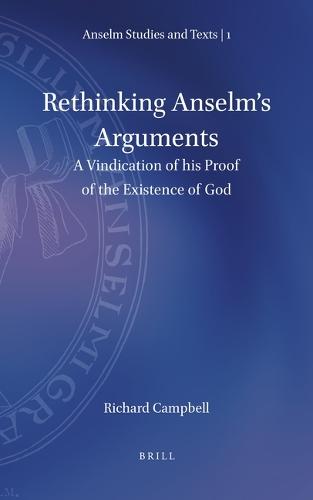
This book re-examines Anselm’s famous arguments for the existence of God in his Proslogion, and in his Reply. It demonstrates how he validly deduces from plausible premises that God so truly exists that He could not be thought not to exist. Most commentators, ancient and modern, wrongly located his argument in a passage which is not about God at all. It becomes evident that, consequently, much contemporary criticism is based on misreading and misunderstanding his text. It reconstructs his reasoning through three distinct but logically connected stages. It shows that, even if Anselm’s crucial premises are sceptically interpreted, his conclusions still follow. Properly understood, this argument is not vulnerable to the standard criticisms, including Gaunilo’s ‘Lost island’ counter-example.
Full Product Details
Author: Richard Campbell
Publisher: Brill
Imprint: Brill
Volume: 1
Dimensions:
Width: 15.50cm
, Height: 3.70cm
, Length: 23.50cm
Weight: 0.987kg
ISBN: 9789004358263
ISBN 10: 9004358269
Pages: 548
Publication Date: 30 August 2018
Audience:
Professional and scholarly
,
Professional & Vocational
Format: Hardback
Publisher's Status: Active
Availability: Manufactured on demand

We will order this item for you from a manufactured on demand supplier.
Reviews
On the whole the book is impressively thorough for a topic so large and a book just topping five hundred pages. Reading the introduction one finds that the book originated in an attempt to write a journal article reflecting on the state of Anselm studies forty years after his original book on the subject, and is immediately reminded of Locke's intention to put a few thoughts together and ending up with Essay Concerning Human Understanding . It is conceivable that the present work will share with Locke's 'few thoughts' not just the circumstances under which it was begun, but the popularity and influence within its discipline - no less is deserved . Alexander Westenberg, in Revista Espanola de Filosofia Medieval 26/1 (2019).
"""On the whole the book is impressively thorough for a topic so large and a book just topping five hundred pages. Reading the introduction one finds that the book originated in an attempt to write a journal article reflecting on the state of Anselm studies forty years after his original book on the subject, and is immediately reminded of Locke's intention to put a few thoughts together and ending up with Essay Concerning Human Understanding . It is conceivable that the present work will share with Locke's 'few thoughts' not just the circumstances under which it was begun, but the popularity and influence within its discipline - no less is deserved"". Alexander Westenberg, in Revista Española de Filosofía Medieval 26/1 (2019)."
""On the whole the book is impressively thorough for a topic so large and a book just topping five hundred pages. Reading the introduction one finds that the book originated in an attempt to write a journal article reflecting on the state of Anselm studies forty years after his original book on the subject, and is immediately reminded of Locke's intention to put a few thoughts together and ending up with Essay Concerning Human Understanding . It is conceivable that the present work will share with Locke's 'few thoughts' not just the circumstances under which it was begun, but the popularity and influence within its discipline - no less is deserved"". Alexander Westenberg, in Revista Española de Filosofía Medieval 26/1 (2019).
Author Information
Richard Campbell, AM, MA BD (Syd), DPhil (Oxon), FACE, is Emeritus Professor of Philosophy at The Australian National University. He is the author of From Belief to Understanding (1976), Truth and Historicity (1992), The Concept of Truth (2011) and The Metaphysics of Emergence (2015).