|
Overview
Full Product Details
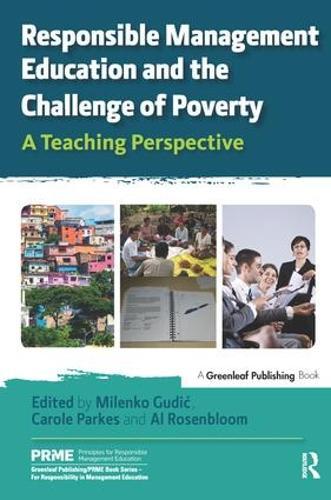
Author: Milenko Gudić , Carole Parkes , Al Rosenbloom
Publisher: Taylor & Francis Ltd
Imprint: Greenleaf Publishing
Dimensions:
Width: 15.60cm
, Height: 2.00cm
, Length: 23.40cm
Weight: 0.544kg
ISBN: 9781783532575
ISBN 10: 1783532572
Pages: 260
Publication Date: 16 December 2015
Audience:
Professional and scholarly
,
Professional & Vocational
Format: Hardback
Publisher's Status: Active
Availability: In Print 
This item will be ordered in for you from one of our suppliers. Upon receipt, we will promptly dispatch it out to you. For in store availability, please contact us.
Table of Contents
IntroductionSection 1: Frameworks for understanding 1. Realizing the promise of experiential learning in poverty-related management education Sheldene Simola, Trent University, Canada2. Explication as a method to access and enhance practitioner and faculty learning Val Lowman, OBE, Lendlease Be Onsite, UK3. Innovative inclusive development strategies: lessons from the Philippines Andrea Santiago, De La Salle University, The Philippines Fernando Roxas, Graduate School of Business, Asian Institute of Management, The Philippines4. Management education with poverty alleviation focus: a framework for curriculum design and pedagogical alignment Shiv K. Tripathi, Mzumbe University, TanzaniaAjai Prakash, University of Lucknow, IndiaWolfgang Amann, HEC Paris, FranceSection 2: Course design and topic integration within courses 615. Teaching about the base of the pyramid: bringing students to the intersection of business and poverty alleviation Ted London, William Davidson Institute and Ross School of Business, University of Michigan, USA6. Strategies for the integration of poverty alleviation into management curriculum: poverty – how can business help? Geri Mason, School of Business, Government, and Economics, Seattle Pacific University7. Poverty in a marketing class? Saroja Subrahmanyan, Elfenworks Center for Responsible Business, Saint Mary’s College of California, USA J. Tomas Gomez-Arias, Saint Mary’s College of California, USA8. A new vocabulary for teaching poverty in marketing Paulo Cesar Motta, Pontifical Catholic University of Rio de Janeiro, Brazil Thomas Brashear Alejandro, University of Massachusetts Amherst, USA9. Educating young leaders for alleviating poverty through an organizational behaviour course Claudio Andres Rivera, Riga Business School, Latvia10. Simmons World Challenge: a case study in grounding management education in global poverty Mindell Reiss Nitkin, Simmons College, USAMary Shapiro, Simmons College, USASection 3: Extracurricular and community-based approaches11. Ethics to reduce poverty: the case of the “100 Youths for Ethics in Development” programme in Argentina Maria Laura Fiorotto, UNDP, Bolivia12. Challenges and opportunities for student engagement in university social projects in the current socioeconomic context of Russia Oleg Vikhanskiy, Lomonosov Moscow State University Business School, Russia Elena Kiseleva, Lomonosov Moscow State University Business School, Russia Natalia Churkina, Lomonosov Moscow State University Business School, Russia13. The impact of university social services through social incubation and student engagement in poverty alleviation Luis Portales, Universidad de Monterrey, MexicoConsuelo García de la Torre, EGADE Business School, Tecnológico de Monterrey, Mexico14. A case study of community learning and open innovation to reduce poverty at the base of the pyramid Lutz E. Schlange, University of Applied Sciences, Eastern SwitzerlandSection 4: Contemporary issues15. Financial exclusion: technology, the digital divide and poverty Daniel R. Horne, School of Business, Providence College, USA16. The importance of responsible public management in addressing the challenge of poverty: the need for socially responsible public management Athanasios Chymis, Centre of Planning and Economic Research (KEPE), Greece Massimiliano Di Bitetto, Italian National Research Council (CNR) Paolo D’Anselmi, University of Rome, Tor Vergata, Italy Antonis Skouloudis, Centre for Environmental Policy and Strategic Environmental Management, University of the Aegean, GreeceConclusion: Taking stock and moving towards the next stepsAbout the editorsAbout the contributors
Reviews
Socially Responsive Organizations and the Challenge of Poverty and its companion Responsible Management Education and the Challenge of Poverty: A Teaching Perspective edited by Milenko Gudic, Carole Parkes and Al Rosenbloom are books that should be required in all areas of education and not limited to management education. My review focuses on the use of these books in Schools of Education that are educating the future teachers and education leaders in the United States. However, since most Schools of Education collaborate with the Humanity, Science and Business community, the review will be inclusive of all of these disciplines. The first book, Socially Responsive Organizations and the Challenge of Poverty provides the reader with the issues including much valued international statistics, the challenges, the responses and the discussion of the future. Not only does the first section elaborate on the statistics of poverty in many countries, but it also provides knowledge about poverty and the effects of resources on poverty, specifically water and energy, that need to be acknowledged in order to understand the underlying causes of poverty with the repercussions that occur when society struggles to access basic human needs. The second section focuses on the challenges and specifically elaborates on housing, food and labor with section three targeting the responses to these challenges. Finally, innovative solutions are brought forward providing the reader with a look into the future. The second book, Responsible Management Education and the Challenge of Poverty: A Teaching Perspective follows similar format as the first book. It is divided into five sections. The second section, contain chapters that specifically help in the development of redesigning existing courses or in the development of new courses. Specific readings are included in this section and suggestions for vocabulary development is stressed. The third section focuses on the community and again provided guidance for inclusion in courses. Even though these books were written to focus on including poverty as a challenge for business and management education, the information and statistics, the suggestions for inclusion in the curriculum, and the future challenges could be used in other courses at a University or College. In education, teachers and administration are all struggling with how to motivate and aid students, many who are living in poverty. All are trying to accommodate the vast changes occurring due to global immigration and diverse population. Cultural needs, English as a second language, and rural and urban societal structures impact the curriculum not only in what is taught but in the pedagogy of that content. These two books address the information Education professionals need to begin to make that accommodation in their classrooms and in their schools. -- Judith Bazler, Academic and Business Research Institute
Socially Responsive Organizations and the Challenge of Poverty and its companion Responsible Management Education and the Challenge of Poverty: A Teaching Perspective edited by Milenko Gudic, Carole Parkes and Al Rosenbloom are books that should be required in all areas of education and not limited to management education. My review focuses on the use of these books in Schools of Education that are educating the future teachers and education leaders in the United States. However, since most Schools of Education collaborate with the Humanity, Science and Business community, the review will be inclusive of all of these disciplines. The first book, Socially Responsive Organizations and the Challenge of Poverty provides the reader with the issues including much valued international statistics, the challenges, the responses and the discussion of the future. Not only does the first section elaborate on the statistics of poverty in many countries, but it also provides knowledge about poverty and the effects of resources on poverty, specifically water and energy, that need to be acknowledged in order to understand the underlying causes of poverty with the repercussions that occur when society struggles to access basic human needs. The second section focuses on the challenges and specifically elaborates on housing, food and labor with section three targeting the responses to these challenges. Finally, innovative solutions are brought forward providing the reader with a look into the future. The second book, Responsible Management Education and the Challenge of Poverty: A Teaching perspective follows similar format as the first book. It is divided into five sections. The second section, contain chapters that specifically help in the development of redesigning existing courses or in the development of new courses. Specific readings are included in this section and suggestions for vocabulary development is stressed. The third section focuses on the community and again provided guidance for inclusion in courses. Even though these books were written to focus on including poverty as a challenge for business and management education, the information and statistics, the suggestions for inclusion in the curriculum, and the future challenges could be used in other courses at a University or College. In education, teachers and administration are all struggling with how to motivate and aid students, many who are living in poverty. All are trying to accommodate the vast changes occurring due to global immigration and diverse population. Cultural needs, English as a second language, and rural and urban societal structures impact the curriculum not only in what is taught but in the pedagogy of that content. These two books address the information Education professionals need to begin to make that accommodation in their classrooms and in their schools. -- Judith Bazler, Academic and Business Research Institute
Socially Responsive Organizations and the Challenge of Poverty and its companion Responsible Management Education and the Challenge of Poverty: A Teaching Perspective edited by Milenko Gudic, Carole Parkes and Al Rosenbloom are books that should be required in all areas of education and not limited to management education. My review focuses on the use of these books in Schools of Education that are educating the future teachers and education leaders in the United States. However, since most Schools of Education collaborate with the Humanity, Science and Business community, the review will be inclusive of all of these disciplines. The first book, Socially Responsive Organizations and the Challenge of Poverty provides the reader with the issues including much valued international statistics, the challenges, the responses and the discussion of the future. Not only does the first section elaborate on the statistics of poverty in many countries, but it also provides knowledge about poverty and the effects of resources on poverty, specifically water and energy, that need to be acknowledged in order to understand the underlying causes of poverty with the repercussions that occur when society struggles to access basic human needs. The second section focuses on the challenges and specifically elaborates on housing, food and labor with section three targeting the responses to these challenges. Finally, innovative solutions are brought forward providing the reader with a look into the future. The second book, Responsible Management Education and the Challenge of Poverty: A Teaching Perspective follows similar format as the first book. It is divided into five sections. The second section, contain chapters that specifically help in the development of redesigning existing courses or in the development of new courses. Specific readings are included in this section and suggestions for vocabulary development is stressed. The third section focuses on the community and again provided guidance for inclusion in courses. Even though these books were written to focus on including poverty as a challenge for business and management education, the information and statistics, the suggestions for inclusion in the curriculum, and the future challenges could be used in other courses at a University or College. In education, teachers and administration are all struggling with how to motivate and aid students, many who are living in poverty. All are trying to accommodate the vast changes occurring due to global immigration and diverse population. Cultural needs, English as a second language, and rural and urban societal structures impact the curriculum not only in what is taught but in the pedagogy of that content. These two books address the information Education professionals need to begin to make that accommodation in their classrooms and in their schools. -- Judith Bazler, Academic and Business Research Institute
Author Information
Milenko Gudi?, Carole Parks, Al Rosenbloom
Tab Content 6
Author Website:
Countries Available
All regions
|