Overview
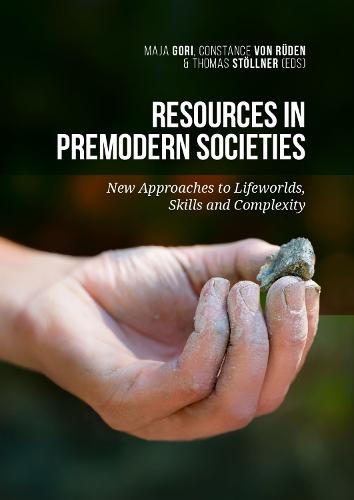
This volume brings together innovative research to explore the profound impact of resources on the development of early societies. Divided into three major themes – lifeworlds in resource landscapes, skill and embodied knowledge, and the role of resources within complex systems – the volume draws on diverse case studies, from Bronze Age Chinese mining to Iron Age preurban resource management and the metallurgy-pastoralism nexus. Contributors reveal how materials were not merely extracted but embedded within cognitive frameworks, cultural traditions, and social transformations. Special emphasis is placed on the relational and evolving nature of craft skills, technological innovations, and the embodied growth of knowledge. Advanced computational approaches focussing on complexity, further illuminate patterns of mobility, resource use, and state formation. Integrating archaeological, anthropological, and modeling perspectives, this volume offers an interdisciplinary and multi-scalar analysis of resources and their impact on societies in premodern times. It is intended for scholars, researchers, and advanced students in archaeology, anthropology, history, and related disciplines who are interested in material culture, environmental adaptation, cognitive processes, and the dynamics of complex societies.
Full Product Details
Author: Maja Gori ,
Constance von Rüden ,
Thomas Stöllner
Publisher: Sidestone Press
Imprint: Sidestone Press
ISBN: 9789464271508
ISBN 10: 9464271507
Pages: 310
Publication Date: 26 March 2026
Audience:
Professional and scholarly
,
Professional & Vocational
Format: Paperback
Publisher's Status: Active
Availability: Not yet available

This item is yet to be released. You can pre-order this item and we will dispatch it to you upon its release.
Author Information
Maja Gori holds a PhD in Pre- and Protohistory and Aegean Archaeology from the University of Heidelberg, in cotutelle de thèse with the University of Paris 1 Panthéon-Sorbonne. She has worked as a postdoctoral researcher at the Universities of Bochum, Heidelberg, Amsterdam, and Mainz. In 2017, she obtained the Habilitation as professor in Italy, and since 2018 she has held a permanent position as researcher at the CNR-ISPC (Institute for Heritage Science, Italian National Research Council), where she was promoted to senior researcher in 2024. In 2025, she was appointed Associate Professor of Pre- and Protohistory at the University of Trento. Her research focuses on prehistoric archaeology, particularly in the Balkans and Central Mediterranean. Her interests include mobility and cultural transmission, the relationship between identities and material culture, archaeological theory, network analysis, agent-based modelling, and the political uses of archaeology in present-day identity building. Key publications: M. Gori, A. Hellmuth Kramberger, T. Krapf & G. Recchia (eds.) Archaeology of Mountainous Landscapes in Balkan Prehistory. Prähistorische Archäologie in Südosteuropa: Propylaeum 2026. M. Gori & A. Abar, 2022. Confronting Anthropological and Natural Scientific Approaches to Migration in Archaeology, in M. Fernández-Götz, C. Nimura, P. Stockhammer & R. Cartwright (eds.): Rethinking Migrations in Late Prehistoric Eurasia. Proceedings of the British Academy. Oxford University Press, Oxford M. Gori, A. Di Renzoni & E. Carletti 2021. Connecting the Dots in the Adriatic-Ionian Area. Long-Distance Networks in the 3rd Millennium BC. Origini XLV-2021: 147-170. A. Bulatović, M.Gori & M. Vander Linden. Radiocarbon Dating the 3rd Millennium BC in the Central Balkans: a re-examination of the Early Bronze Age sequence, Radiocarbon 62.5, 2020: 1163–1191 M. Gori, Kατὰ γῆν καὶ κατὰ θάλασσαν. Cetina communities on the move across the Central Mediterranean and the Balkans in the 3rd millennium BC. In: J. Maran, R. Băjenaru, S.C. Alincăi, A.D. Popescu, S. Hansen (eds.), Objects, Ideas and Travelers. Contacts between the Balkans, the Aegean and Western Anatolia during the Bronze and Early Iron Age, Proc. Conf. to the memory of A. Vulpe, Bonn: Habelt, 2020, pp. 65–83 M. Gori & M. Ivanova (eds.). Balkan Dialogues. Negotiating Identity Between Prehistory and the Present, London & New York: Routledge, 2017. M. Gori. Along the Rivers and Through the Mountains. A reviewed chrono-cultural framework for the south-western Balkans during the late 3rd and early 2nd millennium BCE, UPA, Bonn: Habelt, 2015. Constance von Rüden is currently junior professor for Prehistory at the Ruhr-University Bochum with a special focus on Mediterranean prehistory and theory. Previously she held post-doc positions at the German Archaeological Institute in Athens, at the Centre for Mediterranean Studies at Bochum and at Heidelberg University. She has edited several volumes, published the wall paintings from Tall Mishrife/Qatna with an investigation of their interregional relations (2011) and issued the book “Feasting, craft and depositional practice in Late Bronze Age Palaepaphos” together with Artemis Georgiou, Ariane Jacobs and Paul Halstead. Since 2010, she has been co-director of the Tell el-Dab’a wall painting project in the eastern Nile Delta in Egypt (together with Manfred Bietak) and, since 2017, the director of a survey project in Sant’Antioco/Sardinia. Thomas Stöllner holds the Chair for Pre- and Protohistory at the Ruhr University Bochum in Germany and directs the Research Department and the Department of Mining Archaeology at the Deutsches Bergbau-Museum Bochum (DBM). His main area of research is the social and economic development of mining communities throughout pre- and protohistory with a focus on mining, the archaeometry of mining, and the archaeology of technology and social interrelations with the aid of studies in settlements and graveyards. His research spans from Old World archaeology, including Central and Eastern Europe, to the Caucasus, the Middle East, and Central Asia, as well as South America. ORCID: https://orcid.org/0000-0001-8681-3632