Overview
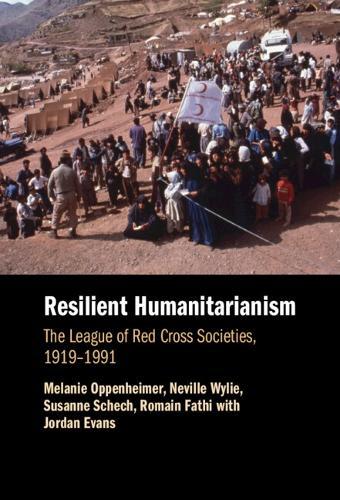
In the first independent study of the League of Red Cross Societies, an interdisciplinary team of leading scholars examine its history, and how it influenced twentieth-century humanitarianism. They explore how the League evolved from 1919 to 1991 as a peacetime organisation of the Red Cross in contrast to the original wartime focus of the International Committee of the Red Cross. Investigating largely unknown, but significant actors, they shed new light on the League's activities in Southeast Asia, the Horn of Africa, Latin America and Europe through case studies focussing on its global health initiatives, the complexity of its networks in war and peace, and its role in providing relief. The authors argue that it is impossible to understand today's Red Cross and Red Crescent movement and global humanitarianism without considering the structures, expertise and training provided by the League to member National Societies from 1919 to 1991.
Full Product Details
Author: Melanie Oppenheimer (Australian National University, Canberra) ,
Neville Wylie (University of Stirling) ,
Susanne Schech (Flinders University of South Australia) ,
Romain Fathi (Australian National University, Canberra)
Publisher: Cambridge University Press
Imprint: Cambridge University Press
ISBN: 9781009702232
ISBN 10: 1009702238
Pages: 330
Publication Date: 30 April 2026
Audience:
General/trade
,
General
Format: Hardback
Publisher's Status: Forthcoming
Availability: Not yet available, will be POD

This item is yet to be released. You can pre-order this item and we will dispatch it to you upon it's release. This is a print on demand item which is still yet to be released.
Reviews
'A topical, much-needed monograph, authored by a group of brilliant, competent, knowledgeable historians. This is the first broad, critical history of the League of Red Cross Societies (LRCS), from its inception to the end of the Twentieth Century. Of all the components of the Red Cross movement, it was, so far, the one that had gone unnoticed, often overlooked, and sometimes ignored. The book rectifies the situation; it provides a comprehensive, accessible historical analysis of an organisation that, according to the authors, 'deliberately operated as an enabler, a co-ordinator, providing a space for convening different agents rather than as an actor in its own right'.' Davide Rodogno, Geneva Graduate Institute of International and Development Studies 'This sweeping history of the League of Red Cross Societies provides an in-depth look at the world's largest humanitarian network, tracing its efforts to promote global health, world peace, sustainable development, and local capacity throughout the twentieth century. A must read for scholars and practitioners of humanitarianism alike.' Julia F. Irwin, Louisiana State University 'A hugely insightful, wide-ranging work, with a remarkable range of reference. Resilient Humanitarianism will be the standard work in the field for years to come and scholars in the history of humanitarianism and modern history in general will find their work enhanced and their thinking stimulated by this rich, fascinating book.' Dan Stone, Royal Holloway, University of London 'This is a much needed and welcome addition to the historiography of humanitarianism. The League's history has been overlooked, which is a pity. The authors do a magnificent job recalling a history that required considerable diplomatic dexterity. But part of the history is also part of the hoped for present and future. The League had an interesting organizational design that made it quite affected by outside forces, and this vulnerability also proved to be important to its resilience. An important lesson for those who want to make humanitarianism less hierarchical and more relational.' Michael Barnett, George Washington University 'This exhaustive study on the LRCS closes crucial loopholes in our knowledge about 'the world's largest humanitarian and volunteer network'. Showing how numerous actors pursued different, sometimes contradictory interests while maintaining cooperation, this book reveals a crucial but little-known side of twentieth century health work.' Iris Borowy, Shanghai University
Author Information
Melanie Oppenheimer is Honorary Professor of History at The Australian National University and Emeritus Professor at Flinders University and author of All Work, No Pay: Australian Civilian Volunteers in War. Her research covers voluntary work, gender and war and she is the centenary historian of the Australian Red Cross. Neville Wylie is Professor of International History at the University of Stirling and author of Barbed Wire Diplomacy: Britain, Germany, and the Politics of Prisoners of War 1939–1945. He was one of the first independent scholars to consult the ICRC archives in the early 1990s. Susanne Schech is Emeritus Professor of Geography at Flinders University and author of Culture and Development: A Critical Introduction (2000). Her research contributes to critical development geographies on race and whiteness, humanitarian migration and resettlement, and the politics of international volunteering. Romain Fathi is Associate Professor in History at the Australian National University and an affiliated researcher at the Centre d'Histoire de Sciences Po. He is author of The Red Cross's Public Health Turn. His research focusses on the First World War, the history of public health, and the treatment of human remains in conflicts. Jordan Evans is an early career researcher in the College of Humanities, Arts, and Social Sciences at Flinders University. His research investigates the history of blood transfusion in the 20th century and its intersections with humanitarianism, technology, and decolonisation.