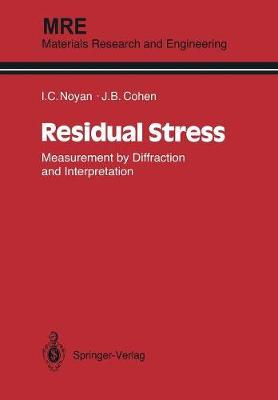
Residual Stress: Measurement by Diffraction and Interpretation

Author:   Ismail C. Noyan ,  Jerome B. Cohen
Publisher:   Springer-Verlag New York Inc.
Edition:   Softcover reprint of the original 1st ed. 1987
ISBN:  

9781461395713


Pages:   276
Publication Date:   01 July 2012
Format:   Paperback
Availability:   Manufactured on demand   Availability explained
We will order this item for you from a manufactured on demand supplier.

Our Price $419.76 Quantity:  
Add to Cart

Share |

Residual Stress: Measurement by Diffraction and Interpretation


Overview

As industries find that the market for their goods and services is often as closely connected to their quality as to their price, they become more interested in inspection and quality control. Non-destructive testing is one aspect of this topic; the subject of this book is a sub-field of this domain. The techniques for measuring residual stresses have a long history for a technological subject. Yet, in the last decade or so there has been renewed and vigorous interest, and, as a result of this, there has been considerable progress in our understanding and in our methods. It seemed a proper time to bring the new material together in an organized form suitable for a course or for self-teaching, hence this book. After an initial introduction to the qualitative ideas concerning the origin, role, and measurement of residual stresses, we follow with chapters on classical elasticity and the relatively new subject of microplasticity. These are primarily introductory or review in nature, and the reader will find it important to consider further the quoted references if he is to be involved in a continuing basis in this area. There follows a chapter on diffraction theory, and then we fuse these subjects with a chapter on diffraction techniques for measuring stresses and strains which at present is our most general tool for non-destructive evaluation in this area.

Full Product Details

Author:   Ismail C. Noyan ,  Jerome B. Cohen
Publisher:   Springer-Verlag New York Inc.
Imprint:   Springer-Verlag New York Inc.
Edition:   Softcover reprint of the original 1st ed. 1987
Dimensions:   Width: 17.00cm , Height: 1.50cm , Length: 24.40cm
Weight:   0.508kg
ISBN:  

9781461395713


ISBN 10:   1461395712
Pages:   276
Publication Date:   01 July 2012
Audience:   Professional and scholarly ,  Professional & Vocational
Format:   Paperback
Publisher's Status:   Active
Availability:   Manufactured on demand   Availability explained
We will order this item for you from a manufactured on demand supplier.
Language:   German

Table of Contents

1 Introduction.- 1.1 The Origin of Stresses.- 1.2 Methods of Measuring Residual Stresses.- 1.3 Some Examples of Residual Stresses.- References.- 2 Fundamental Concepts in Stress Analysis.- 2.1 Introduction.- 2.2 Definitions.- 2.3 Stress and Strain.- 2.4 Forces and Stresses.- 2.5 Displacements and Strains.- 2.6 Transformation of Axes and Tensor Notation.- 2.7 Elastic Stress-Strain Relations for Isotropic Materials.- 2.8 Structure of Single Crystals.- 2.9 Elastic Stress-Strain Relations in Single Crystals.- 2.10 Equations of Equilibrium.- 2.11 Conditions of Compatibility.- 2.12 Basic Definitions in Plastic Deformation.- 2.13 Plastic Deformation of Single Crystals.- 2.14 Deformation and Yielding in Inhomogeneous Materials.- Problems.- 3 Analysis of Residual Stress Fields Using Linear Elasticity Theory.- 3.1 Introduction.- 3.2 Macroresidual Stresses.- 3.3 Equations of Equilibrium for Macrostresses.- 3.4 Microstresses.- 3.5 Equations of Equilibrium for Micro- and Pseudo-Macrostresses.- 3.6 Calculation of Micro- and PM Stresses.- 3.7 The Total Stress State in Surface Deformed Multiphase Materials.- 3.8 Macroscopic Averages of Single Crystal Elastic Constants.- 3.9 The Voigt Average.- 3.10 The Reuss Average.- 3.11 Other Approaches to Elastic Constant Determination.- 3.12 Average Diffraction Elastic Constants.- Summary.- References.- 4 Fundamental Concepts in X-ray Diffraction.- 4.1 Introduction.- 4.2 Fundamentals of X-rays.- 4.3 Short-wavelength Limit and the Continuous Spectrum.- 4.4 Characteristic Radiation Lines.- 4.5 X-ray Sources.- 4.6 Absorption of X-rays.- 4.7 Filtering of X-rays.- 4.8 Scattering of X-rays.- 4.9 Scattering from Planes of Atoms.- 4.10 The Structure Factor of a Unit Cell.- 4.11 Experimental Utilization of Bragg’s Law.- 4.12 Monochromators.- 4.13Collimators and Slits.- 4.14 Diffraction Patterns from Single Crystals.- 4.15 Diffraction Patterns from Polycrystalline Specimens.- 4.16 Basic Diffractometer Geometry.- 4.17 Intensity of Diffracted Lines for Polycrystals.- 4.18 Multiplicity.- 4.19 Lorentz Factor.- 4.20 Absorption Factor.- 4.21 Temperature Factor.- 4.22 X-ray Detectors.- 4.23 Deadtime Correction for Detection Systems.- 4.24 Total Diffracted Intensity at a Given Angle 20.- 4.25 Depth of Penetration of X-rays.- 4.26 Fundamental Concepts in Neutron Diffraction.- 4.27 Scattering and Absorption of Neutrons.- Problems.- Bibliography and References.- 5 Determination of Strain and Stress Fields by Diffraction Methods.- 5.1 Introduction.- 5.2 Fundamental Equations of X-ray Strain Determination.- 5.3 Analysis of Regular “d” vs. sin2? Data.- 5.4 Determination of Stresses from Diffraction Data.- 5.5 Biaxial Stress Analysis.- 5.6 Triaxial Stress Analysis.- 5.7 Determination of the Unstressed Lattice Spacing.- 5.8 Effect of Homogeneity of the Strain Distribution and Specimen Anisotropy.- 5.9 Average Strain Data from Single Crystal Specimens.- 5.10 Interpretation of the Average X-ray Strain Data Measured from Polycrystalline Specimens.- 5.11 Interpretation of Average Stress States in Polycrystalline Specimens.- 5.12 Effect of Stress Gradients Normal to the Surface on d vs. sin2? Data.- 5.13 Experimental Determination of X-ray Elastic Constants.- 5.14 Determination of Stresses from Oscillatory Data.- 5.15 Stress Measurements with Neutron Diffraction.- 5.16 Effect of Composition Gradients with Depth.- 5.17 X-ray Determination of Yielding.- 5.18 Summary.- Problem.- References.- 6 Experimental Errors Associated with the X-ray Measurement of Residual Stress.- 6.1 Introduction.- 6.2 Selection of the Diffraction Peakfor Stress Measurements.- 6.3 Peak Location.- 6.4 Determination of Peak Position for Asymmetric Peaks.- 6.5 Statistical Errors Associated with the X-ray Measurement of Line Profiles.- 6.6 Statistical Errors in Stress.- 6.7 Instrumental Errors in Residual Stress Analysis.- 6.8 Corrections for Macrostress Gradients.- 6.9 Corrections for Layer Removal.- 6.10 Summary.- Problems.- References.- 7 The Practical Use of X-ray Techniques.- 7.1 Introduction.- 7.2 The Use of Ordinary Diffractometers.- 7.3 Software and Hardware Requirements.- 7.4 Available Instruments.- 7.5 Selected Applications of a Portable X-ray Residual Stress Unit (By W. P. Evans).- Reference.- 8 The Shape of Diffraction Peaks — X-ray Line Broadening.- 8.1 Introduction.- 8.2 Slit Corrections.- 8.3 Fourier Analysis of Peak Broadening.- Problem.- References.- Appendix A: Solutions to Problems.- Appendix B.- B.1 Introduction.- B.2 The Marion-Cohen Method.- B.3 Dölle-Hauk Method (Oscillation-free Reflections).- B.4 Methods of Peiter and Lode.- B.5 Use of High Multiplicity Peaks.- References.- Appendix C: Fourier Analysis.- Appendix D: Location of Useful Information in “International Tables for Crystallography”.- Appendix F: A Compilation of X-ray Elastic Constants (By Dr. M. James).- References.

Reviews

Author Information

Tab Content 6

Author Website:  

Countries Available

All regions
Latest Reading Guide

NOV RG 20252


Shopping Cart
Your cart is empty
Shopping cart
Mailing List