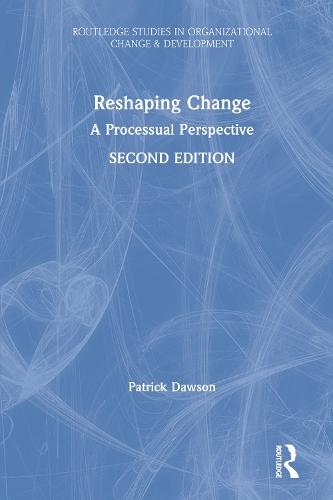
Reshaping Change: A Processual Perspective

Author:   Patrick Dawson
Publisher:   Taylor & Francis Ltd
Edition:   2nd edition
ISBN:  

9781138574687


Pages:   282
Publication Date:   10 June 2019
Format:   Hardback
Availability:   In Print   Availability explained
This item will be ordered in for you from one of our suppliers. Upon receipt, we will promptly dispatch it out to you. For in store availability, please contact us.

Our Price $462.00 Quantity:  
Add to Cart

Share |

Reshaping Change: A Processual Perspective


Overview

Full Product Details

Author:   Patrick Dawson
Publisher:   Taylor & Francis Ltd
Imprint:   Routledge
Edition:   2nd edition
Weight:   0.544kg
ISBN:  

9781138574687


ISBN 10:   1138574686
Pages:   282
Publication Date:   10 June 2019
Audience:   College/higher education ,  Tertiary & Higher Education ,  Undergraduate
Format:   Hardback
Publisher's Status:   Active
Availability:   In Print   Availability explained
This item will be ordered in for you from one of our suppliers. Upon receipt, we will promptly dispatch it out to you. For in store availability, please contact us.

Table of Contents

List of Figures and Tables Acknowledgments Introduction Introduction The case for adopting a processual approach The temporal dynamics of changing organizations Grounding a processual perspective in empirical research Main aims of the book The Development of the Processual Perspective and the Process Turn in Organization Studies Introduction Laying the foundations: The importance of context and process Pettigrew’s contribution to the processual-contextualist approach The process turn in organization studies Empirically grounded processual research and process philosophy: Issues and challenges Developing a typology of process research in fieldwork studies Processes of narrative change: Stories, sensemaking and dialogue Processes of temporal change: Time, temporality and practice Conclusion A Processual Framework: The Non-linear Dynamic Processes of Organizational Change Introduction Studying change over time: Analytical distinctions and conceptual considerations Type of organizational change The before, during and after of organizational change: ‘Catching reality in flight’ through conventional timeframes The importance of multiple times and multiple temporalities Doing processual research: Approach, commitment and methods Digging in the field: The committed researcher Longitudinal research designs in collecting processual data The processual framework reappraised and developed Temporal context Beyond contextual boundaries Culture and history Sensemaking and sensegiving Time and temporality Stories and narratives for understanding change Power-political processes Sociomaterial relations Assemblages and entanglement: Some early debates The concept of sociomateriality reappraised Conclusion Miners’ Stories and the Power-Political Processes of Contested Change Introduction The power of stories, storytellers and storying The power-political process of contested change at Glenrothes colliery Stories and the storying process in changing organizations Retrospective stories and prospective storying Temporal sensemaking and change: It’s ‘us’ against ‘them’ Attribution of blame in making sense of performance Review and appeal: The power of stories to resist and steer change Conclusion Temporal Context and Non-linear Change at General Motors Introduction Context, time and temporality in the study of changing organizations Moving context beyond business considerations dominant in mainstream change management models Alternative conceptions of time and the concept of temporal context Temporal context: The illustrative example of General Motors The historical context of General Motors Holden Data gathering and the concern with data triangulation Stories in temporal context: Narrative in the making and processes in the shaping Temporal context and depth of contextual knowledge Temporal context and the sociomaterial dynamics of cell design Temporal context and power-political process Conclusion Sociomaterial Relations in the Emergence and Growth of Micro-X Introduction Ongoing change and sociomateriality at Micro-X The concept of sociomateriality and the importance of time Micro-X: A high-tech start-up company based in Adelaide The birth of a business: From idea generation to marketing and product emergence Finding a partner organization for distribution and sales Securing finance and building networks Prototypes, reliability testing and the core technology Establishing a Micro-X facility in South Australia: From design to manufacture Drawing on the experience of ex-Holden employees Quality supply and manufacture Strategy, collaboration and innovation Conclusion: Sociomaterial relations and the Micro-X story The Design of Longitudinal Case Study Research and the Importance of Process and Time 7. The Design of Longitudinal Case Study Research And The Importance Of Process And Time Introduction Time and temporality in processual research and the ethnographic case study Process ontology and debates on temporality and change Temporal practices and temporal awareness in researching workplace change A facilitating framework for accommodating time and temporality in extended case study research The design and practice of longitudinal research Longitudinal design and processual research: Practical constraints and contextual opportunities Conclusion Conducting Processual Fieldwork: Data Collection and Analysis Introduction Tacit knowledge: There is no substitute for dirty hands Doing it: Processual research and the task of data collection Observational methods The use of interviews Combining observation and in-depth interviewing Other data collection techniques and supplementary methods Processual analysis: The long vigil The essential needs of processual analysis The need for contextual richness in accommodating conflicting data Conclusion Disseminating Processual Research: Audience and Storyteller Introduction Stories and storytelling The anecdotal story as a recipe for success: The popular management literature Stories and storytelling in academic study The processual case study in written form The question of higher levels of output and the constraints of research group pressures The case study and the audience: A typology Content and style of the case material The currency of publications: Challenges, opportunities and constraints Conclusion Conclusion Introduction Practical dimensions of processual research Concluding comments on developments in the processual approach Appendix I: Some Examples of Interview Schedules and a Supervisor’s Questionnaire Introduction Supervisor’s interview schedule Yard staff interview schedule Supervisor’s questionnaire Appendix II: An Example of a Processual Case Study Write-up for Company Agreement on Publishable Material Introduction The company write-up: Total quality management at Laubman and Pank Introduction Research strategy and methods Laubman and Pank Quality management at Laubman and Pank Senior management assessment of service excellence Laboratory manufacturing and service excellence Service excellence and competitive optometric practice Conclusion: TQM in the Laubman and Pank Group Conclusion Appendix III: An Example of a Processual Case Study Used for Teaching Purposes Introduction Guidelines for case study tutorials A recommended approach The British Rail case study: Learning from the past? The computerisation of freight operations control The implementation problem The ‘task force’ approach Creating a culture of change Technological change and organizational innovation Case study questions Conclusion Bibliography Index

Reviews

Author Information

Patrick Dawson is a Professor of Change, Creativity and Innovation at the University of Adelaide, Professor of Organizational Change at the University of Northumbria, and an Emeritus Professor of Management at the University of Aberdeen.

Tab Content 6

Author Website:  

Countries Available

All regions
Latest Reading Guide

NOV RG 20252


Shopping Cart
Your cart is empty
Shopping cart
Mailing List