Overview
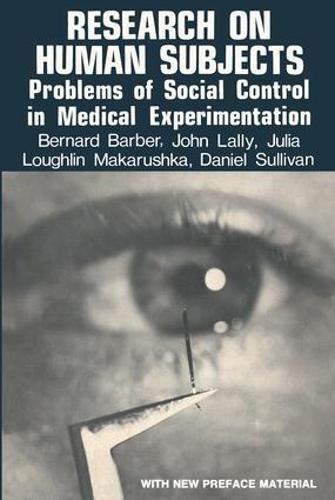
The use of human subjects in biomedical research has increased rapidly with scientific discoveries. However, the failure to achieve the highest - or even adequate - standards of professional moral concern and behavior is a serious side effect. Research on Human Subjects is based on four years of intensive research in which two studies were completed - one on a nationally representative sample of biomedical research institutions, the second on a sample of 350 researchers who actually used human subjects. The authors explore prevalent ethical norms, the actual ethical behavior of scientists, and the dilemma between the values of humane therapy and scientific discovery. They document the inadequate training that biomedical researchers receive in the ethics of research on human subjects, not only in medical schools but in post-graduate training as well. This landmark work makes very specific suggestions for policy change and reform for the biomedical research profession and its employment of human subjects.
Full Product Details
Author: Bernard Barber ,
John J. Lally ,
Julia Loughlin Makarushka ,
Daniel Sullivan
Publisher: Taylor & Francis Inc
Imprint: Transaction Publishers
Edition: New edition
Dimensions:
Width: 15.20cm
, Height: 1.50cm
, Length: 22.90cm
Weight: 0.362kg
ISBN: 9780878556496
ISBN 10: 0878556494
Pages: 284
Publication Date: 30 January 1979
Audience:
College/higher education
,
Professional and scholarly
,
Undergraduate
,
Postgraduate, Research & Scholarly
Format: Paperback
Publisher's Status: Active
Availability: Manufactured on demand

We will order this item for you from a manufactured on demand supplier.
Reviews
<p> Barber's research tells us that we cannot rely solely on the ethics of research professionals to ensure that the rights of subjects are adequately protected. <p> --The Civil Liberties Review <p> <p> A landmark in opening an essential area of inquiry for the public and for the scientific community. <p> --David Mechanic, Science Magazine <p> <p> An essential reference for social scientists, biomedical researchers, policy makers, and administrators concerned with the ethics of human experimentation. <p> --Herbert Kelman, Social Forces
Barber's research tells us that we cannot rely solely on the ethics of research professionals to ensure that the rights of subjects are adequately protected. --The Civil Liberties Review A landmark in opening an essential area of inquiry for the public and for the scientific community. --David Mechanic, Science Magazine An essential reference for social scientists, biomedical researchers, policy makers, and administrators concerned with the ethics of human experimentation. --Herbert Kelman, Social Forces Barber's research tells us that we cannot rely solely on the ethics of research professionals to ensure that the rights of subjects are adequately protected. --The Civil Liberties Review A landmark in opening an essential area of inquiry for the public and for the scientific community. --David Mechanic, Science Magazine An essential reference for social scientists, biomedical researchers, policy makers, and administrators concerned with the ethics of human experimentation. --Herbert Kelman, Social Forces Barber's research tells us that we cannot rely solely on the ethics of research professionals to ensure that the rights of subjects are adequately protected. --The Civil Liberties Review A landmark in opening an essential area of inquiry for the public and for the scientific community. --David Mechanic, Science Magazine An essential reference for social scientists, biomedical researchers, policy makers, and administrators concerned with the ethics of human experimentation. --Herbert Kelman, Social Forces