Awards
- Runner-up for Foreign Policy Section Best Book Award (United States).
- Runner-up for Foreign Policy Section Best Book Award 2020 (United States)
- Winner of J. David Singer Best Book Award (United States).
- Winner of J. David Singer Best Book Award 2020 (United States)
Overview
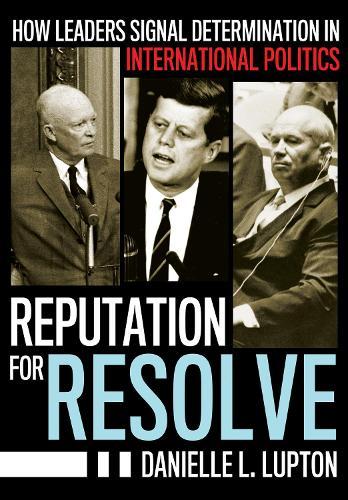
How do reputations form in international politics? What influence do these reputations have on the conduct of international affairs? In Reputation for Resolve, Danielle L. Lupton takes a new approach to answering these enduring and hotly debated questions by shifting the focus away from the reputations of countries and instead examining the reputations of individual leaders. Lupton argues that new leaders establish personal reputations for resolve that are separate from the reputations of their predecessors and from the reputations of their states. Using innovative survey experiments and in-depth archival research, she finds that leaders acquire personal reputations for resolve based on their foreign policy statements and behavior. Reputation for Resolve shows that statements create expectations of how leaders will react to foreign policy crises in the future and that leaders who fail to meet expectations of resolute action face harsh reputational consequences. Reputation for Resolve challenges the view that reputations do not matter in international politics. In sharp contrast, Lupton shows that the reputations for resolve of individual leaders influence the strategies statesmen pursue during diplomatic interactions and crises, and she delineates specific steps policymakers can take to avoid developing reputations for irresolute action. Lupton demonstrates that reputations for resolve do exist and can influence the conduct of international security. Thus, Reputation for Resolve reframes our understanding of the influence of leaders and their rhetoric on crisis bargaining and the role reputations play in international politics.
Full Product Details
Author: Danielle L. Lupton
Publisher: Cornell University Press
Imprint: Cornell University Press
Dimensions:
Width: 15.20cm
, Height: 2.50cm
, Length: 22.90cm
Weight: 0.907kg
ISBN: 9781501747717
ISBN 10: 1501747711
Pages: 264
Publication Date: 15 April 2020
Recommended Age: From 18 years
Audience:
General/trade
,
General
Format: Hardback
Publisher's Status: Active
Availability: Manufactured on demand

We will order this item for you from a manufactured on demand supplier.
Reviews
Lupton skillfully achieves her goals and much more, making a compelling case that reputations matter a great deal for leaders navigating the domain of international relations. Students, scholars, and policy makers should greatly profit from a thoughtful reading of this work. * Choice * This is an important book that is a welcome addition to the ongoing research on reputation and foreign policy, while also having important policy implications. In addition to its novel theoretical contribution, Lupton's study is also valuable in demonstrating the validity of a multimethod approach through her well-crafted qualitative and experimental research design. As such, Reputation for Resolve should have a strong appeal to diverse audiences, ranging from scholars and students of international politics to the broader policy community. * Perspectives on Politics * Lupton's work is especially innovative for combining a micro-foundational perspective on her research question, through process tracing survey experiments that manipulate key features of both context and leader behavior, with case studies that probe how Soviet premier Nikita Khrushchev evaluated two US presidents-Dwight Eisenhower and Kennedy-through a reputational lens. * World Politics *
Lupton skillfully achieves her goals and much more, making a compelling case that reputations matter a great deal for leaders navigating the domain of international relations. Students, scholars, and policy makers should greatly profit from a thoughtful reading of this work. * Choice *
Lupton's work is especially innovative for combining a micro-foundational perspective on her research question, through process tracing survey experiments that manipulate key features of both context and leader behavior, with case studies that probe how Soviet premier Nikita Khrushchev evaluated two US presidents-Dwight Eisenhower and Kennedy-through a reputational lens. * World Politics * This is an important book that is a welcome addition to the ongoing research on reputation and foreign policy, while also having important policy implications. In addition to its novel theoretical contribution, Lupton's study is also valuable in demonstrating the validity of a multimethod approach through her well-crafted qualitative and experimental research design. As such, Reputation for Resolve should have a strong appeal to diverse audiences, ranging from scholars and students of international politics to the broader policy community. * Perspectives on Politics * Lupton skillfully achieves her goals and much more, making a compelling case that reputations matter a great deal for leaders navigating the domain of international relations. Students, scholars, and policy makers should greatly profit from a thoughtful reading of this work. * Choice *
Lupton skillfully achieves her goals and much more, making a compelling case that reputations matter a great deal for leaders navigating the domain of international relations. Students, scholars, and policy makers should greatly profit from a thoughtful reading of this work. * Choice * This is an important book that is a welcome addition to the ongoing research on reputation and foreign policy, while also having important policy implications. In addition to its novel theoretical contribution, Lupton's study is also valuable in demonstrating the validity of a multimethod approach through her well-crafted qualitative and experimental research design. As such, Reputation for Resolve should have a strong appeal to diverse audiences, ranging from scholars and students of international politics to the broader policy community. * Perspectives on Politics * Lupton's work is especially innovative for combining a micro-foundational perspective on her research question, through process tracing survey experiments that manipulate key features of both context and leader behavior, with case studies that probe how Soviet premier Nikita Khrushchev evaluated two US presidents-Dwight Eisenhower and Kennedy-through a reputational lens. * World Politics *
Author Information
Danielle L. Lupton is Assistant Professor of Political Science at Colgate University. She has published articles in Political Analysis, Political Research Quarterly, International Interactions, and the Journal of Global Security Studies. Follow her on X @ProfLupton or on her website at daniellelupton.com.