Overview
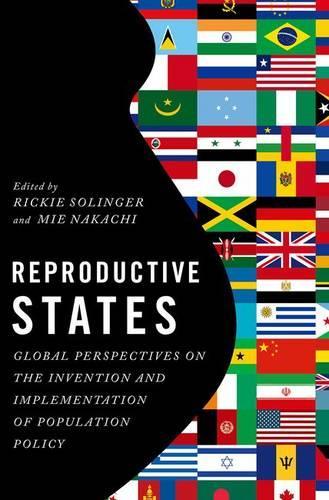
When it comes to government's role in personal matters such as family planning, most bristle at any interference from the State on how to exercise their reproductive rights. China's infamous ""one child"" policy is a well-known example of reproductive politics, but history is filled with other examples of governmental population control to advance its interests. Reproductive States is the first volume of a collection of case studies that explores when and how some of the most populous countries in the world invented and implemented state population policies in the 20th century.The authors, scholars specializing in reproductive politics, survey population policies from key countries on five continents to provide a global perspective. Regardless of the type of government or its cultural history, many of these countries have developed similar policies to control their populations and attempt to combat social problems such as poverty and hunger. However, the common denominator is that states have used women's bodies as a political resource.Far from being just an overseas problem, this volume illustrates how other countries have developed their strategies in response to goals and tactics driven by the United Nations and the United States. Due to fears of a post-World War II ""population bomb"" and uncertainty of how to deal with the world's poor after the Cold War, the U.S. and the Soviet Union led the charge among nations to devise strategies to control their populations, but in different ways. The U.S. and some European countries pressed the poor and ethnic minorities to limit reproduction. China's ""one child"" policy targeted all ranks of society, while Soviet women (who already had few rights) were under surveillance through state-planned services such as medical care and commodity distribution to detect pregnancy.Interweaving biopolitics, gender studies, statecraft, and world systems, Reproductive States offer reflections on the outcome of such policies and their legacies in our day.
Full Product Details
Author: Rickie Solinger ,
Mie Nakachi
Publisher: Oxford University Press Inc
Imprint: Oxford University Press Inc
Dimensions:
Width: 15.20cm
, Height: 2.80cm
, Length: 23.10cm
Weight: 0.499kg
ISBN: 9780199311088
ISBN 10: 0199311080
Pages: 400
Publication Date: 28 January 2016
Audience:
College/higher education
,
Postgraduate, Research & Scholarly
Format: Paperback
Publisher's Status: Active
Availability: To order

Stock availability from the supplier is unknown. We will order it for you and ship this item to you once it is received by us.
Reviews
In days gone by, these ten chapters on population policy in ten of the largest, most powerful countries on Earth all might have been contributed by men. This time, however, all the authors (including the coeditors) are women, in many cases from the countries they write about, and they take a decidedly feminist perspective in outlining how each country arrives at actionable population policies. For those concerned with the feminist political implications of population policies, this is a good summary of how some major nations have approached the issue. --E. Carlson, Florida State University, CHOICE The stories Reproductive States tells bring us back to the connections between population policies and economic growth, and their relationship, in turn, to women ... The stories told in these chapters expose the racial, ethnic, religious, gender and class biases that shaped the establishment and implementation of each country's population policies. -- Mindy Jane Roseman, Women's Review of Books
The stories Reproductive States tells bring us back to the connections between population policies and economic growth, and their relationship, in turn, to women ... The stories told in these chapters expose the racial, ethnic, religious, gender and class biases that shaped the establishment and implementation of each country's population policies. * Mindy Jane Roseman, Women's Review of Books *
The stories Reproductive States tells bring us back to the connections between population policies and economic growth, and their relationship, in turn, to women ... The stories told in these chapters expose the racial, ethnic, religious, gender and class biases that shaped the establishment and implementation of each country's population policies. Mindy Jane Roseman, Women's Review of Books
In days gone by, these ten chapters on population policy in ten of the largest, most powerful countries on Earth all might have been contributed by men. This time, however, all the authors (including the coeditors) are women, in many cases from the countries they write about, and they take a decidedly feminist perspective in outlining how each country arrives at actionable population policies. For those concerned with the feminist political implications of population policies, this is a good summary of how some major nations have approached the issue. --E. Carlson, Florida State University, <em>CHOICE</em>
Author Information
Rickie Solinger is a historian and curator. She is author of Reproductive Politics: What Everyone Needs to Know. Mie Nakachi is Associate Professor of Gender Studies and Russian History at the Center for Applied Ethics, Hokkaido University.