|
|
|||
|
||||
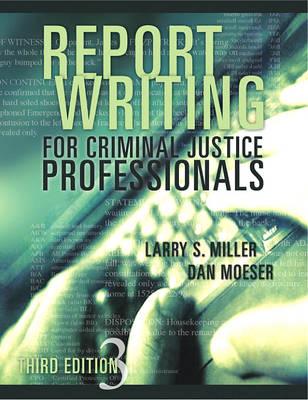
OverviewSo much of the process of criminal justice depends on good documentation, and criminal justice professionals can spend as much as 50-75% of their time writing up administrative and research reports. Much of the legal process depends on the careful documentation that records crucial information. And yet most of these law enforcement, security, corrections, and probation and parole officers have not had adequate training in how to provide a well-written, accurate, brief, and complete report. Report Writing for Criminal Justice Professionals provides practical advice on report writing -- with specific writing samples and guidelines. The authors go beyond the routine English grammar approach to deal with the difficult but often-ignored problem of documentation that will hold up in court. Important concepts are emphasized with related checklists, forms, and pull-out chapter tests. The material is organized into three sections: The Nature of Report Writing, The Mechanics of Report Writing, and The Modernization of Report Writing NEW TO THIS EDITION Updated and revised with new material on forensics and scientific reports, crime reporting, common errors in forensic reports, and automation of report writing. Appendixes are thoroughly revised, with new examples of reporting forms, worksheets, and reports, including a sample forensic lab report and presentence investigation report. Full Product DetailsAuthor: Larry S. Miller , Denise L. Whitehead , John T. WhiteheadPublisher: Taylor & Francis Inc Imprint: Anderson Publishing Edition: 3rd New edition Dimensions: Width: 21.00cm , Height: 2.10cm , Length: 28.00cm Weight: 0.941kg ISBN: 9781593453169ISBN 10: 1593453167 Pages: 400 Publication Date: 01 January 2006 Audience: College/higher education , General/trade , Tertiary & Higher Education , General Replaced By: 9781437755848 Format: Paperback Publisher's Status: Unknown Availability: Out of print, replaced by POD We will order this item for you from a manufatured on demand supplier. Table of ContentsSection One: The Nature of Report Writing 1. The Why and How of Report Writing 2. Starting to Write 3. The Face Page 4. The Narrative — The Continuation Page and Follow-Up Report 5. Habits that Make for Speedy Writing 6. Other Types of Writing 7. Reading and Correcting Reports Section Two: The Mechanics of Report Writing 8. Simplified Study of Grammar 9. Avoiding Errors in Sentence Structure 10. Making Punctuation Work 11. Breaking the Spelling Jinx 12. Using or Abusing Words 13. Abbreviating and Capitalizing Section Three: The Modernization of Report Writing 14. Innovations and Predictions in Criminal JusticeReviewsAuthor InformationLarry S. Miller is Distinguished Professor of Criminal Justice & Criminology at East Tennessee State University. He is the author of several books on topics including criminal investigation, criminal justice report writing, police photography, and more. John T. Whitehead is a Professor and former Chair in the Department of Criminal Justice and Criminology at East Tennessee State University. He completed his M.A. at the University of Notre Dame and earned his Ph.D. in Criminal Justice from SUNY-Albany. He teaches courses in corrections, criminal justice ethics, and the death penalty. Tab Content 6Author Website:Countries AvailableAll regions |
||||