|
|
|||
|
||||
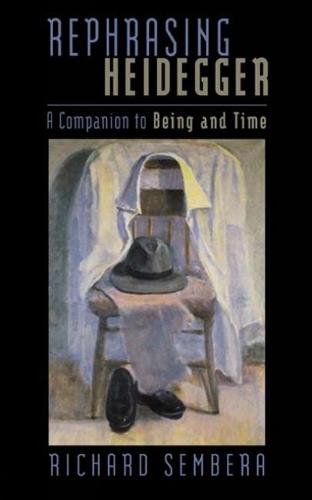
Overview"Richard Sembera introduces the reader to the essential features of Being and Time, Heidegger's main work in clear and unambiguous English. He dispels the nimbus of unintelligibility surrounding Heidegger's thought, a nimbus that Heidegger himself helped create and that has tended to confine serious Heidegger scholarship to closed circles. This is not a work about the ""existentialist"" Heidegger, the ""Nazi"" Heidegger, the ""gnostic"" Heidegger, or the ""mystic"" Heidegger. Nor is it a ""diluted"" Heidegger for beginners. Rephrasing Heidegger interprets the philosopher on his own terms, covering all the main aspects of Being and Time, and is particularly interesting for its detailed analysis of the structure and contents of this epoch-making philosophical work. Rephrasing Heidegger includes a unique glossary of technical terms which recur frequently throughout Being and Time whose translation is problematic or uncertain. It also includes a German-English lexicon which catalogues the translations of Heidegger's terms in the most important English translations of Being and Time. This is the first detailed commentary in English by a Heidegger specialist trained at Heidegger's own university by the world-renowned Heidegger scholar Prof. F.-W. von Herrman, the editor of the most important volumes of Heidegger's collected works in German." Full Product DetailsAuthor: Richard SemberaPublisher: University of Ottawa Press Imprint: University of Ottawa Press Dimensions: Width: 12.70cm , Height: 2.50cm , Length: 20.30cm Weight: 0.320kg ISBN: 9780776606637ISBN 10: 0776606638 Pages: 330 Publication Date: 02 January 2008 Audience: Professional and scholarly , Professional & Vocational Format: Paperback Publisher's Status: Out of Print Availability: Awaiting stock Table of Contents"INTRODUCTION 3 1 THE ORIGINS OF PHENOMENOLOGY 11 1.1 THE HISTORY OF THE TERM ""PHENOMENOLOGY"" 11 1.2 THE ""CRISIS"" OF EUROPEAN SCIENCE 16 1.3 HUSSERL'S PHENOMENOLOGICAL FOUNDATION 21 1.4 HEIDEGGER'S HERMENEUTICS OF FACTICITY 25 1.5 THE VICISSITUDES OF THE PHENOMENOLOGICAL MOVEMENT 32 2 HERMENEUTIC PHENOMENOLOGY AS FUNDAMENTAL ONTOLOGY 37 2.1 UNDERSTANDING VERSUS PERCEPTION 37 2.2 WHY ASK THE QUESTION OF BEING? ( 1-4) 40 2.3 THE STRUCTURE OF THE BOOK ""BEING AND TIME"" ( 5,6,8) 46 2.4 HEIDEGGER'S CONCEPT OF PHENOMENOLOGY ( 7) 52 2.5 THE EVERYDAY WORLD ( 9-27) 59 a) The Worldliness of the World 60 b) The One-self 69 2.6 THE INDIFFERENT MODE OF BEING-IN ( 28-34). SENSIBILITY, UNDERSTANDING, AND TALK 73 a) Sensibility 74 b) Understanding 75 c) Talk 79 2.7 THE INAUTHENTIC MODE OF BEING-IN ( 35-38). TURMOIL, CURIOSITY AND CROSSTALK 86 a) Crosstalk 86 b) Curiosity 88 c) Ambiguity 89 d) Turmoil 90 e) Falling 91 2.8 AUTHENTIC SENSIBILITY: ANGST ( 39-40) 91 2.9 THE PRIMEVAL STRUCTURE OF DASEIN AS CONCERN ( 41-42) 97 2.10 REALITY AND TRUTH ( 43-44) 103 a) Concern, Truth, and Authenticity 103 b) Being, Entities, and Dasein 108 3 THE TIMING OF TIMELINESS 115 3.1 THE PROBLEM OF COMPLETENESS AND AUTHENTICITY ( 45-46) 115 3.2 AUTHENTIC UNDERSTANDING: DEATH ( 47-53) 119 3.3 AUTHENTIC TALK: THE CALL OF CONSCIENCE ( 54-60) . 129 3.4 THE STRUCTURE OF AUTHENTICITY AS DECIDEDNESS ( 61-62) 139 3.5 TIMELINESS AS THE SENSE OF CONCERN ( 63-66) 145 a) The Future: Advent 148 b) The Past: Continuance 148 c) The Present: Encounter 149 d) The Ecstatic Structure of Timeliness 150 3.6 TIMELINESS AND ITS MODIFICATIONS ( 67-71) 153 3.7 THE FOUNDATION OF HISTORICITY ( 72-77) 160 3.8 THE VULGAR CONCEPT OF TIME ( 78-83) 166 APPENDICES 171 A. GLOSSARY OF TECHNICAL TERMS 171 B. GERMAN-ENGLISH LEXICON 189 C. IMPORTANT CONCEPTUAL DIVISIONS 193 D. SELECTIVE BIBLIOGRAPHY 197 INDEX NOMINUM 207"ReviewsAuthor InformationA scholar of German philosophy from Leibniz to Heidegger, Richard Sembera is professor at the College Dominicain in Ottawa. Tab Content 6Author Website:Countries AvailableAll regions |
||||