Overview
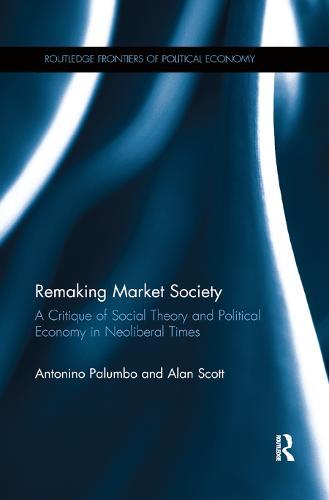
Neoliberalism has been one of the most hotly contested themes in academic and political debate over the last 30 years. Given the global and persistent influence of neoliberal ideas on contemporary styles of governance, social-service provision, and public policy, this intensive interest is understandable. At the same time, the use of the term has become loose, vague, and over-extended, particularly in the extensive critical literature. Rather than engage in further critique, or in the reconstruction of the history of neoliberalism, this volume seeks to bring analytical clarity to the ongoing debate. Drawing inspiration from the work of the Hungarian economic historian, Karl Polanyi, Remaking Market Society combines critique, original formulations, and case studies to form an analytical framework that identifies the key instruments of neoliberal governance. These include privatization, marketization, and liberalization. The case studies examine the development of neoliberal instruments (reform of the British civil service); their refinement (reform of higher education in England and Wales); and their dissemination across national borders (EU integration policies). Rather than look back nostalgically on the post-war welfare-state settlement, in the final chapter the authors ask why the coalitions that supported that settlement broke down in the face of the neoliberal reform movement. This highly original work offers a distinctive transdisciplinary approach to political economy, and therefore is an important read for students and academics who are interested in political economy as well as social theory and political philosophy.
Full Product Details
Author: Antonino Palumbo (Palermo University, Italy) ,
Alan Scott (University of New England, Australia)
Publisher: Taylor & Francis Ltd
Imprint: Routledge
Weight: 0.450kg
ISBN: 9780367868031
ISBN 10: 0367868032
Pages: 236
Publication Date: 12 December 2019
Audience:
College/higher education
,
Tertiary & Higher Education
Format: Paperback
Publisher's Status: Active
Availability: In Print

This item will be ordered in for you from one of our suppliers. Upon receipt, we will promptly dispatch it out to you. For in store availability, please contact us.
Reviews
On a theoretical level, the authors aim to formulate a powerful modernist counternarrative to both postmodern social theory and neoliberal political economy approaches towards social and economic change. In doing so, they provide a sophisticated and demanding contribution to the critical literature on neoliberalism and neoliberal policies. - Karl M. Beyer
""On a theoretical level, the authors aim to formulate a powerful modernist counternarrative to both postmodern social theory and neoliberal political economy approaches towards social and economic change. In doing so, they provide a sophisticated and demanding contribution to the critical literature on neoliberalism and neoliberal policies."" - Karl M. Beyer
Author Information
Antonino Palumbo is a political theorist who works on globalization, the transformation of governance and the implications of changes in state steering for modern representative democracies. Since 2002 he has been teaching at Palermo University (Italy), where he is an associate professor in political philosophy. Alan Scott is Professor in the School of Behavioural, Cognitive, and Social Sciences, University of New England, Australia, and Adjunct Professor of Sociology at the University of Innsbruck, Austria. He has taught and researched at universities in the UK, Austria, Australia, and France, and his main research interests are in the fields of political sociology and social theory.