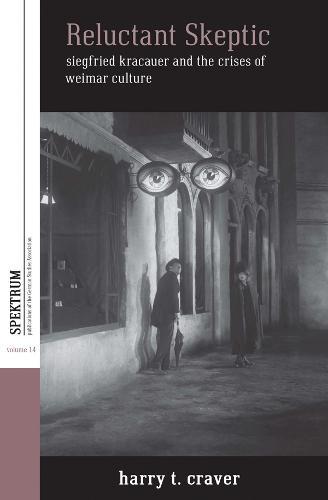
Overview
Discusses Kracauer from the perspective of the history of religion in modern Germany Seeks to give more emphasis to the importance of the history of religious thought in modern German cultural and intellectual history Approaches Kracauer on the basis of some of his earlier, less known writings.
Full Product Details
Author: Harry T. Craver
Publisher: Berghahn Books
Imprint: Berghahn Books
Volume: 14
ISBN: 9781789208368
ISBN 10: 178920836
Pages: 294
Publication Date: 14 January 2020
Audience:
Professional and scholarly
,
Professional & Vocational
Format: Paperback
Publisher's Status: Active
Availability: Available To Order

We have confirmation that this item is in stock with the supplier. It will be ordered in for you and dispatched immediately.
Reviews
Reluctant Skeptic opens a window into a moment and a place in time through in-depth analysisof Kracauer's polyphonic engagement with pressing contemporary questions and the role of the critic in assessing them. It makes no claim that Kracauer's perceptions of secularization and religion offer the paramount vantage point from which to take the measure of the crises we associate with Weimar, and it acknowledges that Kracauer's attentiveness to religion ebbed in the later 1920s. It succeeds admirably in creating an intellectual milieu analogous to the socio-cultural or socio-denominational milieus explored in studies of Weimar political culture It also offers a fresh perspective on the intellectual uncertainties of the post-war era. - German History Unpretentiously written and based on a judicious interpretation of a wide range of materials, Reluctant Skeptic contributes to our understanding not only of Siegfried Kracauer's intellectual development, but also of Weimar culture as a whole. - Martin Jay, University of California, Berkeley
Harry Craver's rich and nuanced study revisits Kracauer's nonconformist views and underscores the religious context in which they emerged... In portraying Kracauer's reflections on religious concepts as emblematic of post-World War I German intellectual life, Craver sets the stage for a novel, intriguing discussion of Weimar modernity and its crisis. - American Historical Review Reluctant Skeptic opens a window into a moment and a place in time through in-depth analysisof Kracauer's polyphonic engagement with pressing contemporary questions and the role of the critic in assessing them. It makes no claim that Kracauer's perceptions of secularization and religion offer the paramount vantage point from which to take the measure of the crises we associate with Weimar, and it acknowledges that Kracauer's attentiveness to religion ebbed in the later 1920s. It succeeds admirably in creating an intellectual milieu analogous to the socio-cultural or socio-denominational milieus explored in studies of Weimar political culture It also offers a fresh perspective on the intellectual uncertainties of the post-war era. - German History In great and fascinating detail, Craver guides his readers through the confused intellectual landscape that was Weimar Germany and the confusing currents that swirled through Kracauer's deeply fissured consciousness. - Journal of European Studies Unpretentiously written and based on a judicious interpretation of a wide range of materials, Reluctant Skeptic contributes to our understanding not only of Siegfried Kracauer's intellectual development, but also of Weimar culture as a whole. - Martin Jay, University of California, Berkeley
Author Information
Harry T. Craver holds a doctorate from the University of Toronto and currently teaches at the University of North Carolina, Chapel Hill. His work has appeared in publications such as New German Critique.