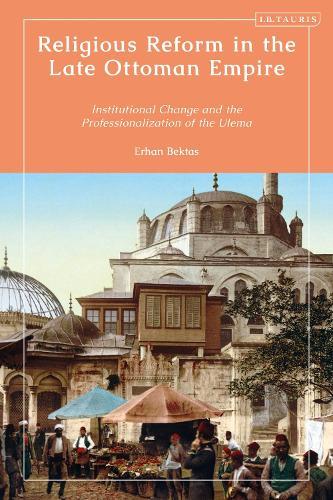
Overview
The influence of the ulema, the official Sunni Muslim religious scholars of the Ottoman Empire, is commonly understood to have waned in the empire’s last century. Drawing upon Ottoman state archives and the institutional archives of the ulema, this study challenges this narrative, showing that the ulema underwent a process of professionalisation as part of the wider Tanzimat reforms and thereby continued to play an important role in Ottoman society. First outlining transformations in the office of the Sheikh ul-islam, the leading Ottoman Sunni Muslim cleric, the book goes on to use the archives to present a detailed portrait of the lives of individual ulema, charting their education and professional and social lives. It also includes a glossary of Turkish-Arabic vocabulary for increased clarity. Contrary to beliefs about their decline, the book shows they played a central role in the empire’s efforts to centralise the state by acting as intermediaries between the government and social groups, particularly on the empire’s peripheries.
Full Product Details
Author: Erhan Bektas (Üsküdar University, Turkey)
Publisher: Bloomsbury Publishing PLC
Imprint: I.B. Tauris
Dimensions:
Width: 15.40cm
, Height: 1.80cm
, Length: 23.20cm
Weight: 0.360kg
ISBN: 9780755645510
ISBN 10: 0755645510
Pages: 232
Publication Date: 27 June 2024
Audience:
Professional and scholarly
,
College/higher education
,
Professional & Vocational
,
Tertiary & Higher Education
Format: Paperback
Publisher's Status: Active
Availability: Manufactured on demand

We will order this item for you from a manufactured on demand supplier.
Reviews
A thrilling account of the everyday life of Ottoman ulema based on unique quantitative data. It provides an understanding of what an average Ottoman alim’s life looked like outside of the elite circles of scholars. A blend of institutional history of the Seyhülislam’s Office and new roles and positions the ulema acquired within society during the final decades of the Empire. * Nadir Ozbek, Bogaziçi University, Turkey * This book provides an interesting reassessment of late Ottoman scholars and their place during a time of imperial transformation and reform. Using prosopographical analysis, Bektas’s study paints a rich picture of Ottoman religious scholars as mobile, politically-engaged functionaries who not only responded to institutional and social changes happening around them, but were important forces in shaping their world. * Micah A. Hughes, Indiana University, USA * Through this seminal work on the history of Ottoman Ulema … Bektas’s pioneering analysis of the Ulema in terms of their social origins, education and professional careers and experiences within the context of Istanbul as an educational hub is a genuine contribution to the field. -- Imran H Khan Suddahazai, The One Institute, UK * The Muslim World Book Review *
"""A thrilling account of the everyday life of Ottoman ulema based on unique quantitative data. It provides an understanding of what an average Ottoman alim's life looked like outside of the elite circles of scholars. A blend of institutional history of the Seyhülislam's Office and new roles and positions the ulema acquired within society during the final decades of the Empire."" --Nadir Ozbek, Bogaziçi University, Turkey ""This book provides an interesting reassessment of late Ottoman scholars and their place during a time of imperial transformation and reform. Using prosopographical analysis, Bektas's study paints a rich picture of Ottoman religious scholars as mobile, politically-engaged functionaries who not only responded to institutional and social changes happening around them, but were important forces in shaping their world."" --Micah A. Hughes, Indiana University, USA"
A thrilling account of the everyday life of Ottoman ulema based on unique quantitative data. It provides an understanding of what an average Ottoman alim’s life looked like outside of the elite circles of scholars. A blend of institutional history of the Seyhülislam’s Office and new roles and positions the ulema acquired within society during the final decades of the Empire. * Nadir Ozbek, Bogaziçi University, Turkey * This book provides an interesting reassessment of late Ottoman scholars and their place during a time of imperial transformation and reform. Using prosopographical analysis, Bektas’s study paints a rich picture of Ottoman religious scholars as mobile, politically-engaged functionaries who not only responded to institutional and social changes happening around them, but were important forces in shaping their world. * Micah A. Hughes, Indiana University, USA *
Author Information
Erhan Bektas is Assistant Professor of History at Üsküdar University, Turkey. He has previously published peer reviewed articles in journals such as Middle Eastern Studies, International Journal of History Studies and the Journal of Ottoman Legacy Studies.