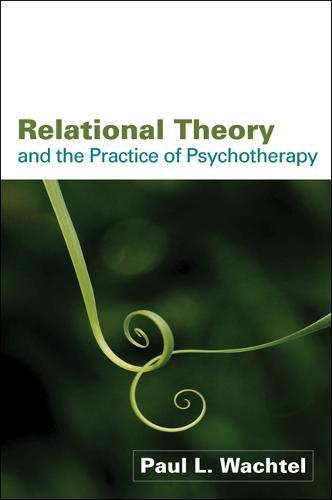
Overview
This important and innovative book explores a new direction in psychoanalytic thought that can expand and deepen clinical practice. Relational psychoanalysis diverges in key ways from the assumptions and practices that have traditionally characterized psychoanalysis. At the same time, it preserves, and even extends, the profound understanding of human experience and psychological conflict that has always been the strength of the psychoanalytic approach. Through probing theoretical analysis and illuminating examples, the book offers new and powerful ways to revitalize clinical practice. This book will be invaluable to clinical psychologists, psychiatrists, social workers, psychiatric nurses, and counselors; graduate students and residents in these fields. It may also serve as a text in psychotherapy graduate programs.
Full Product Details
Author: Paul L. Wachtel (City College and the Graduate Center of the City University of New York, United States) , Nancy McWilliams , Marcia Sheinberg , Lewis Aron (New York University Postdoctoral Program in Psychotherapy & Psychoanalysis, USA)
Publisher: Guilford Publications
Imprint: Guilford Publications
Dimensions:
Width: 15.20cm
, Height: 2.50cm
, Length: 22.90cm
Weight: 0.493kg
ISBN: 9781609180454
ISBN 10: 1609180453
Pages: 338
Publication Date: 17 December 2010
Audience:
College/higher education
,
College/higher education
,
Undergraduate
,
Postgraduate, Research & Scholarly
Format: Paperback
Publisher's Status: Active
Availability: Out of stock 
The supplier is temporarily out of stock of this item. It will be ordered for you on backorder and shipped when it becomes available.
Table of Contents
1. Context and Relationship in Psychotherapy: An Introduction 2. How Do We Understand Another Person? One-Person and Two-Person Perspectives 3. The Dynamics of Personality: One-Person and Two-Person Views 4. From Two-Person to Contextual: Beyond Infancy and the Consulting Room 5. Drives, Relationships, and the Foundations of the Relational Point of View 6. The Limits of the Archaeological Vision: Relational Theory and the Cyclical–Contextual Model 7. Self-States, Dissociation, and the Schemas of Subjectivity and Intersubjectivity 8. Exploration, Support, Self-Acceptance, and the “School of Suspicion” 9. Insight, Direct Experience, and the Implications of a New Understanding of Anxiety 10. Enactments, New Relational Experience, and Implicit Relational Knowing 11. Confusions about Self-Disclosure: Real Issues, Pseudo-Issues, and the Inevitability of Trade-Offs 12. The “Inner” World, the “Outer” World, and the Lived-In World: Mobilizing for Change in the Patient’s Daily Life
Reviews
We have needed a book like this. Wachtel has artfully charted the sea change from classical to intersubjective formulations and has made clear what the relational turn means for clinicians...In a voice that is unfailingly respectful and integrative, Wachtel explores core elements of the contemporary relational movement, ties those themes to relevant clinical challenges, and in the process provides a condensed but remarkably comprehensive course in the history of psychoanalytic ideas. - Nancy McWilliams, Graduate School of Applied and Professional Psychology, Rutgers, The State University of New Jersey, USA This conceptually rich volume...will be valuable to psychodynamic therapists working towards more effective approaches to intervention, and to cognitive-behavioral therapists who wish to explore the richness of the psychotherapeutic relationship and of inner experience. It would be an excellent text for a graduate seminar exploring contemporary approaches to psychoanalysis or integrative approaches to psychotherapy. - James Pretzer, Director, Cleveland Center for Cognitive Therapy, USA
Author Information
Paul L. Wachtel, PhD, Doctoral Program in Clinical Psychology, City College and the Graduate Center, City University of New York, USA
Tab Content 6
Author Website:
Countries Available
All regions
|