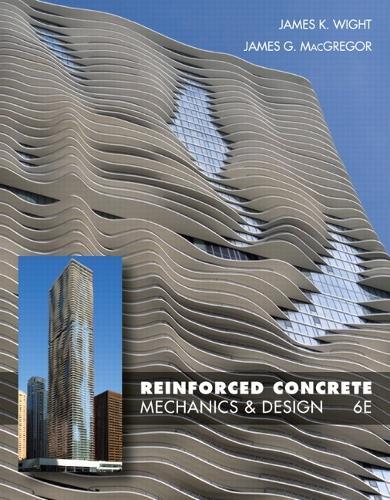
Reinforced Concrete: Mechanics and Design

Author:   James K. Wight ,  James G. MacGregor
Publisher:   Pearson Education (US)
Edition:   6th edition
ISBN:  

9780132176521


Pages:   1176
Publication Date:   29 November 2011
Replaced By:   9780133485967
Format:   Hardback
Availability:   In Print   Availability explained
Limited stock is available. It will be ordered for you and shipped pending supplier's limited stock.

Our Price $506.88 Quantity:  
Add to Cart

Share |

Reinforced Concrete: Mechanics and Design


Overview

Reinforced Concrete: Mechanics and Design, 6/e is a perfect text for professionals in the field who need a comprehensive reference on concrete structures and the design of reinforced concrete. Reinforced concrete design encompasses both the art and science of engineering. This book presents the theory of reinforced concrete as a direct application of the laws of statics and mechanics of materials. In addition, it emphasizes that a successful design not only satisfies design rules, but also is capable of being built in a timely fashion and for a reasonable cost. A multi-tiered approach makes Reinforced Concrete: Mechanics and Design an outstanding textbook for a variety of university courses on reinforced concrete design. Topics are normally introduced at a fundamental level, and then move to higher levels where prior educational experience and the development of engineering judgment will be required.

Full Product Details

Author:   James K. Wight ,  James G. MacGregor
Publisher:   Pearson Education (US)
Imprint:   Prentice Hall
Edition:   6th edition
Dimensions:   Width: 20.30cm , Height: 4.30cm , Length: 25.40cm
Weight:   1.990kg
ISBN:  

9780132176521


ISBN 10:   0132176521
Pages:   1176
Publication Date:   29 November 2011
Audience:   College/higher education ,  Tertiary & Higher Education
Replaced By:   9780133485967
Format:   Hardback
Publisher's Status:   Out of Print
Availability:   In Print   Availability explained
Limited stock is available. It will be ordered for you and shipped pending supplier's limited stock.

Table of Contents

PREFACE xi ABOUT THE AUTHORS xv CHAPTER 1 INTRODUCTION 1-1 Reinforced Concrete Structures 1-2 Mechanics of Reinforced Concrete  1-3 Reinforced Concrete Members 1-4 Factors Affecting Choice of Reinforced Concrete for a Structure  1-5 Historical Development of Concrete and Reinforced Concrete as Structural Materials 1-6 Building Codes and the ACI Code   CHAPTER 2 THE DESIGN PROCESS 2-1 Objectives of Design 2-2 The Design Process 2-3 Limit States and the Design of Reinforced Concrete  2-4 Structural Safety 2-5 Probabilistic Calculation of Safety Factors 2-6 Design Procedures Specified in the ACI Building Code  2-7 Load Factors and Load Combinations in the 2011 ACI Code  2-8 Loadings and Actions 2-9 Design for Economy 2-10 Sustainability 2-11 Customary Dimensions and Construction Tolerances  2-12 Inspection  2-13 Accuracy of Calculations  2-14 Handbooks and Design Aids    CHAPTER 3 MATERIALS 3-1 Concrete  3-2 Behavior of Concrete Failing in Compression  3-3 Compressive Strength of Concrete 3-4 Strength Under Tensile and Multiaxial Loads  3-5 Stress–Strain Curves for Concrete 3-6 Time-Dependent Volume Changes 3-7 High-Strength Concrete  3-8 Lightweight Concrete 3-9 Fiber Reinforced Concrete 3-10 Durability of Concrete  3-11 Behavior of Concrete Exposed to High and Low Temperatures  3-12 Shotcrete 3-13 High-Alumina Cement  3-14 Reinforcement 3-15 Fiber-Reinforced Polymer (FRP) Reinforcement  3-16 Prestressing Steel   CHAPTER 4 FLEXURE: BEHAVIOR AND NOMINAL STRENGTH OF BEAM SECTIONS  4-1 Introduction  4-2 Flexure Theory  4-3 Simplifications in Flexure Theory for Design 4-4 Analysis of Nominal Moment Strength for Singly Reinforced Beam Sections  4-5 Definition of Balanced Conditions  4-6 Code Definitions of Tension-Controlled and Compression-Controlled Sections  4-7 Beams with Compression Reinforcement 4-8 Analysis of Flanged Sections 4-9 Unsymmetrical Beam Sections    CHAPTER 5 FLEXURAL DESIGN OF BEAM SECTIONS 5-1 Introduction  5-2 Analysis of Continuous One-Way Floor Systems 5-3 Design of Singly-Reinforced Beam Sections with Rectangular Compression Zones  5-4 Design of Doubly-Reinforced Beam Sections 5-5 Design of Continuous One-Way Slabs   CHAPTER 6 SHEAR IN BEAMS 6-1 Introduction  6-2 Basic Theory 6-3 Behavior of Beams Failing in Shear 6-4 Truss Model of the Behavior of Slender Beams Failing in Shear  6-5 Analysis and Design of Reinforced Concrete Beams for Shear–ACI Code  6-6 Other Shear Design Methods  6-7 Hanger Reinforcement 6-8 Tapered Beams  6-9 Shear in Axially Loaded Members  6-10 Shear in Seismic Regions   CHAPTER 7 TORSION  7-1 Introduction and Basic Theory 7-2 Behavior of Reinforced Concrete Members Subjected to Torsion 7-3 Design Methods for Torsion 7-4 Thin-Walled Tube/Plastic Space Truss Design Method 7-5 Design for Torsion and Shear–ACI Code  7-6 Application of ACI Code Design Method for Torsion    CHAPTER 8 DEVELOPMENT, ANCHORAGE, AND SPLICING OF REINFORCEMENT 8-1 Introduction 8-2 Mechanism of Bond Transfer 8-3 Development Length 8-4 Hooked Anchorages 8-5 Headed and Mechanically Anchored Bars in Tension 8-6 Design for Anchorage 8-7 Bar Cutoffs and Development of Bars in Flexural Members  8-8 Reinforcement Continuity and Structural Integrity Requirements 8-9 Splices   CHAPTER 9 SERVICEABILITY 9-1 Introduction  9-2 Elastic Analysis of Stresses in Beam Sections  9-3 Cracking 9-4 Deflections of Concrete Beams  9-5 Consideration of Deflections in Design 9-6 Frame Deflections 9-7 Vibrations  9-8 Fatigue   CHAPTER 10 CONTINUOUS BEAMS AND ONE-WAY SLABS 10-1 Introduction 10-2 Continuity in Reinforced Concrete Structures 10-3 Continuous Beams 10-4 Design of Girders 10-5 Joist Floors  10-6 Moment Redistribution   CHAPTER 11 COLUMNS: COMBINED AXIAL LOAD AND BENDING 11-1 Introduction 11-2 Tied and Spiral Columns  11-3 Interaction Diagrams  11-4 Interaction Diagrams for Reinforced Concrete Columns  11-5 Design of Short Columns  11-6 Contributions of Steel and Concrete to Column Strength  11-7 Biaxially Loaded Columns   CHAPTER 12 SLENDER COLUMNS 12-1 Introduction 12-2 Behavior and Analysis of Pin-Ended Columns  12-3 Behavior of Restrained Columns in Nonsway Frames  12-4 Design of Columns in Nonsway Frames  12-5 Behavior of Restrained Columns in Sway Frames  12-6 Calculation of Moments in Sway Frames Using Second-Order Analyses  12-7 Design of Columns in Sway Frames 12-8 General Analysis of Slenderness Effects  12-9 Torsional Critical Load      CHAPTER 13 TWO-WAY SLABS: BEHAVIOR, ANALYSIS, AND DESIGN 13-1 Introduction 13-2 History of Two-Way Slabs 13-3 Behavior of Slabs Loaded to Failure in Flexure  13-4 Analysis of Moments in Two-Way Slabs 13-5 Distribution of Moments in Slabs 13-6 Design of Slabs  13-7 The Direct-Design Method  13-8 Equivalent-Frame Methods  13-9 Use of Computers for an Equivalent-Frame Analysis  13-10 Shear Strength of Two-Way Slabs 13-11 Combined Shear and Moment Transfer in Two-Way Slabs  13-12 Details and Reinforcement Requirements 13-13 Design of Slabs Without Beams  13-14 Design of Slabs with Beams in Two Directions  13-15 Construction Loads on Slabs 13-16 Deflections in Two-Way Slab Systems  13-17 Use of Post-Tensioning    CHAPTER 14 TWO-WAY SLABS: ELASTIC AND YIELD-LINE ANALYSES 14-1 Review of Elastic Analysis of Slabs  14-2 Design Moments from a Finite-Element Analysis 14-3 Yield-Line Analysis of Slabs: Introduction  14-4 Yield-Line Analysis: Applications for Two-Way Slab Panels  14-5 Yield-Line Patterns at Discontinuous Corners 14-6 Yield-Line Patterns at Columns or at Concentrated Loads    CHAPTER 15 FOOTINGS 15-1 Introduction  15-2 Soil Pressure Under Footings 15-3 Structural Action of Strip and Spread Footings  15-4 Strip or Wall Footings  15-5 Spread Footings 15-6 Combined Footings  15-7 Mat Foundations  15-8 Pile Caps    CHAPTER 16 SHEAR FRICTION, HORIZONTAL SHEAR TRANSFER, AND COMPOSITE CONCRETE BEAMS 16-1 Introduction 16-2 Shear Friction 16-3 Composite Concrete Beams    CHAPTER 17 DISCONTINUITY REGIONS AND STRUT-AND-TIE MODELS  17-1 Introduction 17-2 Design Equation and Method of Solution 17-3 Struts 17-4 Ties 17-5 Nodes and Nodal Zones  17-6 Common Strut-and-Tie Models 17-7 Layout of Strut-and-Tie Models  17-8 Deep Beams 17-9 Continuous Deep Beams  17-10 Brackets and Corbels  17-11 Dapped Ends 17-12 Beam–Column Joints  17-13 Bearing Strength 17-14 T-Beam Flanges   CHAPTER 18 WALLS AND SHEAR WALLS 18-1 Introduction 18-2 Bearing Walls 18-3 Retaining Walls 18-4 Tilt-Up Walls  18-5 Shear Walls 18-6 Lateral Load-Resisting Systems for Buildings 18-7 Shear Wall—Frame Interaction 18-8 Coupled Shear Walls 18-9 Design of Structural Walls–General  18-10 Flexural Strength of Shear Walls 18-11 Shear Strength of Shear Walls  18-12 Critical Loads for Axially Loaded Walls   CHAPTER 19 DESIGN FOR EARTHQUAKE RESISTANCE  19-1 Introduction 19-2 Seismic Response Spectra 19-3 Seismic Design Requirements  19-4 Seismic Forces on Structures  19-5 Ductility of Reinforced Concrete Members  19-6 General ACI Code Provisions for Seismic Design 19-7 Flexural Members in Special Moment Frames  19-8 Columns in Special Moment Frames 19-9 Joints of Special Moment Frames 19-10 Structural Diaphragms 19-11 Structural Walls 19-12 Frame Members not Proportioned to Resist Forces Induced by Earthquake Motions  19-13 Special Precast Structures 19-14 Foundations APPENDIX A APPENDIX B INDEX              

Reviews

Author Information

James K. Wight received his B.S. and M.S. degrees in civil engineering from Michigan State University in 1969 and 1970, respectively, and his Ph.D. from the University of Illinois in 1973. He has been a professor of structural engineering in the Civil and Environmental Engineering Department at the University of Michigan since 1973. He teaches undergraduate and graduate classes on analysis and design of reinforced concrete structures. He is well known for his work in earthquake-resistant design of concrete structures and spent a one-year sabbatical leave in Japan where he was involved in the construction and simulated earthquake testing of a full-scale reinforced concrete building. Professor Wight has been an active member of the American Concrete Institute (ACI) since 1973 and was named a Fellow of the Institute in 1984. He is currently the Senior Vice President of ACI and the immediate past Chair of the ACI Building Code Committee 318. He is also past Chair of the ACI Technical Activities Committee and Committee 352 on Joints and Connections in Concrete Structures. He has received several awards from the American Concrete Institute including the Delmar Bloem Distinguished Service Award (1991), the Joe Kelly Award (1999), the Boise Award (2002), the C.P. Siess Structural Research Award (2003 and 2009), and the Alfred Lindau Award (2008). Professor Wight has received numerous awards for his teaching and service at the University of Michigan including the ASCE Student Chapter Teacher of the Year Award, the College of Engineering Distinguished Service Award, the College of Engineering Teaching Excellence Award, the Chi Epsilon-Great Lakes District Excellence in Teaching Award, and the Rackham Distinguished Graduate Mentoring Award. He has received Distinguished Alumnus Awards from the Civil and Environmental Engineering Departments of the University of Illinois (2008) and Michigan State University (2009).     James G. MacGregor, University Professor of Civil Engineering at the University of Alberta, Canada, retired in 1993 after 33 years of teaching, research, and service, including three years as Chair of the Department of Civil Engineering. He has a B.Sc. from the University of Alberta and a M.S. and Ph.D. from the University of Illinois. In 1998 and 1999 he received a Doctor of Engineering (Hon) from Lakehead University, and in 1999 a Doctor of Science (Hon) from the University of Alberta. Dr. MacGregor is a Fellow of the Academy of Science of the Royal Society of Canada and a Fellow of the Canadian Academy of Engineering. A Past President and Honorary Member of the American Concrete Institute, Dr. MacGregor has been an active member of ACI since 1958. He has served on ACI technical committees including the ACI Building Code Committee and its subcommittees on flexure, shear, and stability and the ACI Technical Activities Committee. This involvement and his research has been recognized by honors jointly awarded to MacGregor, his colleagues, and students. These included the ACI Wason Medal for the Most Meritorious Paper (1972, and 1999), the ACI Raymond C. Reese Medal, and the ACI Structural Research Award (1972 and 1999). His work on the developing the Strut-and-Tie model for the ACI Code was recognized by the ACI Structural Research Award (2004). In addition, he has received several ASCE Awards, including the prestigious ASCE Norman Medal with three colleagues (1983). Dr. MacGregor chaired the Canadian Committee on Reinforced Concrete Design from 1977 through 1989, moving on to chair the Standing Committee on Structural Design for the National Building Code of Canada from 1990 through 1995. From 1973 to 1976 he was a member of the Council of the Association of Professional Engineers, Geologists, and Geophysicists of Alberta. At the time of his retirement from the University of Alberta, Professor MacGregor was a principal in MKM Engineering Consultants. His last project with that firm was the derivation of site-specific load and resistance factors for an eight-mile long concrete bridge.

Tab Content 6

Author Website:  

Countries Available

All regions
Latest Reading Guide

MRGC26


Shopping Cart
Your cart is empty
Shopping cart
Mailing List