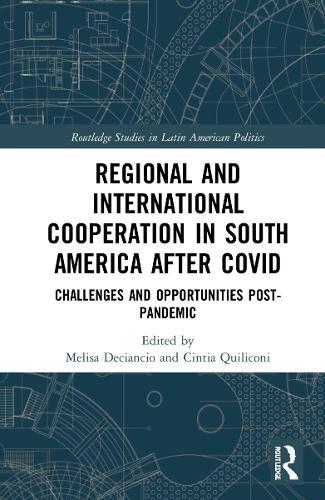
Full Product Details
Author: Melisa Deciancio (FLASCO, Buenos Aires) ,
Cintia Quiliconi (FLACSO, Ecuador)
Publisher: Taylor & Francis Ltd
Imprint: Routledge
Weight: 0.403kg
ISBN: 9781032129457
ISBN 10: 103212945
Pages: 254
Publication Date: 22 July 2022
Audience:
College/higher education
,
Tertiary & Higher Education
,
Undergraduate
Format: Hardback
Publisher's Status: Active
Availability: In Print

This item will be ordered in for you from one of our suppliers. Upon receipt, we will promptly dispatch it out to you. For in store availability, please contact us.
Reviews
This edited volume addresses two topical issues to understand the ongoing puzzles of Latin American politics and regionalism: How to explain the 'regional malaise' and decline of post-hegemonic regionalism in Latin America? What have been the immediate implications of the Covid-19 crisis? What lessons can be learned, as related to other issue-areas beyond health, in order to repair and revive regional cooperation and coordination, in the post-Covid-19 area? What are the challenges and opportunities? Arie Kacowicz, The Hebrew University of Jerusalem A timely and welcome contribution to the literature on regionalism in Latin America. This volume provides a novel and much-needed re-thinking of the challenges of regional cooperation initiatives beyond trade and security, and their effectiveness in resolving transnational problems in the post-pandemic world order. Laura Gomez-Mera, Associate Professor, University of Miami Deciancio and Quiliconi have successfully embarked on the difficult task of making sense of the South American responses to the pandemic of COVID-19. By bringing together a group of forefront specialists in Latin American regionalism, their book is an indispensable read for those interested in knowing how actors and institutions responded to the pandemic, why collective action fell short, and how they could do better. Stefano Palestini, Assistant Professor of International Relations at the Pontificia Universidad Catolica de Chile
This edited volume addresses two topical issues to understand the ongoing puzzles of Latin American politics and regionalism: How to explain the 'regional malaise' and decline of post-hegemonic regionalism in Latin America? What have been the immediate implications of the Covid-19 crisis? What lessons can be learned, as related to other issue-areas beyond health, in order to repair and revive regional cooperation and coordination, in the post-Covid-19 area? What are the challenges and opportunities? Arie Kacowicz, The Hebrew University of Jerusalem A timely and welcome contribution to the literature on regionalism in Latin America. This volume provides a novel and much-needed re-thinking of the challenges of regional cooperation initiatives beyond trade and security, and their effectiveness in resolving transnational problems in the post-pandemic world order. Laura Gomez-Mera, Associate Professor, University of Miami
"""This edited volume addresses two topical issues to understand the ongoing puzzles of Latin American politics and regionalism: How to explain the ‘regional malaise’ and decline of post-hegemonic regionalism in Latin America? What have been the immediate implications of the Covid-19 crisis? What lessons can be learned, as related to other issue-areas beyond health, in order to repair and revive regional cooperation and coordination, in the post-Covid-19 area? What are the challenges and opportunities?"" Arie Kacowicz, The Hebrew University of Jerusalem ""A timely and welcome contribution to the literature on regionalism in Latin America. This volume provides a novel and much-needed re-thinking of the challenges of regional cooperation initiatives beyond trade and security, and their effectiveness in resolving transnational problems in the post-pandemic world order."" Laura Gomez-Mera, Associate Professor, University of Miami ""Deciancio and Quiliconi have successfully embarked on the difficult task of making sense of the South American responses to the pandemic of COVID-19. By bringing together a group of forefront specialists in Latin American regionalism, their book is an indispensable read for those interested in knowing how actors and institutions responded to the pandemic, why collective action fell short, and how they could do better."" Stefano Palestini, Assistant Professor of International Relations at the Pontificia Universidad Católica de Chile"
Author Information
Melisa Deciancio is Senior Fellow Researcher at the University of Münster and Research Fellow at the National Scientific and Research Council of Argentina, based in the Department of International Relations at FLACSO Argentina. Cintia Quiliconi is Associate Professor at the International Studies and Communication Department of the Latin American School of Social Sciences FLACSO-Ecuador and senior editor of the Oxford Research Encyclopedia of International Studies.