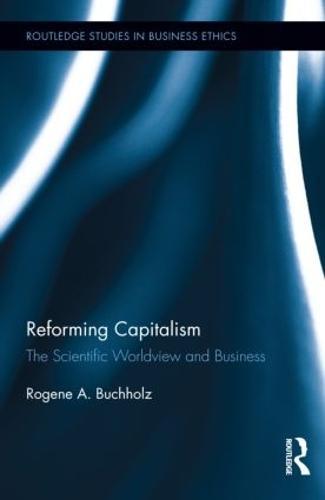
Full Product Details
Author: Rogene Buchholz (Loyola University New Orleans, Louisiana, USA)
Publisher: Taylor & Francis Ltd
Imprint: Routledge
Dimensions:
Width: 15.20cm
, Height: 2.10cm
, Length: 22.90cm
Weight: 0.830kg
ISBN: 9780415517386
ISBN 10: 0415517389
Pages: 346
Publication Date: 25 April 2012
Audience:
College/higher education
,
Tertiary & Higher Education
Format: Hardback
Publisher's Status: Active
Availability: In Print

This item will be ordered in for you from one of our suppliers. Upon receipt, we will promptly dispatch it out to you. For in store availability, please contact us.
Reviews
Against the backdrop of seemingly unending business scandals, this book is a must read for all who are interested in the potential of capitalism to serve community needs. Professor Buchholz, a distinguished and prolific business scholar, offers a rare view of how American Pragmatism can inform our understanding of the relationship between science and capitalism and, in turn, business and society. This provocative view has compelling implications for business practice, public policy, and management education. - Diane Swanson, Kansas State University, USA Rogene Buchholz's new book is an important and unique contribution to a growing body of literature suggesting that recent economic crises have stemmed not so much from managerial ineptness but from the faulty philosophical assumptions--ethical, epistemological, and metaphysical--that underlie conventional economic thinking. Buchholz focuses upon the faulty notion of 'science' that governs modern economic thought and proposes, with the aid of American pragmatism, an alternative conception of science that includes service and democratic social engagement. If implemented, Buchholz's profound and clearly articulated vision would go a long way in putting the American economy on a better road to the future. - Ken Stikkers, Southern Illinois University Carbondale, USA
""Against the backdrop of seemingly unending business scandals, this book is a must read for all who are interested in the potential of capitalism to serve community needs. Professor Buchholz, a distinguished and prolific business scholar, offers a rare view of how American Pragmatism can inform our understanding of the relationship between science and capitalism and, in turn, business and society. This provocative view has compelling implications for business practice, public policy, and management education."" -- Diane Swanson, Kansas State University, USA ""Rogene Buchholz's new book is an important and unique contribution to a growing body of literature suggesting that recent economic crises have stemmed not so much from managerial ineptness but from the faulty philosophical assumptions--ethical, epistemological, and metaphysical--that underlie conventional economic thinking. Buchholz focuses upon the faulty notion of 'science' that governs modern economic thought and proposes, with the aid of American pragmatism, an alternative conception of science that includes service and democratic social engagement. If implemented, Buchholz's profound and clearly articulated vision would go a long way in putting the American economy on a better road to the future."" -- Ken Stikkers, Southern Illinois University Carbondale, USA
<p> Against the backdrop of seemingly unending business scandals, this book is a must read for all who are interested in the potential of capitalism to serve community needs. Professor Buchholz, a distinguished and prolific business scholar, offers a rare view of how American Pragmatism can inform our understanding of the relationship between science and capitalism and, in turn, business and society. This provocative view has compelling implications for business practice, public policy, and management education. Diane Swanson, Kansas State University, USA <p> Rogene Buchholz 's new book is an important and unique contribution to a growing body of literature suggesting that recent economic crises have stemmed not so much from managerial ineptness but from the faulty philosophical assumptions--ethical, epistemological, and metaphysical--that underlie conventional economic thinking. Buchholz focuses upon the faulty notion of science that governs modern economic thought and proposes, wi
Author Information
Rogene A. Buchholz is the Legendre-Soule Chair in Business Ethics Emeritus in the College of Business Administration at Loyola University, New Orleans. He has published over seventy-five articles and is the author or co-author of twelve books in the areas of business and public policy, business ethics, and the environment.