Overview
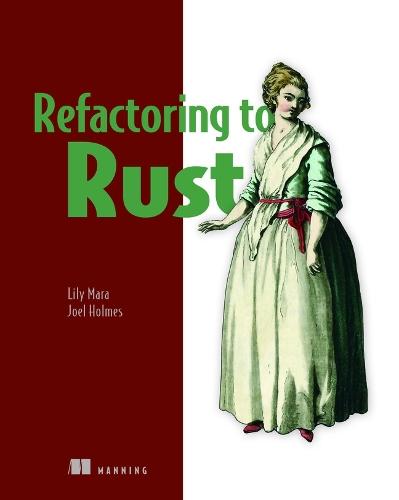
Ship faster code without rewriting from scratch. Many developers hesitate to adopt Rust because of the perceived learning curve or fear of breaking trusted code. What if you could modernize performance-critical parts of your application without overhauling everything at once? By making small, targeted improvements, you can experience Rust’s speed, safety, and reliability right away, while keeping your existing systems stable and secure. Incremental refactoring: Modernize critical paths while keeping trusted code stable. Cross-language libraries: Call Rust from Python, JavaScript, or C for immediate speed gains. Ownership and borrowing guidance: Eliminate data races, improve memory safety, sleep better at night. Async and concurrency patterns: Process events at scale with predictable resource usage. Error handling with enums: Replace cryptic crashes with clear, composable error flows. Refactoring to Rust by experienced engineers Lily Mara and Joel Holmes delivers a practical, language-friendly roadmap for adding Rust libraries to existing applications. The soft-cover, 300-page guide balances clarity with depth, making advanced concepts approachable. Through concise explanations, runnable examples, and side-by-side comparisons, the authors show exactly where Rust outshines scripting and systems languages. Each chapter targets a real refactor, from FizzBuzz pattern matching to blazing-fast HTTP services. By the final page, readers can build production-ready Rust plugins that slash latency, cut memory waste, and future-proof critical features. The result is safer, faster software delivered with confidence. Ideal for intermediate developers who crave performance without a risky rewrite, especially Python, JavaScript, and C maintainers.
Full Product Details
Author: Lily Mara ,
Joel Holmes
Publisher: Manning Publications
Imprint: Manning Publications
Dimensions:
Width: 18.80cm
, Height: 1.80cm
, Length: 23.50cm
Weight: 0.580kg
ISBN: 9781617299018
ISBN 10: 1617299014
Pages: 304
Publication Date: 01 August 2025
Audience:
Professional and scholarly
,
Professional & Vocational
Format: Paperback
Publisher's Status: Active
Availability: Available To Order

We have confirmation that this item is in stock with the supplier. It will be ordered in for you and dispatched immediately.
Reviews
No fluff. You can sense the excitement, pragmatism, and the authors’ guiding hand throughout each chapter. Bastian Gruber, Mozilla Mastering complexity doesn’t mean simplifying the problem—it means making the solution elegant and accessible. This book applies that principle beautifully. Michal Rutka, Freelance DevOps and Cloud Solutions Architect This is the Bible for understanding Rust core principles and refactoring techniques. Sambasiva Andaluri, Oracle
Author Information
Lily Mara is a senior software engineer known for transforming legacy systems with lean, high-performance Rust. With years of cross-language integration experience, Lily brings clear explanations and pragmatic insight to every page. She distills real-world expertise into actionable patterns that let readers ship safer, faster code. Joel Holmes is a software developer who has been focused on building cloud native applications. He has worked at several start-ups helping architect, design, and develop new products and services to help those companies develop and grow. Along the way, he was able to help establish tools and processes that helped development and increase quality.